
Found a profile photo that looks like them? How to check
Found a dating profile photo that looks like your partner? Compare name, age, city, and bio before you decide. Tell them from a look-alike or a fake.
- Author
- CheaterBusting Team
- Editor
- Reviewed by Zakaria Mehbi
- Updated
- Updated
- Reading time
- 7 min read
In this guide
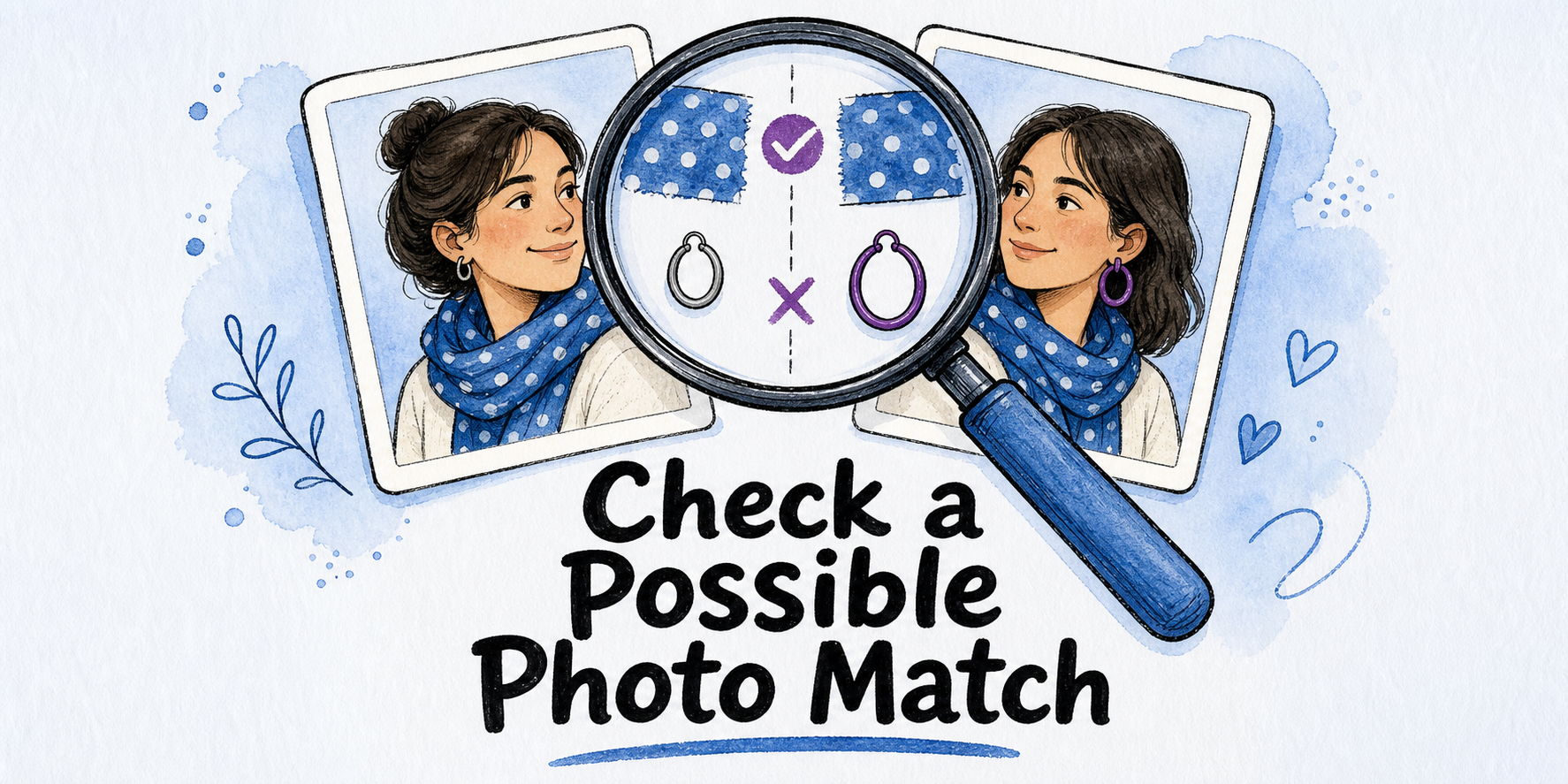
Don’t decide from the face alone. Compare the name or nickname, age, city, and bio details only they would know, and see whether the other photos show the same person. If several clues agree, it’s probably them. If one clue clearly conflicts, you may be looking at a look-alike or someone using their pictures. Either way, a profile on its own doesn’t tell you what it means.
Maybe a friend sent a screenshot. Maybe a face on Tinder made your stomach drop. Either way, you need to slow down for a minute. Fear makes it easy to see your partner in a stranger’s face, and it also makes it easy to miss the sign that the profile really is theirs. This guide gives you a calm way to check.
Could it just be a look-alike?
Yes. NIST says false matches can happen even with high-quality photos, because faces are similar. Relatives, people with the same haircut and beard, and plain coincidence all happen.
That’s why one familiar-looking photo isn’t enough. Treat the face as a reason to look closer, and no more than that. Our post on how accurate dating profile photo matching is explains why.
What should you check first?
Work through these in order. Write down short, plain notes as you go, such as “rounded glasses in two photos,” and keep your feelings out of them.
- Compare features that don’t change with styling. Ears, eyebrows, hairline, a scar or birthmark you know about. None of these is a scientific identity test, so treat them as clues and not as proof.
- Check the name or nickname. A nickname they use with close friends counts for more than a common first name. A common first name with nothing else behind it counts for very little.
- Check the age. Profile ages can be a year or two off. An age 15 years away from theirs is a conflict.
- Check the city and distance. Dating apps show people who are nearby. But Tinder’s Passport™ Mode lets members pick another city, and Hinge only changes location when the member updates it, so a mismatch can mean travel or an old setting.
- Read the bio and prompts. Job, school, pets, hobbies, and the jokes only they would make are hard for a stranger to fake.
- Look at every photo. Does the same face hold up across angles and years? Do any pictures show a place you’ve been, a jacket you recognize, or a friend you know?
- Check what you can’t see. Write “unknown” next to anything the profile doesn’t show. Don’t fill the gap with a guess.
What does it mean when the details don’t agree?
Clues work like votes. When independent ones agree, your confidence goes up. When one clearly disagrees, it can outweigh several weak similarities.
| What you see | What it may mean | What to do next |
|---|---|---|
| Face matches, and name, age, and city all fit | Probably them. The profile could still be old. | Look for details that place it in time, and ask whether it could predate you |
| Face matches, but the name, age, or city conflicts | A look-alike, edited details, or a profile built from their photos | Reverse image search the photos before you do anything else |
| One photo, a short bio, nothing personal | Possibly a borrowed photo | Reverse image search it |
| Several photos of one face, but nothing in the bio matches their life | A look-alike, or a profile that predates you | Ask whether it could be old |
| A verified badge is on the profile | The member passed a selfie check against the profile photos | If the photos look like your partner, a borrowed-photo explanation gets weaker. The badge says nothing about when the profile was made. |
Tinder, Hinge, and Bumble each describe a photo verification that compares a selfie with the member’s profile photos.
Could someone be using their photos?
It happens. Scammers build fake profiles from pictures of real people. The FTC advises doing a reverse image search of a profile picture and checking whether it’s tied to another name or to details that don’t match.
If you have a screenshot, run it. Our step-by-step guide to reverse image searching a dating profile photo takes you through Google Lens, Bing, and TinEye. If the same pictures turn up under a different name on another site, you may be looking at a fake profile and not at your partner.
Could the profile be old?
Yes, and it’s one of the most common explanations. People make profiles before they meet the person they love, then forget them. Deleting the app doesn’t delete the account on Tinder, Hinge, or Bumble. The account stays until it’s deleted.
Activity labels can’t settle it either. Tinder shows a green dot for people online in the last 24 hours, and members can switch it off. Hinge shows an approximate “Active Now” or “Active Today,” which members can also hide. A missing label tells you very little.
So even a profile that looks exactly like them can mean several things. It can be theirs and years old. It can be theirs and recent. It can be a copy of their photos. The photo alone can’t sort those apart. Our page on how confidence scoring works explains how we separate “this profile looks like them” from anything about when or why it exists.
What should you not do?
- Don’t message the profile from a fake account. If it’s a stranger, you’ve just contacted a stranger. If it’s your partner, you’ve set a trap that will feel like a betrayal when it’s found out.
- Don’t go into their phone or accounts to compare. It’s wrong, it can be illegal, and it won’t answer the question you actually care about.
- Don’t confront them on a face alone. If it turns out to be a look-alike, you can’t take those words back.
- Don’t post the screenshot anywhere. It may show a stranger who has done nothing.
How do you check the other apps, not just the one you saw?
One profile on one app is a small part of the picture. If it is your partner, they may have other profiles. If it isn’t, you’d like to know that too.
To search dating sites by photo, you give a service one clear photo of them and the city where they live or work. CheaterBusting compares that photo with publicly visible profiles on up to 12 dating apps, then checks name, age, and city. Each possible match in your report shows what lined up, carries a confidence note, and lists what we couldn’t confirm.
If you’re already fairly sure it’s them, what to do when you find your partner on a dating app walks through the next days calmly.
FAQ
How can I tell a look-alike from the real person?
Compare several independent clues: name or nickname, age, city, bio details, and whether the face holds up across photos. One clear conflict, such as an age far off from theirs, should keep you cautious. Nothing here is proof either way.
What if the name is different but the face matches?
Names are easy to change, so a different name doesn’t rule the profile out. It also doesn’t confirm it. Weigh it with age, city, and the bio. A different name together with a very different age and a far-off city points away from your partner.
Can I use a screenshot of the profile?
Yes, for a reverse image search and as a reference. Crop out the app’s buttons and keep the original. A screenshot is lower quality than the original picture, so a clear photo of your partner is better for a search. Our post on which photo works best for a dating profile search shows what to pick.
Does finding a profile prove they’re cheating?
No. A profile can be old, made before you met, or built by someone else. It shows that a profile looks like them. It can’t show what they did with it.
Should I tell my partner what I found?
Not yet. Check first, calmly, so that you have something steady to say. When you do talk, leave room for them to explain.
A private way to check
If you’d rather not do this one profile at a time, you can start a private search. We never contact them, and the report goes only to you.
Sources
Checked October 2026.
- NIST: Face Recognition Technology Evaluation, Demographic Effects in Face Recognition
- FTC Consumer Advice: What you need to know about romance scams
- Tinder Help Center: Photo Verification
- Hinge Help Center: What is Selfie Verification?
- Bumble Support: Verifying your photos
- Tinder Help Center: Passport™ Mode
- Hinge Help Center: Location Settings
- Tinder Help Center: Recently Active
- Hinge Help Center: Last Active Status
- Tinder Help Center: Delete your Tinder account
- Hinge Help Center: How do I delete my account?
- Bumble Support: Deleting your account
Next decision
Need broader evidence across covered apps?
Review scope, confidence limits, and pricing before starting any private search.
Private & anonymous. We never contact them — and your details are never shared or sold.
Continue reading
Related evidence guides
Photo search vs name search: which finds a dating profile?
Photo search vs name search: which one finds a dating profile? See how each clue holds up on Tinder, Bumble, and Hinge, and how to combine them.
Face search vs reverse image search for dating profiles
Face search vs reverse image search: one finds copies of a picture, the other finds faces that look alike. See which one can reach a dating profile.
How accurate is dating profile photo matching?
How accurate is dating profile photo matching? There is no single number. See what makes a match reliable, what causes wrong ones, and how to check.

Tonight you can keep wondering.
Or you can see what’s out there.
Two minutes. One payment. A private report by a guaranteed date, and we never contact them.
Private & anonymous. We never contact them — and your details are never shared or sold.
From $119 for 4 apps$239Paid once · report in 21 days, or 7 with Express