
Photo Search vs Name Search for Dating Profiles: A Decision Matrix
Compare name-led, exact-image, facial-similarity, and combined dating-profile searches, then choose a route based on your strongest lawful inputs.
- Author
- CheaterBusting Team
- Reviewed
- Reviewed July 31, 2026
- Reading time
- 11 min read
In this guide
TL;DR
- Start with a name-led search when you have distinctive identity details, such as an uncommon name or nickname paired with a narrow age range and city.
- Start with exact-image search when you lawfully possess a clear, unchanged photo that may have been reused online.
- Use combined multi-signal matching when either route is ambiguous, the name is common, or the available photos have changed.
- A service such as CheaterBusting can check some public or otherwise available dating-profile information across selected apps without requiring you to join each app individually.
- No route provides private-account access or complete coverage.
- A possible match is not proof of identity, activity, intent, or cheating. Nothing found does not prove that a profile is absent or never existed.
You may have a name, an approximate age, a city, and one photo yet still feel unsure where to begin. The strongest route depends on which of those inputs is distinctive, current, and lawfully available; the purpose is to find evidence you can interpret cautiously, not to force a relationship verdict.
Table of Contents
- Photo Search vs Name Search: Choose by Your Strongest Input
- A Three-Route Decision Tree
- Worked Example: When a Common Name Needs More Signals
- What a Result Can—and Cannot—Establish
- FAQ
Key Takeaways
- Exact-image retrieval, facial similarity, and multi-signal matching are different methods. The first looks for image reuse, the second surfaces resemblance, and the third assesses several identity clues together.
- Common names invite coincidences. An unchanged reused image can answer an image-retrieval question, but it does not by itself establish who controlled a profile.
- Signals become more useful together. A nickname, approximate age, city, and photo can provide more context than any one clue, while conflicts must remain visible.
- Every route has limits. Selected-app coverage and public-or-otherwise-available information boundaries can produce misses; no route opens private accounts.
- Confidence notes are not verdicts. They describe agreement, conflicts, missing information, and freshness context—not guilt, certainty, or a guaranteed probability.
- Monitoring remains bounded. Later checks may surface visible changes during an active period, but they cannot guarantee discovery.
Photo Search vs Name Search: Choose by Your Strongest Input
A name search uses a name or nickname with contextual identifiers such as approximate age and city. A common name in a large city can point to unrelated people, while a distinctive nickname paired with a narrow age range and reliable location can produce a more interpretable candidate. Changed names, nicknames, ages, locations, and unavailable information can still cause misses.
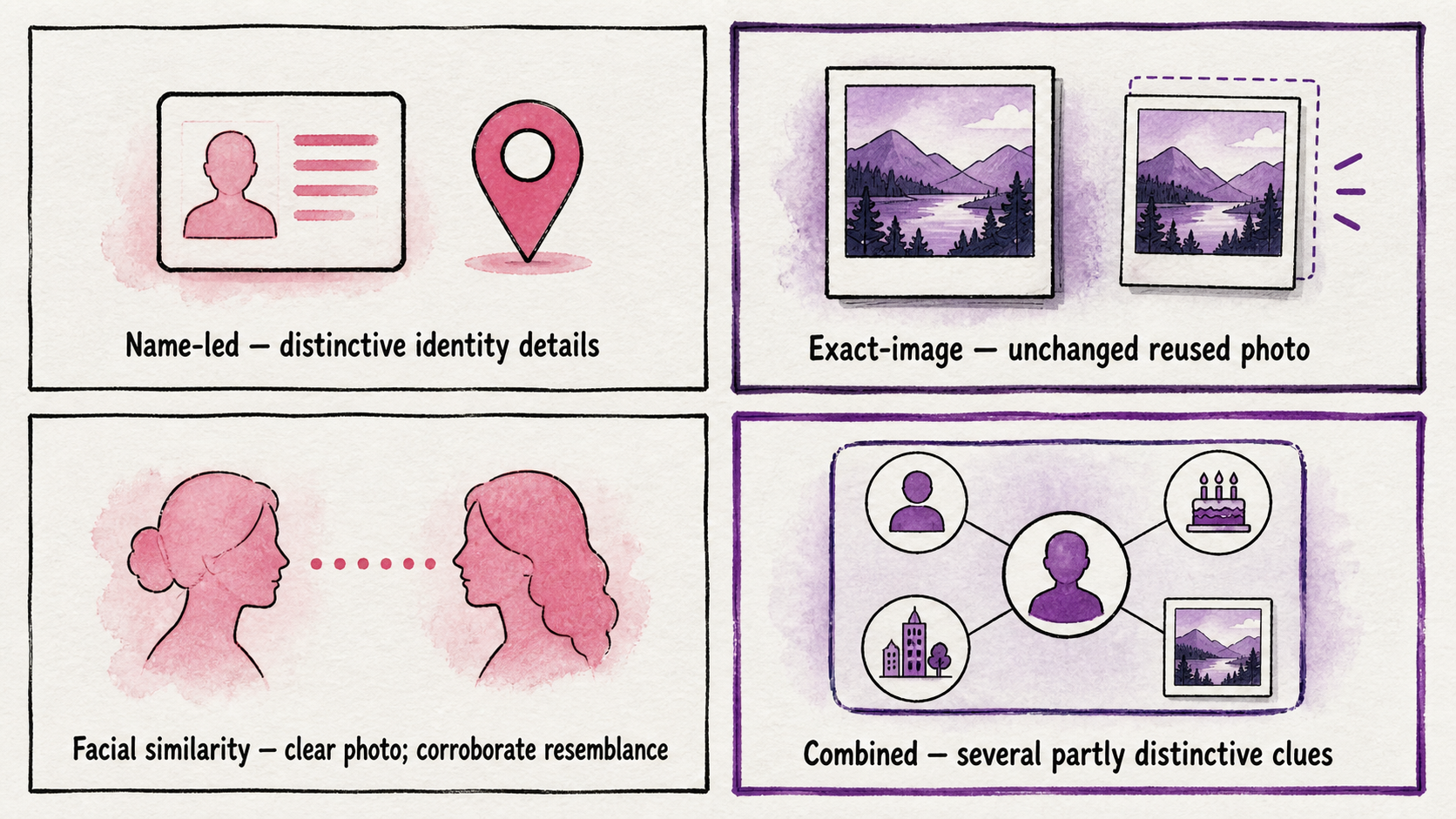
Exact-image search asks a narrower question: does the same image, or a closely changed copy, appear on a retrievable indexed page? It is most useful when you lawfully possess an unchanged photo that may have been reused. It is not designed to find every different picture of one person. The reverse-image search guide explains the distinction between image retrieval and broader identity matching.
Facial similarity is different again. It may surface a different image that resembles the subject, but resemblance is not an exact-image hit or certain identification. Independent details such as age, location, nickname, and profile context must corroborate it. If you already have a possible candidate, the similar-photo guide explains how to assess the resemblance without treating it as proof.
Multi-signal matching reviews name or nickname, approximate age, city, photo, and available freshness information together. It can reduce reliance on a shared name or similar-looking face, but it still cannot prove identity, account control, activity, intent, or cheating. Tinder, Bumble, and Hinge are examples of selected covered apps; their inclusion does not imply universal coverage, affiliation, or special access.
| Route | Best input conditions | Likely false positives | Likely misses | Submitted-data considerations | What an outcome can establish |
|---|---|---|---|---|---|
| Name-led search | A distinctive name or nickname, narrow age range, and reliable city | People sharing a name, age, location, or common nickname | Nicknames, changed details, unavailable profiles, or unselected apps | Requires submitting identity and location details; handling depends on the provider’s current policy | A candidate shares specified visible identity details |
| Exact-image search | A lawful, clear, unchanged image likely to have been reused | Copied images, visually confusing results, or pages concerning someone other than the profile owner | New or heavily changed photos and unavailable or unindexed pages | Requires submitting an image; consider what it reveals and how the provider handles it | The same or a closely changed image appears on a retrievable page |
| Facial-similarity search | A clear lawful photo when a profile may use a different image | Lookalikes, relatives, poor image quality, or misleading resemblance | Obscured faces, appearance changes, and images beyond the search’s reach | Requires submitting a facial image; its sensitivity depends on the reader’s circumstances and provider policy | A different image appears similar and requires corroboration |
| Combined multi-signal matching | Several partly distinctive clues that can be assessed together | A candidate who happens to share several common details | Multiple changed details, unavailable information, and coverage gaps | Requires more categories of data, so submit only what is necessary for a lawful purpose | Visible signals align, conflict, or remain unconfirmed |
There is no universal privacy winner. A name-led route discloses identity and location details, a photo-led route discloses an image, and a combined route supplies more categories of information. Minimize what you submit and review the provider’s current practices. The privacy and safety guide provides a more focused privacy review.
A Three-Route Decision Tree
-
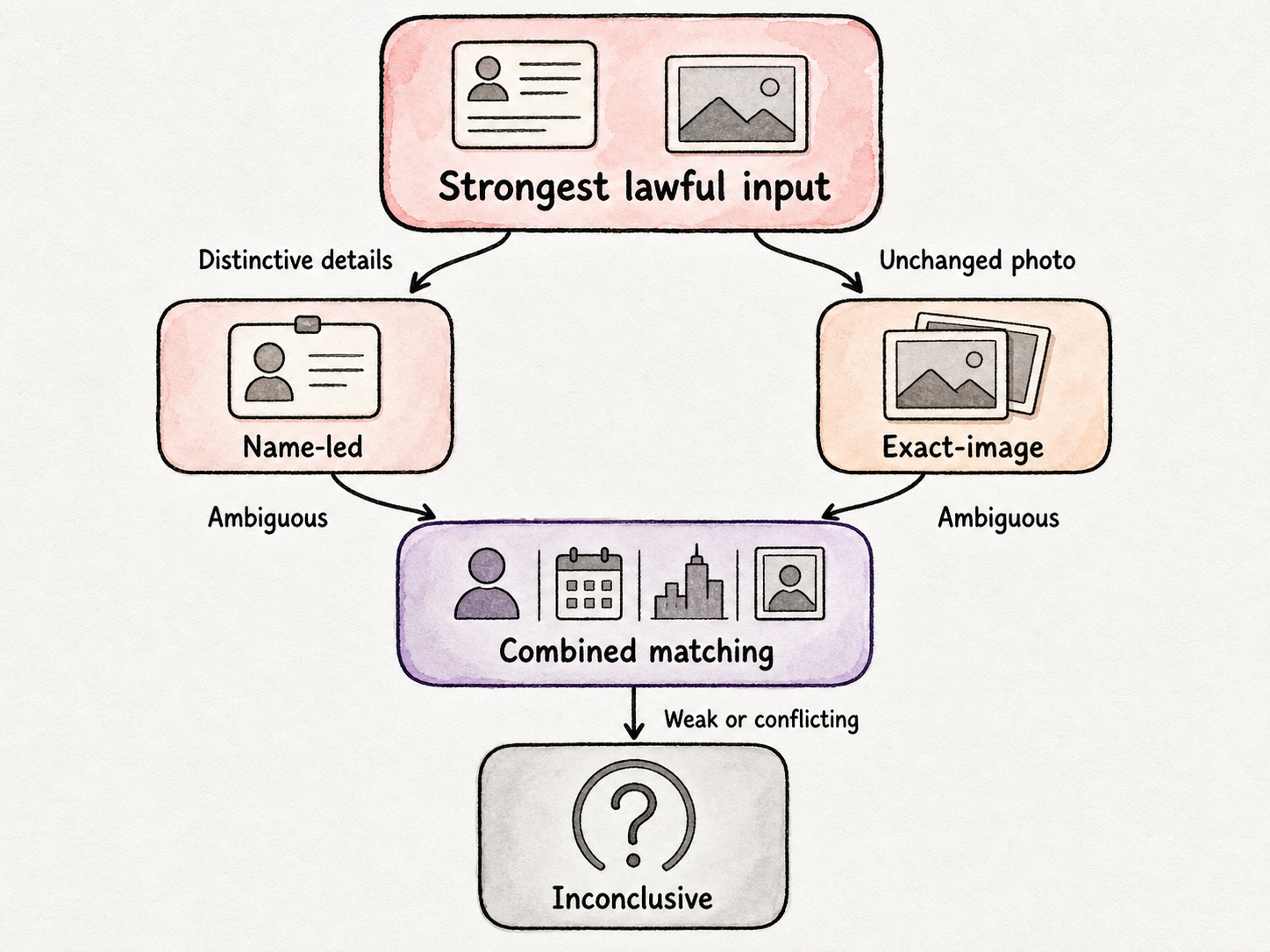
Start name-led when identity details are distinctive. Use a known name or nickname, supported age range, and reliable city. Do not invent variations merely to expand the search.
-
Start exact-image-led when you lawfully hold an unchanged photo. This route is strongest when that particular image may have been reused. Follow the provider’s photo-preparation and onboarding prompts to supply only relevant details.
-
Switch routes when the question concerns different photos of the same person. Exact-image retrieval is not the right test for a completely different photograph. A facial-similarity result can suggest a candidate, but it needs non-photo corroboration.
-
Use combined matching when either starting route is ambiguous. Compare name or nickname, approximate age, city, photo context, and available freshness information. Preserve conflicts and unknowns instead of forcing them to fit.
-
Use a selected-app route when the question spans dating services. A Tinder-only check may not address a question involving Bumble, Hinge, or another service. Review the current apps-covered page before assuming an app is included.
-
Stop at inconclusive when signals remain weak or conflicting. Do not seek passwords, phone access, private accounts, messages, impersonation, or secret databases. More searching is not automatically more informative.
This decision tree also limits unnecessary data sharing: begin with the smallest lawful route capable of addressing the question, and move to combined matching only when another independent signal could materially change the interpretation.
Worked Example: When a Common Name Needs More Signals
Consider a hypothetical person named “Alex Morgan,” approximately 34, believed to live in Chicago. Alex sometimes uses the nickname “Lex.” You have an older photo and a recent photo with different hair, glasses, and framing.
A name-only search is weak because unrelated people may share that name. Approximate age and city narrow the search brief, but they do not eliminate coincidence.
Adding “Lex” introduces another known identifier. A candidate whose visible name or nickname, approximate age, and city align is more relevant than one sharing only the full name. Identity is still unresolved because details can be shared, inaccurate, or outdated.
The photos alter the preferred route. If the older image may have been copied directly into a profile, exact-image retrieval can test whether that particular image appears on a retrievable indexed page. If a profile instead uses the recent photo, searching only the older image may return nothing even when relevant information is available elsewhere.
The recent photo therefore supports combined matching. A different profile image can be considered alongside the nickname, approximate age, city, and visible context. If the face appears similar but the age and city conflict, the candidate remains weak. If several details align but timing is unresolved, it remains a possible identity match—not proof of present activity or cheating.
CheaterBusting describes a combined approach that weighs multiple identity details across selected covered apps and returns confidence notes that preserve alignment, conflicts, missing evidence, and freshness context. Its current methodology explains that process and its limits.
Prepare only information you genuinely know: correct spellings, real nicknames, a supported age range, relevant current or previous cities, and lawfully held photos from meaningfully different periods. Mark approximate details as approximate. The onboarding page shows the identity, location, app, and photo information used to establish a search brief.
What a Result Can—and Cannot—Establish
A possible match indicates overlap among visible signals within the route and scope used. An exact-image hit can show that the same or a closely changed image appears on a retrievable page. A name-led result can show shared identity details. A combined result can show that several clues align. None independently proves who controlled the profile, why it existed, whether it is currently used, or what it means for a relationship.
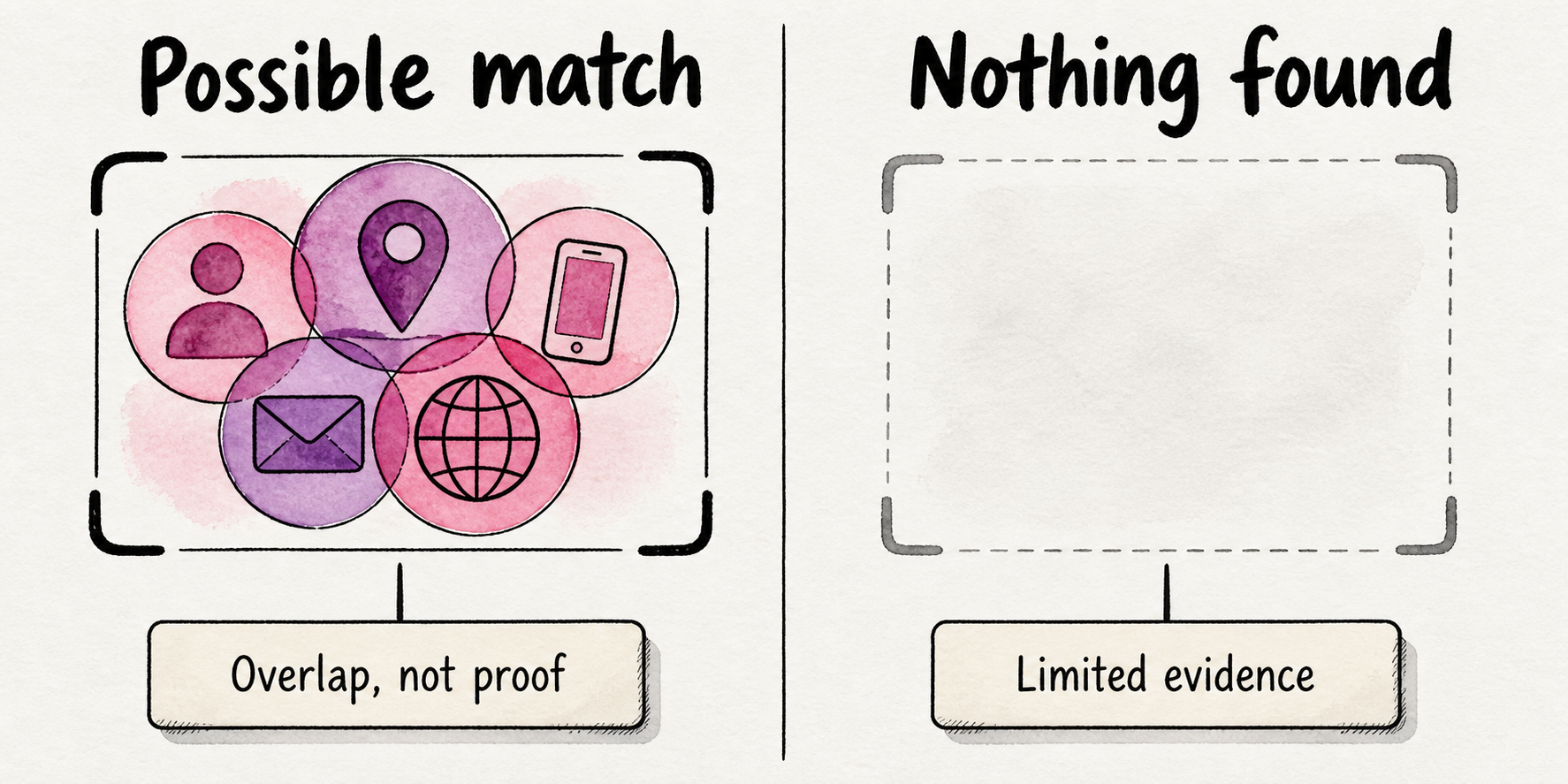
A confidence note is a review aid, not an accuracy percentage or probability guarantee. It should show which details aligned, conflicted, or could not be confirmed. The photo-matching accuracy guide provides a focused framework for interpreting photo evidence without turning resemblance into certainty.
A visible freshness or update signal also has a narrow meaning. It may place an observation in time, but it does not by itself establish intent, authorship, current use, or relationship conduct.
Nothing found means that no supported match appeared within the selected apps, supplied information, availability, and timing of the search. It does not prove that no profile exists or ever existed. A profile may use different details, rely on a newer photo, be unavailable or unindexed, fall outside selected coverage, or become visible later. The sample report’s no-supported-match guidance shows how that outcome differs from claiming that a person has no dating profile.
Ongoing monitoring can surface later visible changes during an active period, but it cannot guarantee future discovery or complete coverage. It is useful when timing is genuinely unresolved, not as a reason to continue searching indefinitely.
CheaterBusting states that it uses submitted details to compare against public or otherwise available information and does not require passwords, phone numbers, private-account access, the subject’s phone, or messages. It also states that searches are anonymous and that the subject is not contacted, messaged, or warned. Those are company-stated practices; broader privacy judgments still require reviewing the current privacy policy and your circumstances.
Before proceeding, compare the provider’s methodology, selected app coverage, privacy terms, and sample report format. If a combined multi-app route fits your lawful purpose and the evidence you possess, start one private search through onboarding using only the necessary details. If the available signals remain weak, conflicting, or unlawfully obtained, stop at inconclusive.
FAQ
Is photo search or name search better for dating profiles?
Neither is universally better. Start name-led when identity details are distinctive, start exact-image-led when you have a lawful unchanged photo, and combine independent signals when either route is ambiguous.
Can someone check public or otherwise available dating-profile information without joining every app?
A service such as CheaterBusting can check some public or otherwise available information across selected apps without requiring the reader to join each one. This does not mean every profile is accessible, every app is covered, or private accounts can be entered.
Does facial similarity prove two photos show the same person?
No. It means the images appear visually similar. Lookalikes, image quality, appearance changes, and missing context can mislead, so independent identity details must corroborate the result.
What does nothing found mean?
It means no supported match appeared within the search’s scope and timing. It does not prove that no profile exists or that one never existed.
When should name and photo signals be combined?
Combine them when the name is common, the relevant photo has changed, or one route produces ambiguous candidates. Approximate age, city, nickname, photo context, and available freshness information can clarify the evidence, but unresolved conflicts should remain visible.
Can any route access private accounts or guarantee complete coverage?
No. Name search, exact-image retrieval, facial similarity, and combined matching are limited by available information and selected coverage. They should never require passwords, private messages, impersonation, someone else’s device, or other unauthorized access.
Next decision
Need broader evidence across covered apps?
Review scope, confidence limits, and pricing before starting any private search.
Continue reading
Related evidence guides
Dating App Face Search vs Reverse Image Search
Choose among exact-image retrieval, facial-similarity search, and multi-signal profile matching while respecting privacy and evidence limits.

How Accurate Is Dating Profile Photo Matching?
Use four evidence factors to judge a dating-profile photo result without mistaking image reuse, resemblance, or confidence for proof.

Is a Dating Profile Photo Search Private and Safe?
Assess photo, policy, access, and payment risks before choosing to upload less data, change providers, or stop.