
How accurate is dating profile photo matching?
How accurate is dating profile photo matching? There is no single number. See what makes a match reliable, what causes wrong ones, and how to check.
- Author
- CheaterBusting Team
- Editor
- Reviewed by Zakaria Mehbi
- Updated
- Updated
- Reading time
- 7 min read
In this guide
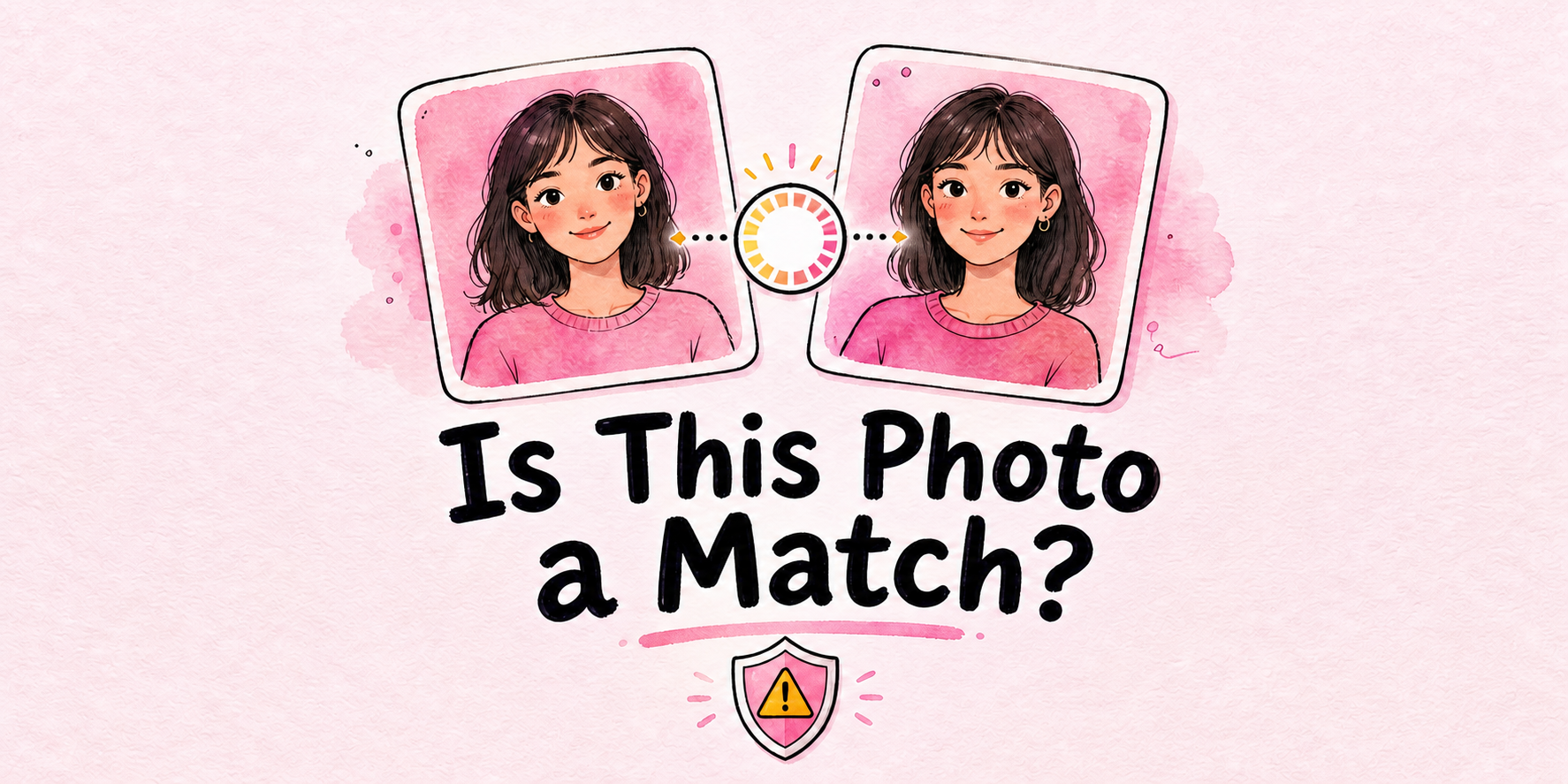
No honest source can give you one accuracy number for dating profile photo matching. How reliable a match is depends on the photo, how old it is, how distinctive the face is, and what else lines up. A clear, recent photo backed by a matching name, age, and city is strong. A blurry photo with nothing else behind it is a guess.
If you’re reading this, a photo probably looks like someone you love, and you need to know how much to trust that. Here is what moves a photo match toward “probably them” or toward “could be anyone,” and what you can check yourself.
Is there an accuracy percentage for photo matching?
No, and be careful with any service that shows one. A percentage only means something if you know how it was measured: which photos, which people, how old the photos were, and how many wrong answers came along with the right ones. Without that, a number is decoration.
We don’t publish an accuracy percentage. Every possible match in a report gets a confidence note that explains its reasons instead. Our page on dating app search accuracy covers the inputs that help and hurt.
Independent testing shows why a single figure can’t work. NIST tested face recognition software in 2019 and found that false matches were often 10 to 100 times more common for some groups of people than for others, depending on the software. A score from one tool tells you very little about another tool.
What makes a photo match more or less reliable?
Five things do most of the work.
| Factor | Makes a match more reliable | Makes it less reliable |
|---|---|---|
| Photo quality | Sharp, facing the camera, good light, face fills a good part of the frame | Blur, sunglasses, hats, heavy filters, a tiny face in a group shot |
| Photo age | Taken in the last year or so | Taken many years ago, or before a big change like a beard or weight loss |
| Consistency | The same face holds up across several photos | One photo only |
| Other clues | Name, age, and city agree | One clue conflicts, such as an age 15 years off, or the name is common and nothing else backs it |
| The profile itself | Several photos that look recent | One photo, no bio, or details that look copied |
NIST says missed matches depend strongly on image quality, and that big changes in how someone looks between two photos can cause misses too. That is why we ask for a clear, recent photo, and why we suggest you read which photo works best for a dating profile search before you upload one.
Why do wrong matches happen?
A photo match can be right about the face and still wrong about what you think it means. Four things cause it.
- Look-alikes. Plenty of people share a face shape, a haircut, and a beard. NIST’s demographics page says false matches can happen even with high-quality photos, because faces are similar.
- Common names. The same first name in the same city describes a lot of people in any large town. A name match with no usable photo stays weak.
- Borrowed photos. Scammers build fake profiles from pictures of real people. The FTC advises checking whether a profile photo is tied to another name or to details that don’t match. A face match under a different name, with an odd bio, deserves extra caution.
- Old profiles. A real profile your partner made years ago can match perfectly on identity and say nothing about today.
Confidence notes call these out when we see them, so a weak match reads as weak.
Why do real profiles get missed?
The same limits work in the other direction. A poor photo, a very old photo, or a profile that uses completely different pictures can make a real profile slip past. The face you hold may not look like the face on the profile. Profiles hidden from new people, a location set to another city, and timing add to the list. Our post on why a dating profile photo search finds nothing goes through every cause and what to try.
How does a confidence note help?
A confidence note rates how closely a profile lines up with the person you described. We weigh photo similarity most, then check name, age, city, and recent activity or updates when they’re visible. Clues that agree raise confidence. Clues that conflict lower it. Here are a few examples of how that plays out.
- Strong photo similarity, same city, age in range: higher confidence, because independent clues agree.
- Strong photo similarity, but the profile is set to a different city: a middle note with a location flag. Tinder’s Passport™ Mode lets members pick another city, so a mismatch can mean travel or an old setting.
- Same first name and city, no clear face in any photo: low. Nothing strong anchors the match.
Picture two possible matches that both look a lot like your partner. In the first, the name is a short form of theirs, the age fits, and the city is where they work. In the second, the face is close, but the age is 12 years off and the city is three states away. The faces are equally convincing. The first deserves a long look. The second is probably someone else. A photo alone can’t carry that decision, and a score that comes without reasons isn’t worth much.
The note measures identity, never guilt. How confidence scoring works shows the full list of signals and what raises or lowers each one.
How can you double-check a match yourself?
You know your partner better than any tool does. Use that.
- Look for details you can place in time. A recent haircut, a jacket you remember, a place you went together.
- Compare the bio with real life. Their job, kids, hobbies, and sense of humor are hard to fake.
- Read the “couldn’t confirm” notes. They tell you exactly what is still open.
- Ask whether the profile could be old. Forgotten accounts are common. Deleting the app isn’t enough on Tinder, Hinge, or Bumble, because the account stays until it’s deleted.
If you’re looking at one candidate profile right now, the step-by-step guide to checking a profile photo that looks like them walks you through each clue.
Does a strong photo match mean they’re cheating?
No. The most accurate match still shows only that a profile looks like them. It can’t tell you when the profile was made, why it’s still there, or what they’ve done with it. Use a match to ask a clearer question, and leave room for them to explain. If you’re weighing next steps, our guide on how to catch a cheater on dating apps covers them calmly.
FAQ
Can photo matching be wrong?
Yes. Look-alikes, borrowed photos, and poor image quality all cause errors. That’s why every match comes with a confidence note and a list of what we couldn’t confirm.
What does a high match percentage mean?
It depends entirely on who measured it and how. If a tool shows you a percentage, ask what it measures. A similarity score between two faces is not the chance that the profile is your partner.
Do relatives and look-alikes fool photo matching?
They can. Faces are similar enough that a wrong match is always possible. Name, age, and city are what separate a look-alike from the real person.
Do filters and beauty apps hurt accuracy?
They can. Smoothing and reshaping filters change the very features that get compared. A plain, natural photo works best.
Does an old photo still work?
It can, but it’s weaker. Haircuts, beards, glasses, and weight all change how someone looks. A photo from the last year or so is the best choice.
Is photo matching more reliable than name matching?
A face is harder to change than a name, so a strong photo match carries more weight than a name match. Neither is proof. Used together, they check each other.
What to do with this
If you want to see what a real answer looks like, you can search dating sites by photo with a private report that shows each possible match, the clues behind it, and what we couldn’t confirm. When you’re ready, start a private search.
Sources
Checked October 2026.
- NIST: NIST Study Evaluates Effects of Race, Age, Sex on Face Recognition Software
- NIST: Face Recognition Technology Evaluation, Demographic Effects in Face Recognition
- FTC Consumer Advice: What you need to know about romance scams
- Tinder Help Center: Passport™ Mode
- Tinder Help Center: Delete your Tinder account
- Hinge Help Center: How do I delete my account?
- Bumble Support: Deleting your account
Next decision
Need broader evidence across covered apps?
Review scope, confidence limits, and pricing before starting any private search.
Private & anonymous. We never contact them — and your details are never shared or sold.
Continue reading
Related evidence guides
Photo search vs name search: which finds a dating profile?
Photo search vs name search: which one finds a dating profile? See how each clue holds up on Tinder, Bumble, and Hinge, and how to combine them.
Face search vs reverse image search for dating profiles
Face search vs reverse image search: one finds copies of a picture, the other finds faces that look alike. See which one can reach a dating profile.
Is a dating profile photo search private and safe?
Is a dating profile photo search private and safe? Learn what happens to the photo you upload, who finds out, and the red flags that mean walk away.
Tonight you can keep wondering.
Or you can see what’s out there.
Two minutes. One payment. A private report by a guaranteed date, and we never contact them.
Private & anonymous. We never contact them — and your details are never shared or sold.
From $119 for 4 apps$239Paid once · report in 21 days, or 7 with Express