
Dating App Face Search vs Reverse Image Search
Choose among exact-image retrieval, facial-similarity search, and multi-signal profile matching while respecting privacy and evidence limits.
- Author
- CheaterBusting Team
- Reviewed
- Reviewed July 31, 2026
- Reading time
- 9 min read
In this guide
TL;DR
- Use exact-image retrieval, commonly called reverse-image search, when you want to know whether the same image appears elsewhere.
- Use facial-similarity search only when resemblance is the relevant question; do not interpret resemblance as confirmed identity.
- Use multi-signal profile matching when lawful independent details could materially strengthen, weaken, or contradict a possible profile candidate.
- No method provides private-account access or complete dating-app coverage.
- A possible match is not proof, and an empty result is not proof of absence.
- Choose the least invasive capable method. Add one lawful independent signal only if it could change the classification, then stop if the result remains inconclusive.
A dating app face search, a reverse-image search, and a multi-signal profile search answer different questions: whether an image was reused, whether two faces appear similar, or whether a possible dating profile aligns across several details. Choose according to the limited result you need, not according to a hoped-for verdict about identity, activity, or a relationship.
Table of Contents
- Key Takeaways
- Choose by the result you need
- Apply the least-invasive decision rule
- Know what no picture-search method can establish
- FAQ
Key Takeaways
- Finding the same image supports image reuse on an accessible page. It does not establish who uploaded or controls that page.
- Finding a similar-looking face supports a resemblance finding, not identity certainty.
- Finding a possible profile candidate supported by multiple details means the available photo and independent information align to some degree. Conflicts and unknowns still matter.
- False positives and false negatives remain possible. Describe the result narrowly and preserve uncertainty.
- No result establishes cheating, intent, current activity, account control, or relationship status.
- Nothing found is inconclusive; it does not prove that a profile does not exist or never existed.
Choose by the result you need: same image, similar face, or supported profile candidate
These three methods seek different kinds of results. That distinction should govern both the search and the language used afterward.
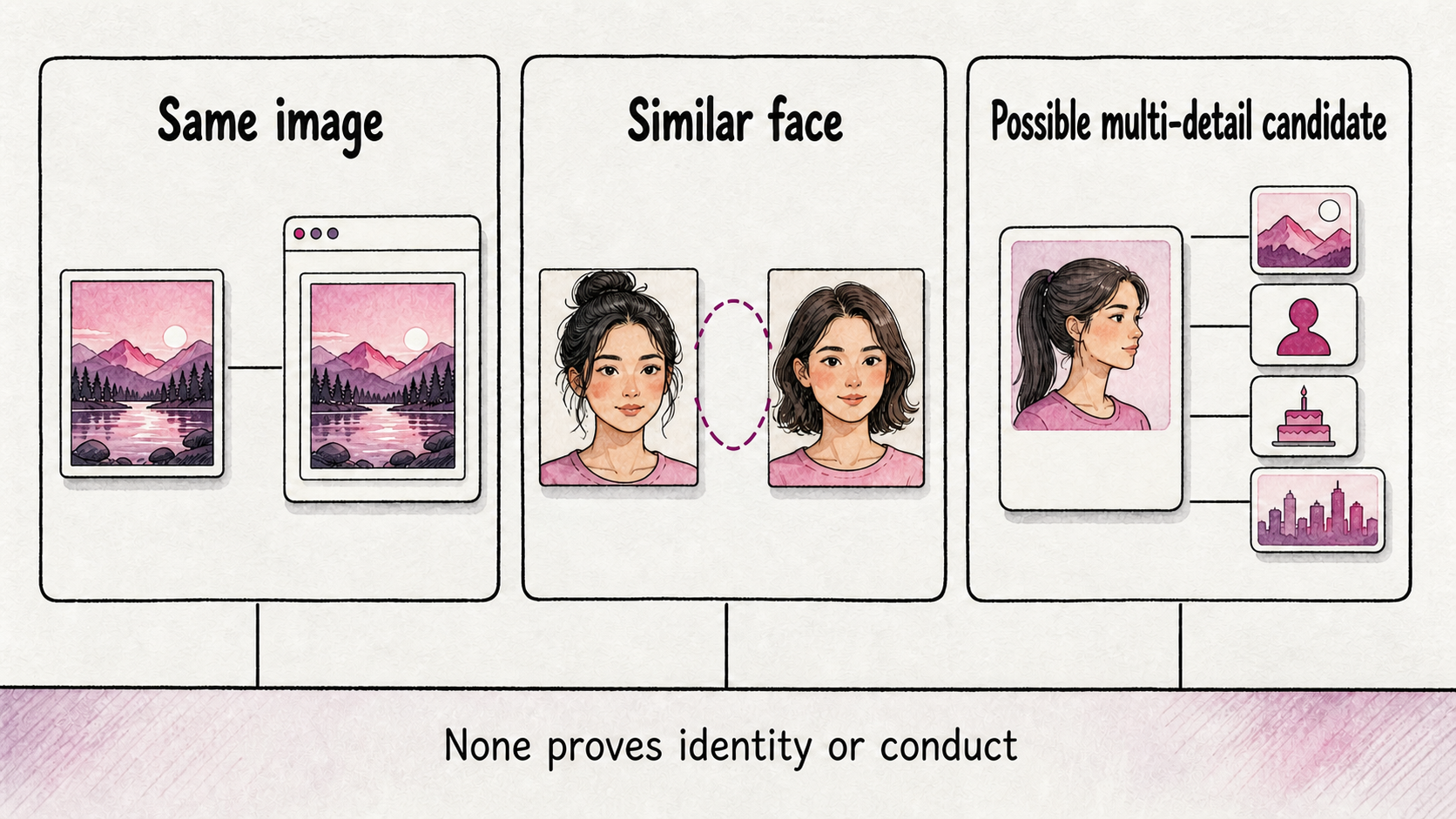
Exact-image retrieval seeks another accessible occurrence of the same image. Reverse-image search is the common route for this question. An exact hit supports the conclusion that the image appears on another accessible indexed page. Private, removed, restricted, unavailable, or unindexed pages may be missed. The result does not establish who uploaded the image, who controls the page, or why the image appears there. The evidentiary limits are explained in How to Reverse Image Search a Dating Profile Photo.
Facial-similarity search seeks images containing visually similar faces rather than another occurrence of the same image. Its result should be described only as resemblance unless independent evidence supports a more specific conclusion. Whether a particular service can find a different photo—and under what conditions—cannot be inferred from the method’s name. That requires current official documentation from the provider being considered.
Multi-signal profile matching compares a possible dating profile using a photo and independent details such as a name or nickname, age, and city. The additional signals can align, conflict, remain missing, or leave the candidate unresolved. This method supports a qualified candidate assessment, not an identity or conduct verdict.
| Method | Retrieval target | Inputs | What it may miss | False-match tradeoff | Privacy exposure | Account requirement | What the result can establish |
|---|---|---|---|---|---|---|---|
| Exact-image retrieval or reverse-image search | Another accessible occurrence of the same image | A lawfully held image | Private, removed, restricted, unavailable, or unindexed pages; pages using a different image | An image hit can still be misattributed to the pictured person or account holder | The selected provider receives the submitted image under its own terms | Cannot be stated generally; check the provider’s current official requirements | That the same image appears on an accessible page |
| Facial-similarity search | A visually similar face | A lawfully held face image | Provider-specific limits must be established from current official documentation | Resemblance can be mistaken for identity, and a missed result remains possible | The selected provider receives a face image under its own terms | Depends on the provider’s documented requirements | That the returned face appears similar—not that identity is confirmed |
| Multi-signal profile matching | A possible dating profile aligned across independent details | A photo plus necessary lawful details such as nickname, age, or city | Profiles outside the service’s stated coverage or available information | Multiple aligned details can still produce a mistaken candidate; conflicting or missing details can prevent confirmation | More personal details may be submitted, so use only what is necessary | Depends on the service’s documented access model | That several details align with a possible candidate, with uncertainty preserved |
Can facial-similarity search find a dating profile that uses a different photo? There is no responsible universal answer. Consider that capability only when a provider’s current official documentation expressly describes it, and treat any returned resemblance as inconclusive without independent support.
Does reverse-image search require a dating-app account? Requirements vary by provider, so the method category alone does not answer that question. Check the chosen provider’s current official requirements. Regardless of account requirements, reverse-image search does not confer access to private dating profiles or guarantee complete dating-app coverage.
Apply the least-invasive decision rule
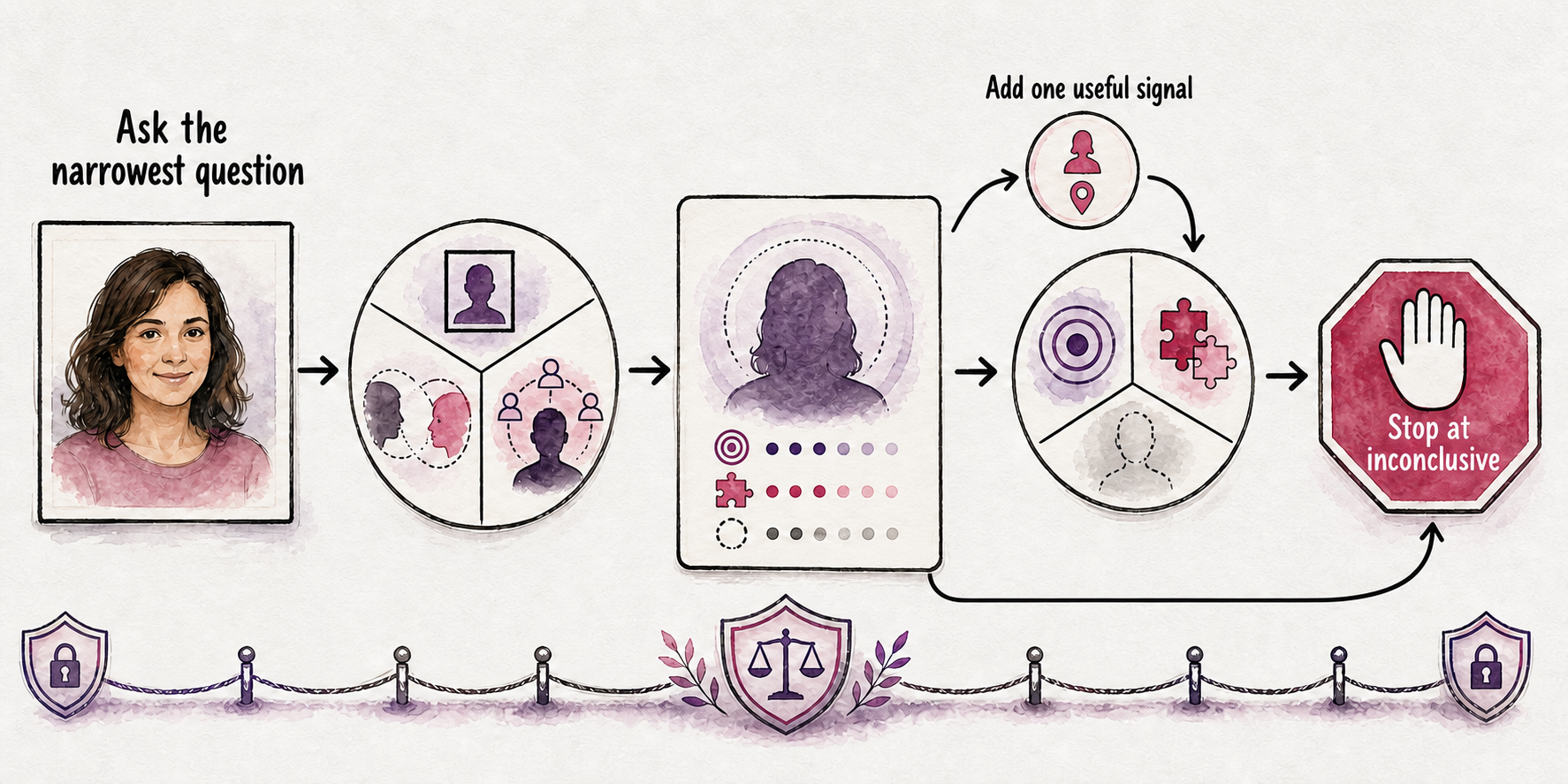
Start with the narrowest question the available information can answer.
- Choose exact-image retrieval when the picture is likely to have been reused unchanged and locating the same image would answer the question.
- Consider facial similarity only when resemblance is itself useful and the provider has documented the relevant capability. Keep any result at the level of similarity.
- Consider multi-signal matching when dating-profile context matters and a lawful independent detail could distinguish one possible candidate from another.
- Add one signal, then reassess. A nickname, age, or city is justified only if it could strengthen, weaken, or contradict the candidate.
- Stop at inconclusive when another lawful check would not change the classification or when resolving the uncertainty would require invasive access.
Consider a hypothetical case. You lawfully hold a photo believed to have been used unchanged. Exact-image retrieval finds that image on an accessible page. The accurate description is “same image found.” The result does not identify who created or controls the page.
A facial-similarity search later returns a different photo that appears similar. Similarity alone does not justify classifying the result as the same person, so it remains inconclusive.
You also lawfully know that the person uses the nickname “Sam,” is 34, and lives in Bristol. If those details are visible on a possible dating profile, they can be compared with the photo context. Alignment supports describing the result as a possible multi-detail candidate; a conflicting age or city weakens it. If the details are absent or the conflicts cannot be resolved, further checking may not change the classification. That is the stopping point.
For readers who need profile-level context, CheaterBusting is one dating-specific multi-signal option across selected covered apps, including Tinder, Bumble, and Hinge. It compares submitted information such as a name or nickname, age, city, and photo, and may include available freshness context. Its reports keep conflicts and unconfirmed details visible and provide confidence notes rather than verdicts. Review the methodology or view a sample report before deciding whether one private multi-app search fits the question.
Know what no picture-search method can establish
Use result language that matches the evidence: “same image found,” “similar face returned,” or “possible multi-detail profile candidate.” None means “identity proved” or “cheating proved.”
No method described here grants access to private profiles, messages, passwords, login codes, a subject’s device, secret databases, or complete dating-app coverage. A possible match does not prove identity, who controls a profile, whether it is presently active, why it exists, the person’s intent, relationship status, or cheating.
A confidence note describes how the available signals align and where information conflicts or remains unknown. It is not a universal accuracy percentage. False positives and false negatives remain possible even when the result appears persuasive.
An empty result also has a narrow meaning: the chosen method returned nothing within what it could examine. It does not prove that a profile does not exist or never existed.
CheaterBusting states that it compares submitted details with public or otherwise available information, requests no passwords or private-account access, and has no special access to or affiliation with dating apps. Its privacy policy explains these access boundaries. The service also limits use to lawful purposes and rejects stalking, harassment, and harm. Apply the same restraint to every method: use only lawfully held information, avoid impersonation or invasive access, and stop when repeated checking cannot resolve the question.
FAQ
Which method should I use if I only have a picture?
Use exact-image retrieval when you want to find another occurrence of the same image. Consider facial similarity only when resemblance is the relevant question and the chosen provider officially documents that capability. Move to multi-signal matching only when lawful independent details could materially change how a possible candidate is classified.
Can a face search find a dating profile that uses a different photo?
Do not assume that it can. The answer depends on the documented capability of the particular provider. If its current official documentation does not support that use, choose another method or leave the question unresolved. Any resemblance result remains inconclusive without independent support.
Does reverse-image search require a dating-app account?
There is no general answer supported by the method category alone. Check the chosen provider’s current official account requirements. Whatever those requirements are, reverse-image search does not unlock private dating profiles or provide complete coverage.
Can any method search private profiles or messages?
No method described here grants access to private accounts, messages, passwords, login codes, or someone else’s device. Do not use a service that requests or promises such access.
Does a match prove that the person is active or cheating?
No. A result may support image reuse, visual resemblance, or alignment among visible details. It cannot by itself prove present activity, account control, intent, relationship status, or cheating.
What does “nothing found” mean?
It means the chosen method returned no result within what it could examine. It does not prove that no profile exists, that one never existed, or that another lawful method would reach the same outcome.
Next decision
Need broader evidence across covered apps?
Review scope, confidence limits, and pricing before starting any private search.
Continue reading
Related evidence guides
Photo Search vs Name Search for Dating Profiles: A Decision Matrix
Compare name-led, exact-image, facial-similarity, and combined dating-profile searches, then choose a route based on your strongest lawful inputs.
How Accurate Is Dating Profile Photo Matching?
Use four evidence factors to judge a dating-profile photo result without mistaking image reuse, resemblance, or confidence for proof.
Is a Dating Profile Photo Search Private and Safe?
Assess photo, policy, access, and payment risks before choosing to upload less data, change providers, or stop.