
How to Check If Someone Is on Dating Apps: An Evidence-First Guide
Choose a lawful, proportionate search method, assess identity and timing separately, and interpret dating-profile findings without treating them as proof.
- Author
- CheaterBusting Team
- Reviewed
- Reviewed July 25, 2026
- Reading time
- 14 min read
In this guide
TL;DR
- Lawful options include manual observations, exact-image retrieval, app-specific searching, and private searches across selected apps.
- Choose a method based on the question it can answer, not a promise of certainty.
- Compare several independent details before treating a candidate as a possible identity match.
- A possible match is not proof of cheating, while nothing found is not proof that no profile exists.
- Do not access passwords, devices, messages, or private accounts. Do not impersonate, stalk, harass, intimidate, or disclose information in a way that could cause harm.
When you are worried that someone may be on dating apps, decide first what new information would change your next decision. Choose a proportionate way to look for that information, then preserve the difference between what you observed and what you suspect. Finding a visible profile, identifying its owner, establishing when something changed, and explaining why the profile exists are separate questions.
Table of Contents
- Key Takeaways
- 1. Start With the Question You Need Answered
- 2. Compare Four Lawful Ways to Check
- 3. Prepare the Minimum Useful Search Brief
- 4. Review Identity With More Than One Signal
- 5. Separate Visibility, Freshness, Activity, and Intent
- 6. Classify the Result Before Deciding What It Means
- 7. Keep the Check Private, Lawful, and Proportionate
- 8. Set a Stopping Rule and Choose One Next Step
- FAQ
Key Takeaways
- Question first, method second. A search designed to locate a profile may not establish identity, timing, or activity.
- Several aligned details are stronger than one coincidence. A reliable contradiction can lower confidence.
- Visibility, freshness, platform-defined activity, and intent are not interchangeable.
- Nothing found means no sufficiently supported result appeared within the checked coverage, inputs, and timing. It does not prove absence.
- Every method needs an endpoint. Stop when another attempt cannot add a different source, stronger identity signal, or later observation.
1. Start With the Question You Need Answered
“How do I check if someone is on dating apps?” can describe four different evidence questions:
- Do you want to discover a possible profile? Use a bounded manual check, an app-specific search, or a private multi-app search. The output is a candidate profile or nothing found—not a verdict about its owner.
- Do you want to assess identity confidence? Compare multiple details associated with a candidate, such as a name or nickname, approximate age, location, and photos. Identity confidence concerns how well those details align.
- Do you want to assess freshness? Look for a dated observation or visible change. A profile merely being visible does not tell you when it was created or last controlled.
- Do you want to watch for later changes? Use time-bounded monitoring with a fixed review date. Monitoring can add observations, but it cannot explain private behavior or intent.
Treat activity as a separate issue. An activity claim requires a platform-defined signal observed at a recorded time. It should not be inferred merely because a profile was visible.
These branches matter because methods answer different questions. Exact-image retrieval can show where the same image file appears, but it does not authenticate the person behind a profile or establish current dating activity. A multi-signal identity review may strengthen or weaken a possible match while leaving timing unresolved.
Stop if the selected method cannot answer the question you wrote down. Changing to a better-fitting method may be reasonable; repeating an unsuitable method is not.
2. Compare Four Lawful Ways to Check
Use the same criteria for every option: the question it fits, the inputs it needs, its likely output, its principal limitation, and its stopping rule. The method comparison provides additional category-level guidance.
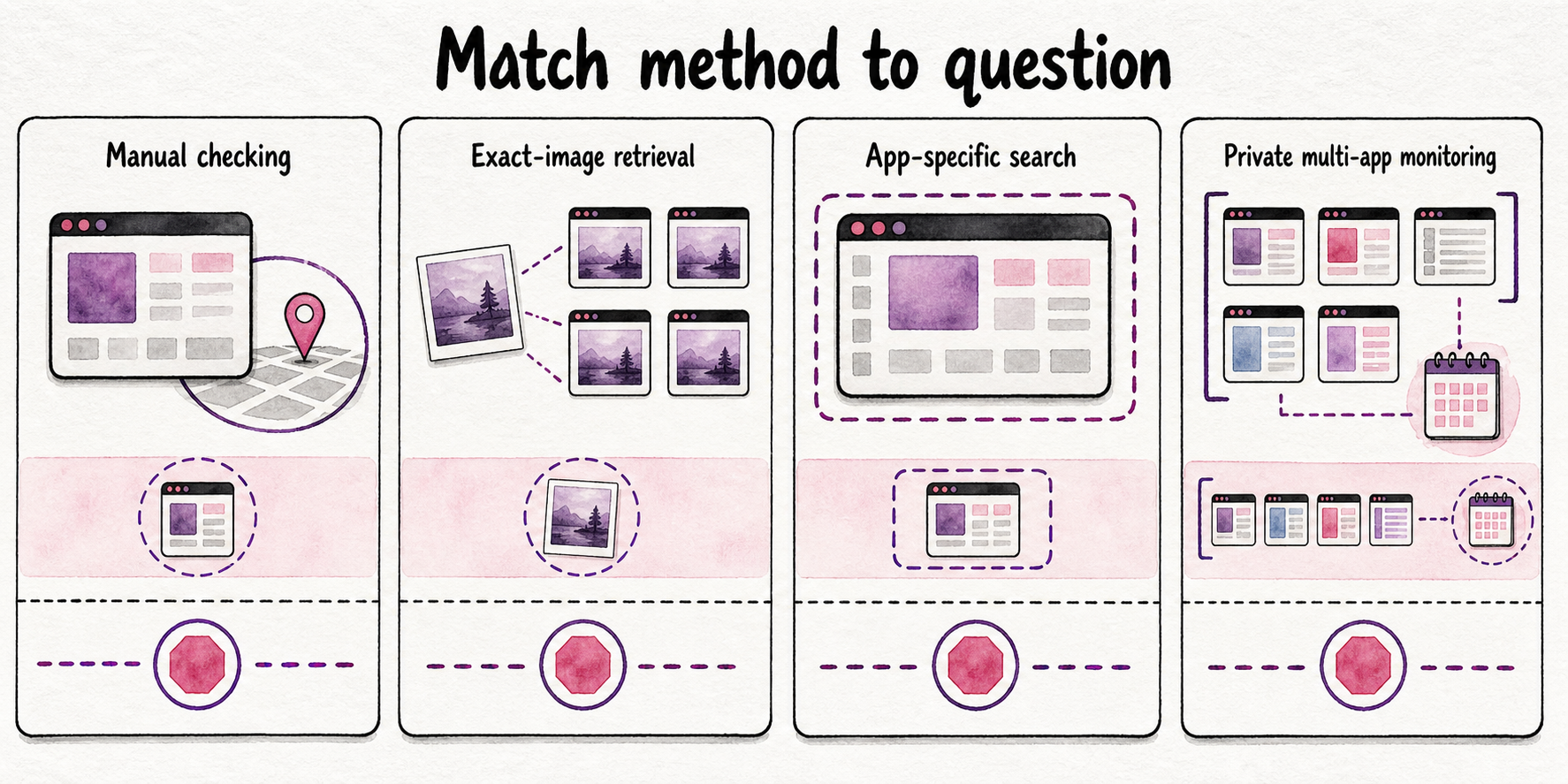
| Method | Best-fit question | Required inputs | Likely output | Principal limitation and stopping rule |
|---|---|---|---|---|
| Manual checking | One bounded, observable question on an app you can lawfully use | Known identity details and likely location | A profile observation or nothing seen | It can be time-consuming and incomplete, and results depend on what the app surfaces. Stop after checking the defined app, area, and review period once. |
| Exact-image retrieval | Whether the same photo file appears elsewhere | A clear image you are entitled to use | An exact or near-exact image occurrence | It tests image reuse, not profile identity, current activity, or intent. Stop when the selected image searches reveal no new source. |
| App-specific search | A question tied to one known platform | Name or nickname, age, location, and photos | A candidate on that app or nothing found | It says little about other apps. Stop at the app boundary and use current specialist guidance for platform-specific questions. |
| Private multi-app monitoring | Discovery across selected covered apps or observation of later visible changes | A consistent identity brief and a defined monitoring period | Possible matches, uncertainty notes, later observations, or nothing found | Coverage and available evidence remain limited. Stop or review on the date chosen before monitoring begins. |
Manual checking offers direct control, but repeating it may not expand coverage or improve the evidence. Exact-image retrieval is useful when photo reuse is the precise question; the reverse-image search guide covers that narrower task without turning an image hit into an identity claim.
App-specific searching fits when the platform itself matters, but detailed procedures differ and should be handled by current specialist guidance. Multi-app monitoring fits better when the unresolved question spans selected apps or concerns later observable changes. No method proves identity, intent, relationship status, or infidelity.
3. Prepare the Minimum Useful Search Brief
A useful search starts with accurate, limited information—not every detail you can collect. Depending on the method, prepare:
- The person’s name and any nickname they are known to use
- Their approximate age or a plausible age range
- Their city, likely location, or a small number of realistic locations
- Clear photos you already hold responsibly and are allowed to use
The how-it-works overview explains how these details can form a search brief. If you plan to use photos, consult the photo-preparation guide for the narrower question of choosing responsibly held, usable images.
Record uncertainty instead of replacing it with a guess. If you do not know the current city, mark it unknown or identify the last reliably known location. If an age is approximate, retain a range.
Use data minimization: collect only what the selected method needs. More personal information is not automatically better, particularly when it was obtained intrusively or has little matching value. The privacy policy explains what information CheaterBusting says it uses and the private access it does not request.
For example, a known nickname, approximate age, likely city, and two clear photos shared with you directly can form a usable starting brief. They do not justify searching private messages, unlocking a device, or acquiring more information through deception.
Stop if the inputs are so weak that many unrelated people could fit, or if improving them would require intrusion. A limited but honest brief is safer than a precise-looking brief built from guesses.
4. Review Identity With More Than One Signal
For each candidate, separate the evidence into three categories: supports, contradicts, and unknown. Compare the same core details each time:
- Name or known nickname
- Approximate age
- City or location context
- Photo and other visible identity context
A common name, broad age range, or generic location is a weak signal. A clear photo alignment may be more useful, but it should not carry the conclusion alone. Reliable disagreements, such as a clearly incompatible age or location, should lower confidence rather than being explained away.
Suppose a profile uses the expected nickname and a plausible age, but its city only partially aligns, the photo is unclear, and no dated freshness evidence is available. The result remains a possible match with substantial limitations. Identity and timing are unresolved.
Confidence describes how well observable signals agree. It is not a laboratory probability, a finding of guilt, or a guarantee. CheaterBusting’s methodology describes how aligned clues, conflicts, missing evidence, and freshness context are kept visible, while its confidence-scoring explanation clarifies what confidence notes do and do not mean.
If the evidence cannot distinguish the candidate from other people, leave identity unresolved. A sample report shows how supporting details, conflicts, unknowns, freshness, and overall confidence can be presented without turning them into a behavioral conclusion.
5. Separate Visibility, Freshness, Activity, and Intent
These evidence layers support different statements and should not be collapsed into one conclusion.
Visibility means a profile was surfaced through a stated source at a particular observation time. It does not reveal when the profile was created, whether it remained under the same person’s control, or why the platform displayed it. The specialist guide to inactive-profile visibility examines this distinction in a narrower platform context.
Freshness requires a dated observation, a newly visible detail, or a documented change. Preserve when and where the observation occurred. If no reliable timing information exists, freshness remains unknown.
Activity should be claimed only when the platform provides a defined signal and its observation time is recorded. Even then, the signal applies to the profile within the platform’s stated meaning. It does not authenticate its owner or establish a swipe, match, message, meeting, or control of the account. For a platform-specific example, see the guide to what a recently active label can establish.
Intent is not visible in a profile result. A sighting cannot establish motive, exclusivity, relationship status, or infidelity. Identity confidence must also be assessed separately from recency: either one can remain unknown even when the other is relatively well supported.
6. Classify the Result Before Deciding What It Means
Use a neutral label before choosing what to do next:
- Possible match: Several identity details align, but proof claims remain out of scope.
- Conflicting candidate: One or more meaningful details disagree with the person being checked.
- Inconclusive evidence: The available signals cannot resolve identity, freshness, or both.
- Nothing found: No sufficiently supported result appeared within the available coverage, inputs, and timing.
Record what was checked, what supported the classification, what contradicted it, and what could not be confirmed. This keeps the limits visible when emotion is pushing toward a stronger conclusion.
Nothing found is especially easy to overread. It may reflect selected app coverage, location assumptions, weak inputs, profile availability, or timing. It is not proof that no profile exists, never existed, or that someone is loyal. The guide to what “no match found” means explains these limits and when correcting a material input may justify another check.
Likewise, a possible match is not proof of identity or cheating. Do not translate any result category into certainty about loyalty, intent, or conduct.
7. Keep the Check Private, Lawful, and Proportionate
Use only information you are allowed to use, and respect the rules applying to the app, search service, and your location. Public visibility does not automatically create unlimited permission to collect, retain, republish, or weaponize personal information.
Do not use:
- Passwords, login codes, or private-account access
- Someone else’s phone, computer, or unlocked device
- Private messages or intercepted communications
- Impersonation, fake identities, or deceptive contact
- Covert or unlawful surveillance
- Stalking, harassment, threats, intimidation, or harmful disclosure
CheaterBusting’s acceptable-use policy sets out prohibited uses, while its privacy policy describes its handling of submitted search information and its stated private-access boundaries.
If the next step depends on a prohibited or intrusive action, stop. If jurisdiction-specific rules could materially change whether you may search, upload, retain, or share information, seek qualified local advice rather than assuming there is one universal legal answer.
Proportionality also concerns foreseeable harm. Do not circulate a candidate profile as though identity were confirmed, particularly when the evidence contains contradictions or unknowns. Stop when your authority to continue is materially uncertain or the foreseeable risk of harm outweighs the limited information the search might add.
8. Set a Stopping Rule and Choose One Next Step
Before another check, complete this sentence: “I will search once more only if it can tell me ___.” If you cannot name the information gain, another search is unlikely to help.
Use a stopping rule matched to the method:
- For manual checking, stop after the predefined app, location range, and observation period.
- For exact-image retrieval, stop when another search would merely repeat the same retrieval question.
- For an app-specific search, stop at that app’s boundary and use specialist guidance if the platform question remains unresolved.
- For monitoring, choose a review date in advance and stop when the period ends or further observations would not change your decision.
Correct a materially wrong name, age, city, or photo before repeating a search. Do not rerun identical weak inputs merely because the first result was uncomfortable or inconclusive.
If broader discovery or time-bounded observation fits the stated question, CheaterBusting offers a private search across selected covered apps. It uses a search brief containing details such as a name or nickname, age, city, and photos; weighs several signals; provides confidence notes and a private report; and monitors during an active paid period. Results are not guaranteed, and a possible match is not proof of cheating.
Choose one next step:
- Continue manually for one narrow, observable question.
- Use the reverse-image search guide for an exact-photo question.
- Review the current app-coverage page before relying on a multi-app search.
- Examine the method comparison, methodology, and confidence explanation if you need to decide whether the evidence model fits your question.
- Inspect the sample report before paying so you understand how matches, conflicts, unknowns, and nothing-found results are presented.
- Review what no match means before repeating weak or unchanged inputs.
- Read the how-it-works overview, privacy policy, and acceptable-use policy before submitting information.
- Start one private search only when selected-app discovery, confidence notes, a private report, and time-bounded monitoring fit the unresolved question: Start my search.
FAQ
Can you check without accessing a phone or account?
Yes. A lawful check can use information you already hold responsibly and public or otherwise available profile information. Do not access another person’s phone, credentials, private accounts, or messages. Review the service’s privacy boundaries and acceptable-use rules before submitting information.
Does a possible match prove cheating?
No. A possible match does not by itself prove identity, current use, intent, relationship status, or cheating. It means only that specified observable details align sufficiently to warrant a qualified possible-match label.
What does nothing found mean?
It means no sufficiently supported result appeared within the search’s available inputs, selected coverage, and timing. It does not prove that no profile exists or ever existed. The full no-match explanation describes the boundaries of that result.
How do you reduce mistaken identity?
Compare several details together, including name or nickname, approximate age, location, and photo context. Record contradictions and unknowns separately, treat generic details as weak signals, and leave identity unresolved when the evidence cannot distinguish between candidates. The confidence-scoring guide explains why confidence reflects signal agreement rather than certainty.
When is monitoring more appropriate than a snapshot?
Monitoring is more appropriate when the question concerns later observable changes rather than what can be seen at one moment. Begin with a named question, a fixed review date, and a stopping rule. Monitoring may add observations, but it cannot establish private behavior, intent, or infidelity.
Will CheaterBusting contact or notify the person?
CheaterBusting states that it does not contact, message, warn, or notify the person being checked. Review the current how-it-works information and privacy policy before using the service.
Which apps are checked?
CheaterBusting checks selected covered apps rather than every dating platform. Review the current apps-covered page before purchase to confirm whether the apps relevant to your question are included.
Next decision
Need broader evidence across covered apps?
Review scope, confidence limits, and pricing before starting any private search.
Continue reading
Related evidence guides
How to Find a Dating Profile by Nickname Without Overclaiming
Build a bounded nickname map, reject guessed aliases, and evaluate possible dating-profile matches using provenance, age, city, and photos.

How to Check a Common-Name Dating Profile Match
Use a collision-risk worksheet to reject weak same-name candidates, test contradictions, and stop before a possible match becomes a false conclusion.
DoTheySwipe Alternative: Define the Fit Before You Switch
Turn one failed requirement into five decision conditions, then choose a documented replacement or stop before paying.