
How to Find a Dating Profile by Nickname Without Overclaiming
Build a bounded nickname map, reject guessed aliases, and evaluate possible dating-profile matches using provenance, age, city, and photos.
- Author
- CheaterBusting Team
- Reviewed
- Reviewed August 8, 2026
- Reading time
- 9 min read
In this guide
TL;DR
- A plausible, responsibly known nickname can improve discovery, but it cannot confirm identity.
- Include only name variants whose source you can record. Exclude guessed aliases, speculative spellings, and names obtained through unauthorized access.
- As a conservative decision rule, require one known variant plus at least two independent details—age, relevant city, or a clear, lawfully held photo—before treating a candidate as reviewable.
- Record the exact variant that produced each candidate instead of reducing it to a generic “name match.”
- Use age, city, and photos as corroboration while keeping profile freshness and activity separate.
- Stop when lawful information cannot distinguish the candidate. An unresolved result is more accurate than a forced conclusion.
A familiar nickname can make a dating-profile result feel immediately convincing, especially when you are already worried. Recognition is not verification: the real task is to preserve how you know the person uses that name and test whether independent details support the same identity without turning uncertainty into an accusation.
Key Takeaways
- Discovery and identity confidence are different. A nickname may surface a candidate without establishing who controls the profile.
- Provenance—how you responsibly know a variant belongs to the person—determines whether that variant belongs in the search.
- Corroboration matters more than familiarity. Age, city, and photos can add context, but no single clue settles identity.
- Contradictions and missing information must remain visible rather than being explained away.
- Lawful use and data minimization are prerequisites. Stop before a search becomes intrusive or disproportionate.
Build a Bounded Nickname Map Before You Search
The goal is not to imagine every name someone might use. It is to create a finite map of variants you already have a responsible basis to connect to that person.
For this workflow, use four practical labels:
- Nickname: A familiar alternative name the person is responsibly known to use.
- Shortened name: A reduced form of a longer given name that the person has actually used.
- Former surname: A previous family name responsibly known to have belonged to the person and relevant to the period or profile being considered.
- Display name: A visible name the person has used in public or otherwise available information.
These are operational labels for this workflow, not universal naming rules or dating-app definitions.
For every variant, record its provenance: how you responsibly know the person uses or previously used it. That might be a name the person uses publicly, one they have used directly with you, or a former surname you already know through a legitimate relationship or record you are entitled to use.
Record confidence in the provenance as high, medium, or uncertain. This describes the connection between the person and the name; it does not establish that a dating profile belongs to them.
In this workflow, corroboration means independently known details such as age, a relevant city, or a clear photo. Identity confidence means the degree to which several independent details align. It is not certainty or proof of behavior.
Use a separate row for every variant:
| Variant | Workflow type | How you know it | Provenance confidence | Relevant period or note |
|---|---|---|---|---|
| Nickname, shortened name, former surname, or display name | High, medium, or uncertain |
The completed map creates a boundary. Do not add generated aliases, speculative spellings, or variants intended to bypass account controls merely because they might produce more results.
Include Known Variants; Exclude Guesses
A variant belongs in the map when you responsibly know it is or was connected to the person and can record the basis for that knowledge.
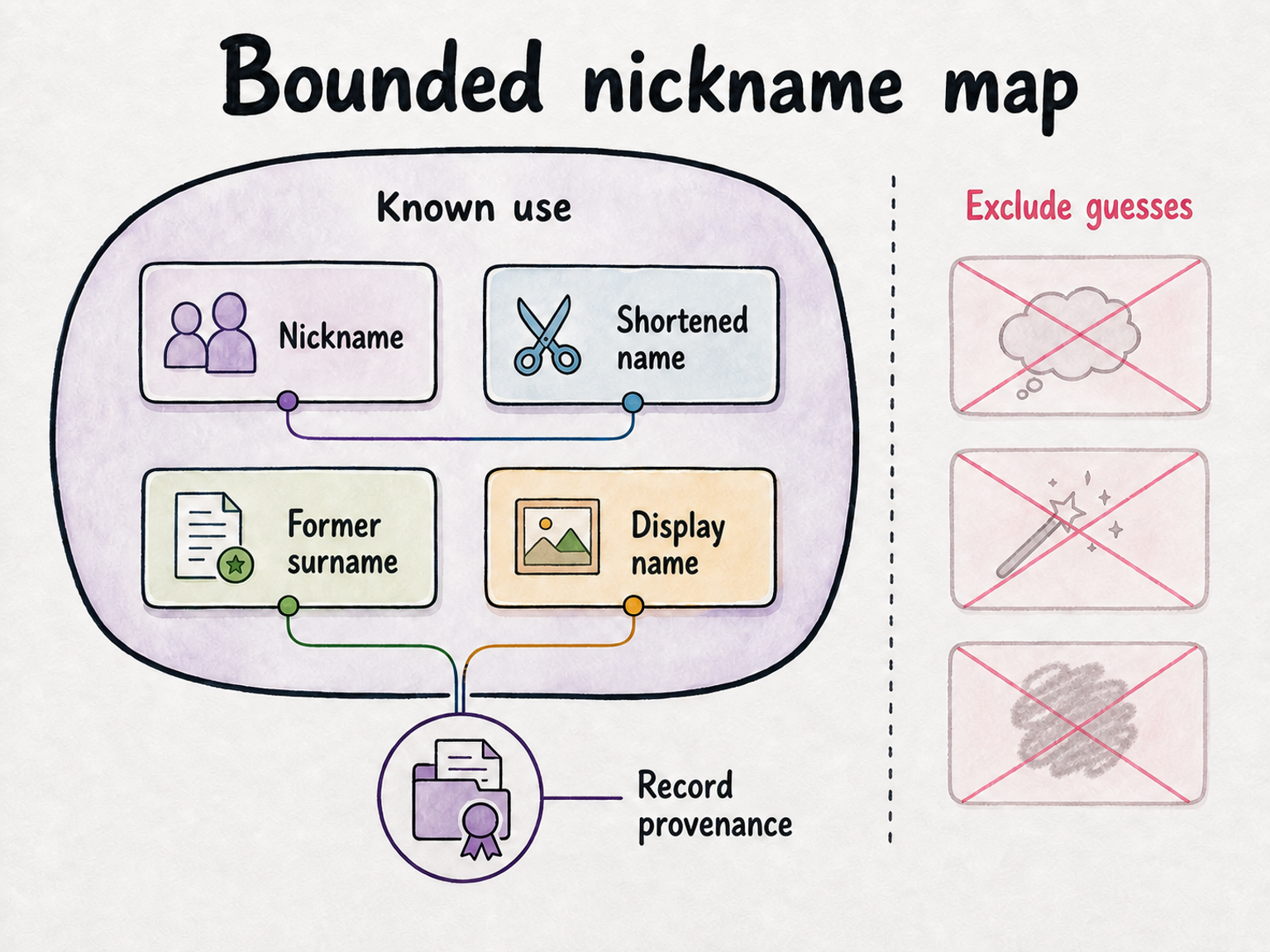
Include:
- A nickname the person has used publicly or directly with you.
- A shortened name you have seen the person use.
- A former surname when its connection is responsibly known and relevant to the question.
- A display name observed in public or otherwise lawfully available information.
- A variant with uncertain provenance only when the uncertainty remains clearly labeled.
Exclude:
- Invented aliases designed to generate more candidates.
- Speculative spellings with no known connection to the person.
- Suggestions that cannot be traced to responsible knowledge.
- Names obtained through unauthorized access to an account, device, or message.
- Variants created for impersonation or to bypass account controls.
For a hypothetical example, retain a shortened name you have actually seen the person use. Exclude another possible shortening created only because it might return more profiles. The rule is based on known use, not linguistic possibility.
A nickname also says nothing by itself about why it was used. Do not interpret nickname use as evidence of concealment, dishonesty, relationship status, or infidelity.
Apply the Minimum-Data Gate
Before treating a nickname-led result as reviewable, apply this conservative editorial rule: require one responsibly known name variant plus at least two independently known corroborating inputs.
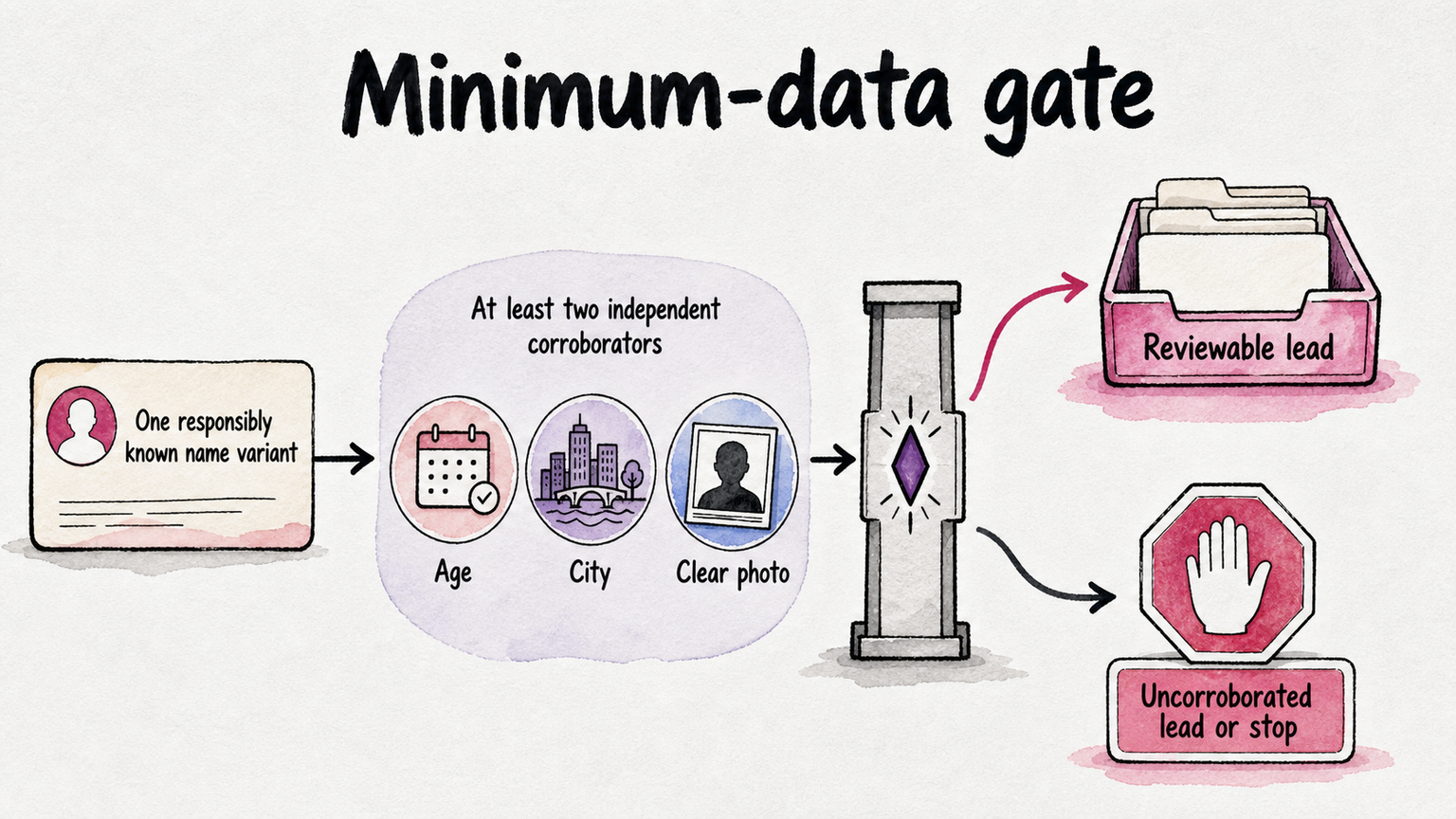
Eligible corroborators are:
- A known age or plausible age range.
- A city relevant to the person and the question.
- A clear, lawfully held photo suitable for comparison.
This is this article’s decision rule, not a published CheaterBusting eligibility requirement. Its purpose is to prevent a familiar name from carrying more evidentiary weight than it deserves.
Hypothetically, a known nickname paired with an independently known age range and a usable photo can enter review. A nickname with no independent corroboration should remain an uncorroborated lead or trigger a stop.
Do not collect unnecessary personal information to satisfy the gate. Use only details needed for a lawful, proportionate question. If the gate cannot be met, correct a mistaken input, leave the matter unresolved, or stop.
Record Which Variant Produced Each Candidate
Assign every candidate a neutral identifier, such as Candidate A or Candidate 01, and record the exact variant that surfaced it. Keep the variant’s provenance beside it rather than writing only “name match.”
Use a log such as:
| Candidate | Triggering variant | Variant type | Provenance | Age alignment | City alignment | Photo context | Contradictions | Unknowns | Identity-confidence note |
|---|---|---|---|---|---|---|---|---|---|
Keep three categories separate:
- Alignment: A known detail agrees with what is visible.
- Contradiction: A reliable visible detail conflicts with what is known.
- Unknown: The detail is missing, unclear, or unavailable for lawful review.
An unknown is not an alignment. A contradiction must not be erased because other details feel persuasive.
Do not label candidates “confirmed partner,” “fake,” or “cheater.” If two candidates appear similar, keep them separate until the available evidence supports treating them as the same candidate.
Reweight the Nickname Match With Age, City, and Photos
A nickname primarily adds discovery value: it may surface a profile that another known name did not. Identity confidence comes from the combined pattern of independent details.
An aligned age or plausible age range adds context without establishing identity. A reliable age conflict lowers confidence and should not be removed by repeatedly widening the range.
An aligned city can make a candidate more relevant, but many people may share a nickname and location. Keep location conflicts visible instead of inventing travel, relocation, or work explanations.
Photo context may add identity value, but it is not proof by itself. A photo may be old, unclear, reused, copied, or inadequate for a reliable comparison. Missing or inconclusive photo evidence must remain missing or inconclusive.
A useful interpretation scale is:
- Nickname only: useful for discovery, weak for identity.
- Nickname plus aligned age and city: more relevant, but potentially ambiguous.
- Nickname plus aligned age, city, and a clear photo: stronger identity alignment, still not certainty.
- Nickname plus reliable contradictions: lower confidence, even when the name feels familiar.
Keep identity alignment separate from profile freshness and activity. Even strong alignment does not establish when a profile was created, whether it is currently used, who presently controls it, or what that person intends.
How a Private Multi-Signal Search Uses the Map
Once the bounded map passes the minimum-data gate, it can provide cleaner inputs for a private, dating-specific search. CheaterBusting accepts names or nicknames, age, city, and photos, then weighs several details together across selected covered apps. Its reports present possible matches, confidence notes, and details that could not be confirmed. The CheaterBusting methodology explains how independent details, conflicts, missing evidence, and freshness context are kept distinct.
The service says it uses public or otherwise available information and does not require passwords, access codes, the subject’s phone, private messages, or entry into private accounts. Its privacy policy also limits searches to information and purposes the user is allowed to use.
Profiles using a known nickname or newer photo may be discoverable through the broader hidden dating profile search, but no result is guaranteed. A possible match and its confidence notes are guidance for review, not proof of identity, current activity, intent, relationship status, or infidelity.
Stop When the Variant Adds Candidates but Not Clarity
More results are not necessarily better. A variant has stopped being useful when it expands the candidate pool without helping distinguish the intended person.
Stop when:
- The variant’s provenance is speculative.
- The minimum-data gate cannot be met with lawfully available information.
- The nickname is the only meaningful alignment.
- Reliable contradictions outweigh the aligned details or cannot be resolved lawfully.
- Resolving uncertainty would require a password, device, private message, private-account access, impersonation, or an account-control bypass.
- Continued searching would be disproportionate to the lawful question.
Record the outcome as unresolved. Do not convert uncertainty into a claim about identity, current use, intent, relationship status, or infidelity.
Nothing found is also inconclusive. It does not prove that no profile exists or ever existed; it means only that the search did not return a result that could be responsibly evaluated within its inputs and scope.
Choose the Smallest Useful Next Step
If the inputs are weak, improve only responsibly known details or stop. That may mean correcting a misspelled known name, clarifying a relevant age range, or selecting a clearer lawfully held photo—not manufacturing additional variants.
If the nickname map passes the gate, review the methodology, privacy boundaries, and way uncertainty will be reported before proceeding. For common-name collisions, location selection, the broader search scope, or the complete name-led process, use the dedicated guide for that issue instead of stretching this nickname workflow beyond its purpose.
The map should lead to one proportionate choice: revise a supported input, conduct one lawful private search, or stop. If you proceed, treat the result as guidance rather than a verdict: Set up my search with the known variant, the minimum necessary corroborating details, and a clear record of what the result can and cannot show.
Next decision
Need broader evidence across covered apps?
Review scope, confidence limits, and pricing before starting any private search.
Continue reading
Related evidence guides
How to Check a Common-Name Dating Profile Match
Use a collision-risk worksheet to reject weak same-name candidates, test contradictions, and stop before a possible match becomes a false conclusion.
How to Check If Someone Is on Dating Apps: An Evidence-First Guide
Choose a lawful, proportionate search method, assess identity and timing separately, and interpret dating-profile findings without treating them as proof.
DoTheySwipe Alternative: Define the Fit Before You Switch
Turn one failed requirement into five decision conditions, then choose a documented replacement or stop before paying.