
How to Check a Common-Name Dating Profile Match
Use a collision-risk worksheet to reject weak same-name candidates, test contradictions, and stop before a possible match becomes a false conclusion.
- Author
- CheaterBusting Team
- Reviewed
- Reviewed August 1, 2026
- Reading time
- 10 min read
In this guide
TL;DR
- A common name can generate plausible candidates, but it has little identifying value without independent corroboration.
- Label every available clue as distinctive, common, contradictory, or unknown instead of simply counting matches.
- Review reliable contradictions before adding up supporting details. One material conflict can eliminate a candidate despite several weak similarities.
- Raise the evidence threshold when the name, age range, and city describe a large candidate pool. The stricter standard may leave more searches inconclusive, which is safer than forcing a match.
- A possible match or confidence note does not prove identity, current use, intent, relationship status, or cheating.
Seeing several profiles with the same name can make an already difficult situation feel deceptively simple: one person looks familiar, the city seems right, and the details begin to feel cumulative. The practical task is not to choose the most plausible-looking profile. It is to determine whether any candidate can be separated from unrelated people without turning ordinary overlap into an identity claim.
Key Takeaways
- A name match means only that the visible name aligns. A known nickname, age range, city, and photo context may add information, but their value depends on how well each clue distinguishes this person from the candidate pool.
- A candidate pool is the set of plausible same-name profiles under review. Several people with the same first name and approximate age in a large city represent a high-collision pool.
- A contradiction is a material conflict with a reliable identity detail. An unavailable field is merely unknown and should not be treated as evidence either way.
- A confidence note should describe the strength and limits of the alignment. It is not a verdict.
- Discovery, identity confidence, profile freshness or activity, and relationship meaning are separate questions. Evidence about one does not automatically answer the others.
Why a common name raises the evidence threshold
A name is useful for finding candidates, but a common name rarely distinguishes one candidate by itself. If several profiles show “Alex,” for example, the name has done its discovery job while doing very little identity work.
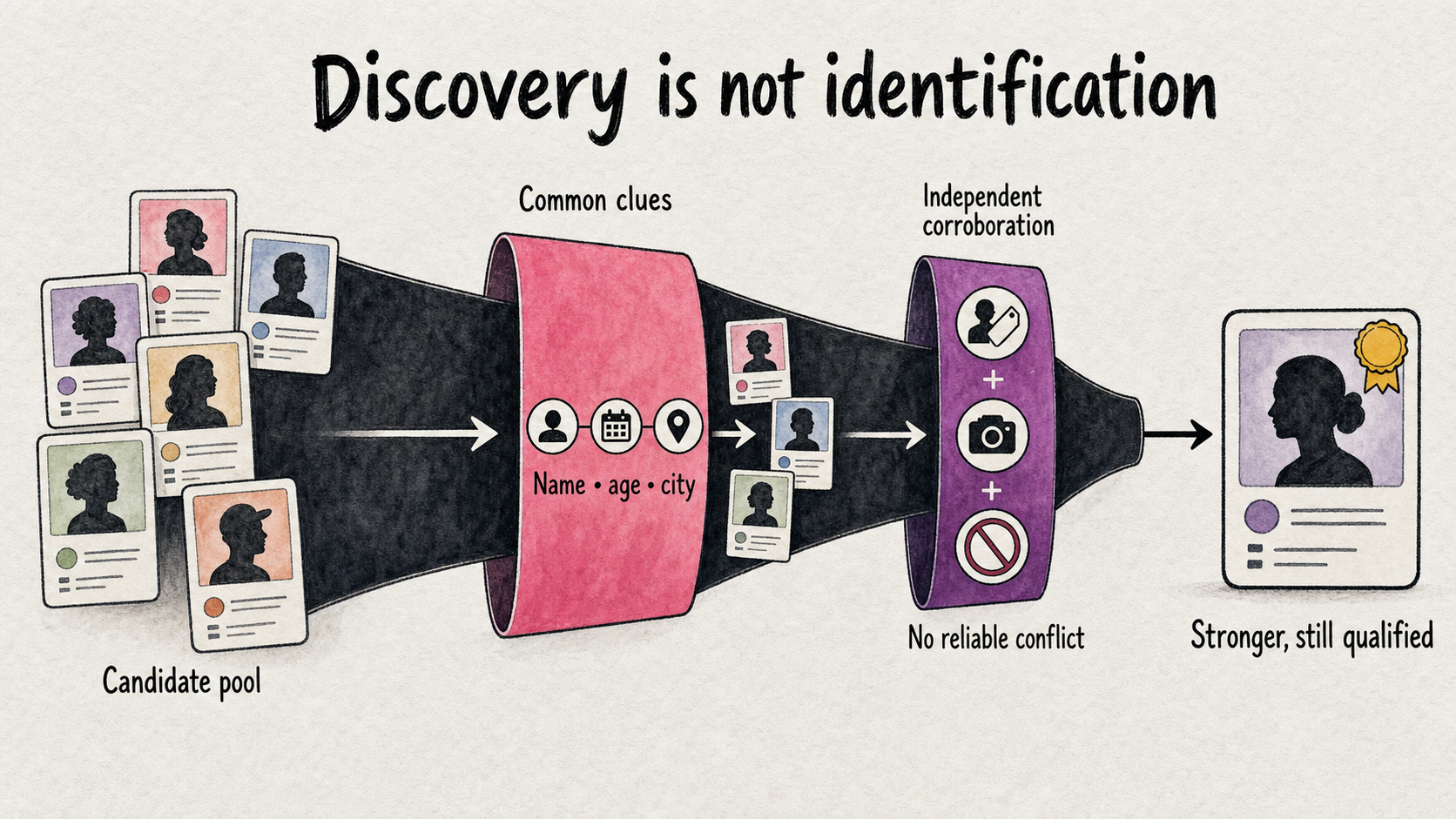
The same problem can affect other fields. “Alex, age 31–35, in a large city” may sound specific when read as a sentence, yet every part can apply to many unrelated people. A matching city may also be less independent than it appears: the city helped define where the candidate was found, so seeing it on the profile may not add much new identifying information.
This is why the threshold should respond to collision risk. When the name and location are common, require stronger independent corroboration before treating a candidate as likely to be the person in question. Independent corroboration adds information beyond the shared name—for example, a responsibly known nickname paired with consistent photo context and no reliable conflict.
Do not replace this principle with a raw match count. Three common clues do not necessarily outweigh one distinctive clue, and they should not erase a material contradiction. The question is not “How many boxes match?” but “How much does each box actually separate this candidate from everyone else?”
A higher threshold has a real tradeoff: it reduces the risk of selecting the wrong person but produces more unresolved results. That is not a failure of the review. It is the honest outcome when the available information cannot support a stronger conclusion.
Test every clue for distinctiveness
Classify each available field before judging the candidate as a whole. Use four labels:
- Distinctive: The clue meaningfully narrows this candidate relative to the others under review.
- Common: The clue aligns but could easily apply to many people in the candidate pool.
- Contradictory: The clue materially conflicts with reliable information already known about the person.
- Unknown: The clue is missing, unclear, or not reliable enough to classify.
Apply the labels contextually rather than treating them as universal scores:
- Name match: A shared common first name is usually common. It identifies a group of candidates, not an individual.
- Known nickname: A nickname you already know the person genuinely uses may be distinctive when it separates one same-name candidate from the rest. Do not generate speculative variants merely to make a profile fit.
- Age range: A broad compatible range is often common. A reliable, material age conflict can be contradictory. Minor uncertainty should remain unknown rather than being stretched into either support or rejection.
- City: A large shared city may be common. A clearly incompatible city can be contradictory if the underlying location information is dependable. This classification does not establish where someone should be searched for or reconstruct a travel or moving history.
- Photo context: Several supplied photos that consistently show recognizable, non-biometric context may be distinctive compared with a single vaguely similar image. Resemblance alone should remain qualified; it is not proof of identity.
- Freshness or recent activity: If this information is unavailable, mark it unknown and keep it separate. Identity alignment does not establish that a profile is current or being used now.
The privacy tradeoff also matters. Adding age, city, nickname, and photos may make candidates easier to distinguish, but it increases the amount of personal information submitted or handled. Use only information you possess lawfully, and only when it could materially change the decision.
Review contradictions before supporting matches
Start each candidate review by asking whether any reliable field rules the person out. This prevents a familiar name, city, or face from creating momentum before conflicting evidence receives proper attention.
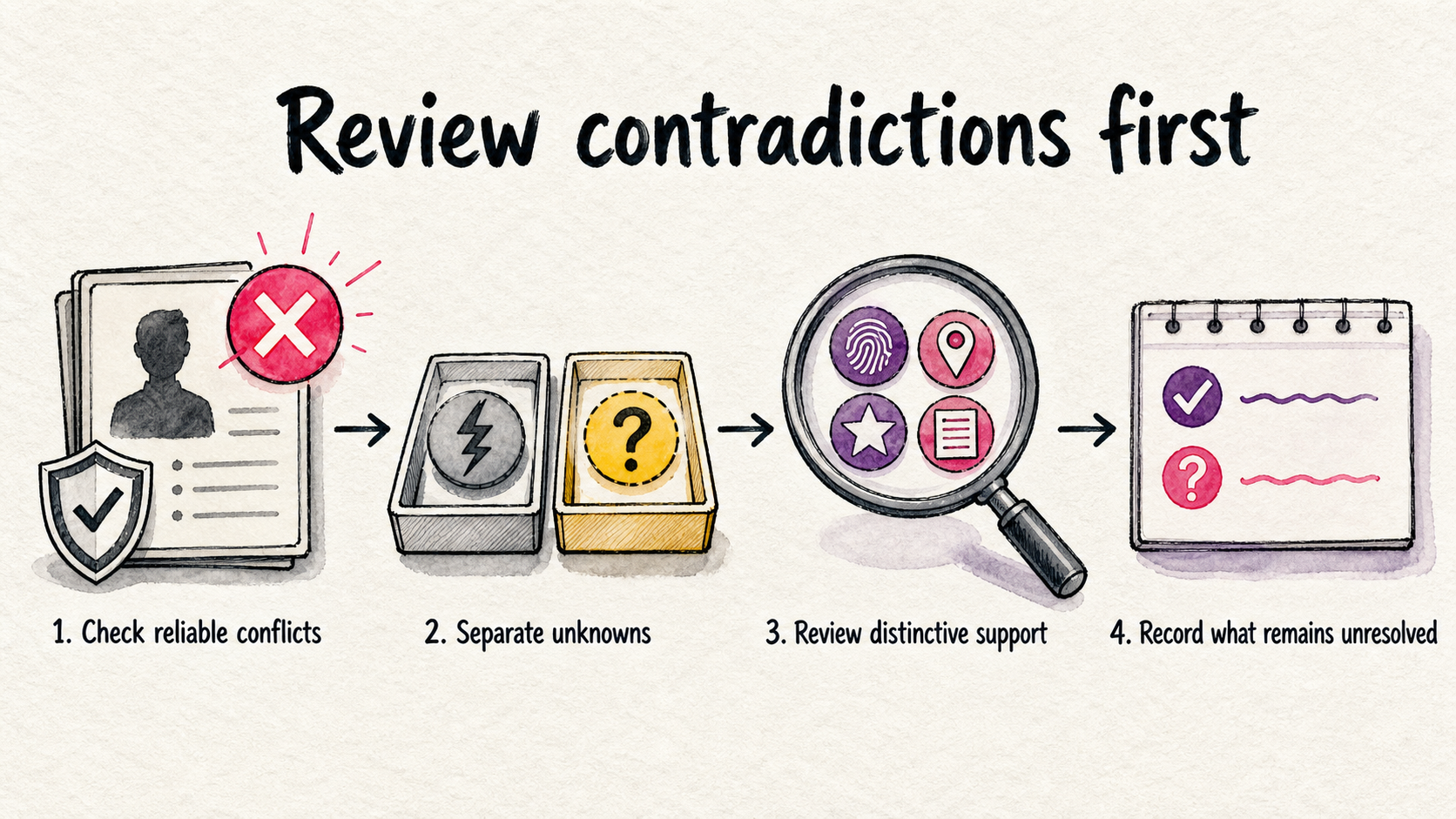
A contradiction should be both material and reliably grounded. Suppose a candidate shares a common name and city but displays an age that conflicts substantially with a dependable known age range. That conflict may justify rejection before weaker photo resemblance is considered.
Not every discrepancy deserves that treatment. A missing age is unknown, not contradictory. A city field that may be outdated is not automatically decisive. A slightly different spelling or uncertain photograph may call for qualification rather than elimination.
Use this order for each candidate:
- Identify any material conflict with a reliable known detail.
- Separate true contradictions from missing or ambiguous information.
- If no disqualifying contradiction remains, examine which supporting clues are genuinely distinctive.
- Record a confidence note that states both the alignment and what remains unresolved.
This is a decision framework, not a validated numerical scoring formula. There is no supported universal weight for a nickname, age, city, or photo, and no method-specific evidence here for publishing a numerical false-positive rate.
Worked example: three same-name candidates
The following worksheet is fictional. It illustrates the method; it is not customer evidence, a measured accuracy result, or a claim about how often these collisions occur.
Assume the search concerns an adult named Alex who is believed to be in a broad 31–35 age range and a large city. “Lex” is a responsibly known nickname, and several lawful reference photos are available.
| Field | Candidate A | Candidate B | Candidate C |
|---|---|---|---|
| Name match | Common: Alex | Common: Alex | Common: Alex |
| Known nickname | Unknown: none visible | Unknown: none visible | Distinctive: uses known nickname “Lex” |
| Age range | Contradictory: materially outside reliable range | Common: broad range aligns | Common: range aligns |
| City | Common: same large city | Unknown: location unclear | Common: same large city |
| Photo context | Common: vague resemblance in one image | Unknown: insufficient context | Distinctive: several photos are consistently aligned |
| Material contradiction | Yes: reliable age conflict | None established | None established |
| Confidence note | Rejected despite common name and city | Unresolved; too little separating information | Stronger candidate, but identity remains qualified |
Candidate A is rejected. The common name and city do not cancel a reliable, material age contradiction. The single vaguely similar image adds too little to reverse that decision.
Candidate B remains unresolved. The name aligns, but the age is broad, the city is unclear, and the photo context is unavailable. Unknown fields must not be quietly converted into matches.
Candidate C is stronger but still qualified. The responsibly known nickname and several consistent photos distinguish this candidate better than the common name, age range, or city. Even so, the worksheet does not establish identity as fact. It also says nothing by itself about freshness, current activity, intent, or cheating.
CheaterBusting applies combined name or nickname, age, city, and photo review across selected covered dating apps rather than treating one field as a verdict. Its private reporting uses confidence notes and keeps unconfirmed details visible. The published sample dating-app search report likewise shows matched, partial, conflicting, and uncertain information while explaining that confidence describes identity-signal overlap—not proof of cheating.
Broader coverage can produce more candidates, but it does not make an individual candidate more certain. It can instead increase the review burden. A focused dating app checker is useful only if its results are interpreted with the same contradiction-first discipline.
Choose one of four outcomes—and do not force a match
Once the worksheet is complete, choose exactly one outcome for each candidate:
- Reject the candidate. Use this when a material contradiction rests on reliable information and is not reasonably explained by uncertainty.
- Retain the candidate as unresolved. Use this when the clues neither distinguish nor eliminate the person.
- Obtain one lawful, decision-changing signal. Seek only information you may lawfully use and that could change the classification—for example, a reliable detail capable of separating two otherwise similar candidates. More common clues are not decision-changing merely because they increase the match count.
- Stop because the available clues cannot distinguish candidates. If every available clue applies equally to two people, selecting the more familiar-looking profile would manufacture certainty rather than discover it.
A stricter review may end without a chosen match. That restraint protects unrelated people and gives you a more defensible basis for whatever you decide next. If a private multi-app review fits your situation, start my search only after deciding which lawful inputs could genuinely distinguish the person and accepting that the result may remain uncertain.
Remember the boundary: identity confidence is not evidence of current activity, intent, relationship status, or cheating. Those questions require different information and should not be inferred from a candidate worksheet.
FAQ
Can a shared name and city confirm identity?
No. A common name and a large shared city may describe many unrelated people. Even when an approximate age also aligns, the fields can remain common rather than independently identifying.
A known nickname or consistent photo context may narrow the pool, but each should still be assessed for distinctiveness and reliability. No single clue should be promoted to proof merely because the situation feels urgent.
What if two candidates still look equally plausible?
Do not choose between them based on intuition or resemblance alone. Mark both unresolved unless a lawful, decision-changing signal can materially separate them.
A high confidence note does not prove identity or cheating, an unknown field is not a contradiction, and finding the same candidate across broader coverage does not automatically strengthen the identity case. The available decisions remain the same: reject the candidate, retain it as unresolved, obtain one lawful decision-changing signal, or stop because the available clues cannot distinguish candidates.
Next decision
Need broader evidence across covered apps?
Review scope, confidence limits, and pricing before starting any private search.
Continue reading
Related evidence guides

How to Find a Dating Profile by Nickname Without Overclaiming
Build a bounded nickname map, reject guessed aliases, and evaluate possible dating-profile matches using provenance, age, city, and photos.
How to Check If Someone Is on Dating Apps: An Evidence-First Guide
Choose a lawful, proportionate search method, assess identity and timing separately, and interpret dating-profile findings without treating them as proof.
DoTheySwipe Alternative: Define the Fit Before You Switch
Turn one failed requirement into five decision conditions, then choose a documented replacement or stop before paying.