
Is My Boyfriend on Dating Apps? A Private Way to Check
Prepare a private multi-app search, assess possible matches carefully, and decide what to do without treating a profile as proof.
- Author
- CheaterBusting Team
- Reviewed
- Reviewed July 21, 2026
- Reading time
- 11 min read
In this guide
TL;DR
- One familiar name, photo, or city is not enough to answer “is my boyfriend on dating apps?” reliably.
- Prepare accurate information you already hold lawfully: his name and known nicknames, age, likely city, clear photos, and the apps most relevant to your concern.
- Check selected relevant apps rather than assuming Tinder is the only possible platform.
- Treat any result as evidence to assess. A possible match does not prove identity, present activity, intent, or cheating.
- An old-looking profile may leave current use unresolved. Nothing found means no qualifying match was located within the search’s available scope and timing—not that no profile exists or ever existed.
If you are worried enough to keep checking one app repeatedly, the useful question is no longer simply whether you can find a profile. It is whether one private, bounded search could give you better information without crossing privacy lines or turning an uncertain result into an accusation. The method below helps you prepare the right details, choose sensible coverage, account for old-profile risk, and decide what the result actually supports.
Table of Contents
- Key Takeaways
- Prepare the details that separate a match from a coincidence
- Choose a private multi-app check without crossing privacy lines
- Read the result as evidence, not a verdict
- Choose the smallest next step that could actually help
- FAQ
Key Takeaways
- Several independent details agreeing are more useful than a name, photo, or location considered alone.
- Multi-app coverage reduces the risk of treating a search of one platform as a complete answer.
- Visible profile content can help with identification while saying little about when the account was last used.
- Keep the search limited to public or otherwise available information. Do not access a partner’s device, messages, passwords, or private accounts.
- A possible match and a nothing-found result both contain uncertainty. Neither establishes loyalty, guilt, or relationship intent.
Prepare the Details That Separate a Match From a Coincidence
Start with information you already know and are entitled to use. The goal is not to assemble an invasive record of your boyfriend’s life. It is to give a search enough accurate, distinctive details to separate a plausible identity match from someone who merely shares a first name or lives in the same city.
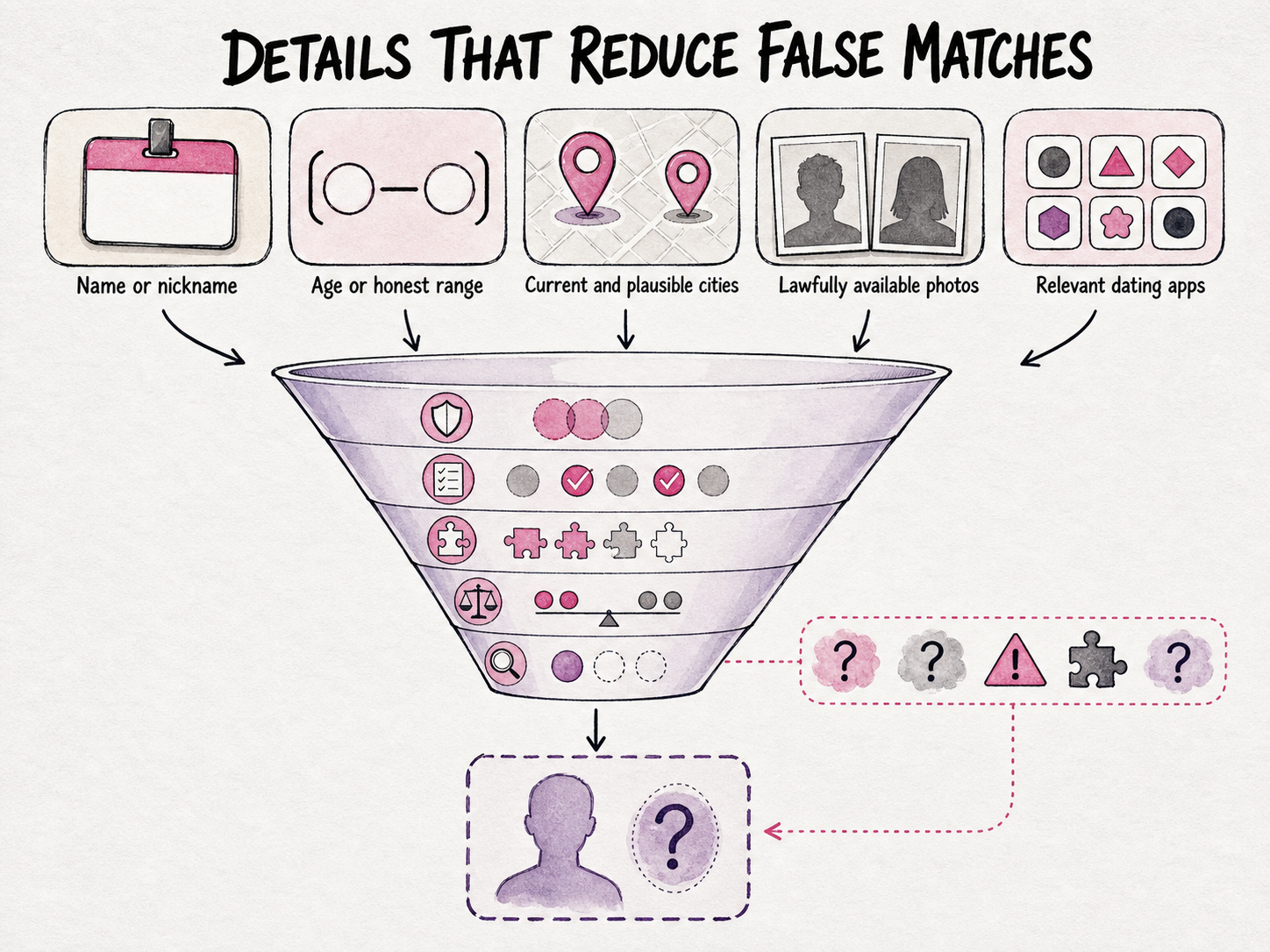
Prepare these inputs before choosing a service or beginning a search:
- His full name as you know it, plus nicknames or shortened forms he commonly uses
- His age, or an honest approximate age if you are unsure
- His current city and any other location that is genuinely plausible
- One or more clear, lawfully available photos
- The dating apps that matter to your question
Preserve uncertainty instead of filling gaps with guesses. If he recently moved and you do not know which city a profile might show, record both plausible locations and label the older one accordingly. If you are unsure of his exact age, use an approximate range rather than inventing a birth date. CheaterBusting’s documented setup similarly begins with identity details, an age or range, likely locations, selected apps, and photos; it advises using the closest accurate information available (search setup).
Consider a hypothetical example. Maya wants to know whether her boyfriend Daniel may appear on dating apps. She knows that he sometimes uses “Dan,” is approximately 31, recently moved from Bristol to Cardiff, and has two current photos that he has shared publicly. Those details are more useful together than a search for “Daniel in Cardiff,” but Maya should still mark Bristol as a former location rather than presenting it as current.
Distinctiveness matters because every weak detail can widen the pool of plausible candidates. A common first name is a light signal. A familiar-looking photo can still be misleading. Agreement across a nickname, approximate age, city, and multiple photos is more informative, while a conflict—such as the wrong age or a location with no known connection—should remain visible rather than being explained away. The company’s methodology describes this same approach: compare independent details, keep conflicts and missing evidence visible, and use confidence to guide review rather than decide whether cheating occurred (matching methodology).
The rule does not change with the relationship label. If you are asking whether your girlfriend, husband, wife, or spouse is on dating apps, use the same restrained set of accurate details. What changes is the person and perhaps the relevant apps—not the standard of evidence.
Choose a Private, Multi-App Check Without Crossing Privacy Lines
A Tinder-only check answers a Tinder-sized question. If your real concern is whether your boyfriend may have a dating profile somewhere, checking one platform and treating the result as complete creates an obvious blind spot. A better scope is the smallest group of relevant, covered apps that could answer your actual question.
CheaterBusting is designed for that dating-specific use case. According to its partner-search page, a search can use a partner’s name, age, city, and photos to check selected dating apps and return a private report; the same page explicitly covers boyfriend, girlfriend, husband, wife, and partner scenarios (partner search). For example, someone concerned about Tinder, Bumble, and Hinge could select those covered apps in one setup instead of assuming that a Tinder result represents the whole dating-app landscape.
Coverage is only one part of the decision. Before paying for any dating-profile search, check whether the method:
- Reviews multiple identity details together
- Shows conflicting or unconfirmed details instead of hiding them
- Explains confidence without presenting it as certainty
- Provides a report even when nothing qualifies as a match
- Continues checking for a clearly defined period if monitoring matters to you
- Stays within public or otherwise available information
- Avoids requesting passwords, private-account access, messages, or the subject’s phone
- Does not contact or warn the person being checked
CheaterBusting says its reports include possible matches or a nothing-found result, confidence notes, and details that could not be confirmed. It also says it continues checking during the active monitoring period, keeps the customer’s name unattached to the search, does not contact the subject, and does not access passwords, private accounts, messages, or the subject’s phone (CheaterBusting). These are company-described capabilities and privacy boundaries, not a promise that every possible profile will be discovered.
Use the service only for a lawful purpose and within the rules that apply where you live. A private search is not permission to impersonate someone, enter an account, obtain a password, install tracking software, harass a partner, or access a device without authorization. CheaterBusting also states that it is independent of the dating apps it checks; its search does not imply special access to their private systems.
Monitoring can be useful when your question involves change over time, but it should still have a boundary. CheaterBusting’s paid plans include monitoring during the active billing period, and the duration changes how long that monitoring continues rather than the underlying matching method (plan coverage). Decide in advance what change would matter and how long you are willing to wait. Otherwise, monitoring can turn a focused decision into an indefinite cycle of checking.
Read the Result as Evidence, Not a Verdict
A report is useful only if you interpret the outcome at the right level. Sort what you receive into one of four practical evidence states.
1. A possible identity match. Review what aligns, what conflicts, and what remains unconfirmed. A matching nickname, age, city, and photo can make the candidate worth examining, but confidence describes agreement among signals—not guilt, a guaranteed probability, or proof of infidelity (confidence scoring).
2. A visible recent or updated signal. A dated change or available freshness indicator may support a narrow statement about the profile. It still does not establish who controlled the account at that moment, why the change occurred, or what the person intended. Describe the observable signal without upgrading it into a relationship conclusion.
3. An old or unchanged profile. Identity and recency are separate questions. Familiar photos and biographical details may support the possibility that the profile relates to your boyfriend, yet unchanged content may provide no dependable answer about current use. Removing an app from a phone is also different from deleting an account, so it helps to understand the difference between deleting an app and deleting an account before interpreting visibility.
If you have already seen a Tinder profile after your boyfriend said he deleted it, use the narrower guide on when a boyfriend’s Tinder profile still appears. If a profile appears again after a long gap, what to do when a dating profile reappears will help you assess that specific situation without assuming continuous activity.
4. Nothing found. This means no sufficiently supported match was located within the available coverage, inputs, and timing. It does not prove that your boyfriend has no profile, that a profile never existed, or that he is loyal. Possible explanations include limited accessible information, inaccurate inputs, a different app, a nickname you did not include, or simply no qualifying match. CheaterBusting defines a no-match result in similarly limited terms and warns that repeated checks cannot guarantee future discovery (what no match means).
Across all four states, avoid conclusions the evidence cannot carry. No result proves cheating, loyalty, intent, present account control, or the nature of your relationship. The report can narrow uncertainty; it cannot settle every question the concern has raised.
Choose the Smallest Next Step That Could Actually Help
Before searching again or starting a difficult conversation, name the unresolved question. Is it identity, recency, app coverage, or what an apparent profile means? Each calls for a different response.
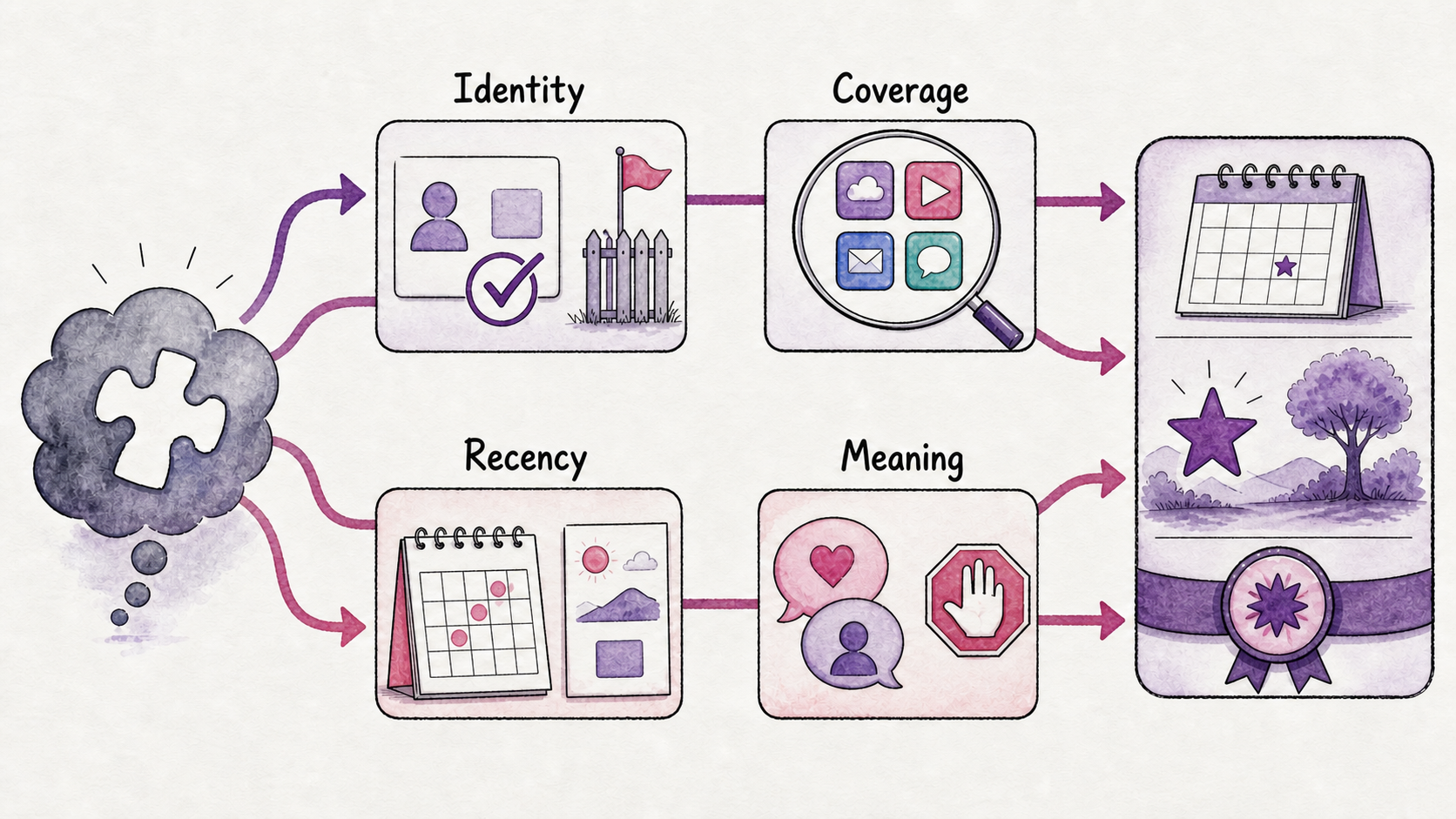
If identity remains uncertain, review the conflicting details once. Correct an inaccurate age, city, nickname, or photo before repeating a search. Do not keep changing inputs until a preferred answer appears.
If recency is the issue, focus only on dependable, dated observations. An unchanged profile is not a reliable substitute for evidence of present use. If you speak with your partner, use non-accusatory language tied to what you actually observed: “I saw a profile with your photo and matching age, but I cannot tell whether it is old. Can we talk about it?” That invites an explanation without presenting an uncertain match as a verdict.
If coverage is the gap, one selected multi-app check may be proportionate. If meaning is the gap, searching more apps may not solve it. A larger pile of ambiguous profiles cannot answer questions about trust, boundaries, or intent by itself.
Set a stopping rule before monitoring. Choose a review date, define the kind of change that would affect your decision, and stop when additional results would not change what you do next. If a conversation could create a safety risk, prioritize personal safety and seek appropriate support rather than confronting someone alone.
When one bounded search could genuinely change your next decision, review the matching method and sample report first. If the scope, privacy boundaries, and result limits fit your needs, start my private multi-app search. If no possible result would change your decision, stopping is the more useful next step.
FAQ
Can I check whether my boyfriend is on dating apps without joining them?
A dating-specific search service can check selected covered apps using details you provide, without requiring you to create profiles on each app. It can only work within its available coverage and information, so it cannot guarantee a complete answer.
Will he know I searched?
CheaterBusting says the customer’s name is not attached to the search and that it does not contact, message, or warn the person being checked. Keep that claim in its documented scope; it is not a promise of invisibility from payment providers, legal obligations, or every other party involved in operating an online service.
Which dating apps can be checked?
Coverage depends on the selected apps the service currently supports. Confirm that the platforms relevant to you are available before checkout rather than assuming every dating app is included.
Can a match prove he is cheating?
No. Even a strong possible identity match does not prove current use, account control, intent, or cheating. Review matching, conflicting, and unconfirmed details separately.
What if nothing is found?
Treat it as “no qualifying match found within this scope and timing.” It does not prove that no profile exists or ever existed, and repeating the same search indefinitely cannot create certainty.
Could the profile be old?
Yes. A profile may support an identity assessment while leaving its age or current use unresolved. Unchanged content should not be treated as proof of recent activity.
Does the same method work for a girlfriend, husband, wife, or spouse?
Yes. Use accurate names or nicknames, age, likely city, lawful photos, and relevant apps. Apply the same limits to every result, regardless of the partner’s gender or relationship label.
Can the search access passwords, phones, private accounts, or messages?
CheaterBusting says it does not require or access those sources. Do not use any method that asks you to obtain credentials, enter a private account, read messages, or access a partner’s device without authorization.
Next decision
Need broader evidence across covered apps?
Review scope, confidence limits, and pricing before starting any private search.
Continue reading
Related evidence guides

Dating App Search Details for a Wife: Build a Minimum-Necessary Brief
Prepare a focused search brief using reliable identity details, a time-qualified location, responsibly held photos, and only relevant dating apps.
How to Check Your Partner Without Joining Dating Apps—and Know When to Stop
Choose a proportionate no-account search method, protect private information, interpret uncertain findings, and stop when further checking cannot change your decision.

How to Find Out If Your Husband Is on Dating Sites Without Joining
Compare four account-free ways to check selected dating apps, prepare only the necessary details, and assess possible matches without treating them as proof.