
Dating App Search Details for a Wife: Build a Minimum-Necessary Brief
Prepare a focused search brief using reliable identity details, a time-qualified location, responsibly held photos, and only relevant dating apps.
- Author
- CheaterBusting Team
- Reviewed
- Reviewed August 4, 2026
- Reading time
- 7 min read

In this guide
TL;DR
- Prepare a reliable name and any nickname your wife is genuinely known to use.
- Record an approximate age rather than inventing precision.
- Add her likely city or area and when that location was believed accurate.
- Choose a few clear, distinct photos that you hold responsibly and are allowed to use.
- Select only the dating apps relevant to the actual concern.
- Stop if the brief depends on passwords, phone access, private messages, impersonation, unlawfully obtained information, or material contradictions you cannot resolve.
A search brief is the smallest organized record of identity and app-scope details needed for a proposed dating-app search. It is not a verdict about your spouse. Its purpose is to preserve what you know, label what you only estimate, and avoid collecting more personal information than the question requires.
Key Takeaways
- Label facts and estimates differently. “Age 36” and “approximately 35–37” express different levels of certainty.
- Include only known variants. Add a nickname only if your wife actually uses it, not because it seems plausible.
- Give old details context. A former city may remain useful, but its date and limitations must be visible.
- Do not upgrade speculation. A rumor about an app or alias is not an identity fact.
- Minimize the data collected. Keep only details needed for a focused comparison.
- Keep private access outside the process. Passwords, devices, private accounts, login codes, and messages are out of scope.
- Treat every outcome cautiously. Prepared details, possible matches, activity signals, and confidence notes cannot by themselves prove identity, account control, intent, relationship status, or infidelity.
Build the Minimum-Necessary Search Brief
Here, “wife” means the spouse who would be the subject of the proposed search. “Dating apps” are platforms relevant to that question. “Selected apps” means a bounded group chosen for a stated reason, not every platform that might exist.
The minimum useful brief has five parts:
-
A reliable name or known nickname. Start with the name she ordinarily uses. Add a maiden name, shortened form, or nickname only if you know she has used it. Do not invent spelling variants to make the brief appear more complete.
-
An approximate age. Use an exact age only when you know it reliably. Otherwise, record an honest range. Approximation preserves uncertainty; false precision makes a weak detail look stronger than it is.
-
A likely location with time context. Record the city, suburb, or broader area relevant to the period in question. Add a date or qualifier, such as “living in Leeds as of spring 2026” or “former location; current city unknown.” There is no universal cutoff after which an old location becomes useless, but it must never be silently presented as current.
-
A few responsibly held photos. Use a small set of clear, distinct images already available to you through lawful, ordinary means. Do not enter a private account or access a device without permission to obtain more.
-
Apps tied to the question. Tinder, Bumble, and Hinge are examples of documented covered apps, but none is mandatory. Select an app because it relates to the concern, not simply because it is popular.
Data minimization connects these fields. Each detail should help distinguish the person, provide honest age or geographic context, or define the relevant apps. If removing a detail would not make a fair comparison materially harder, leave it out.
CheaterBusting’s private search setup accepts identity, age-range, city, photo, and app information. Its matching methodology and broader search framework keep weak or missing inputs visible rather than silently treating them as facts. The service can compare submitted information, but it cannot make an unsupported assumption reliable.
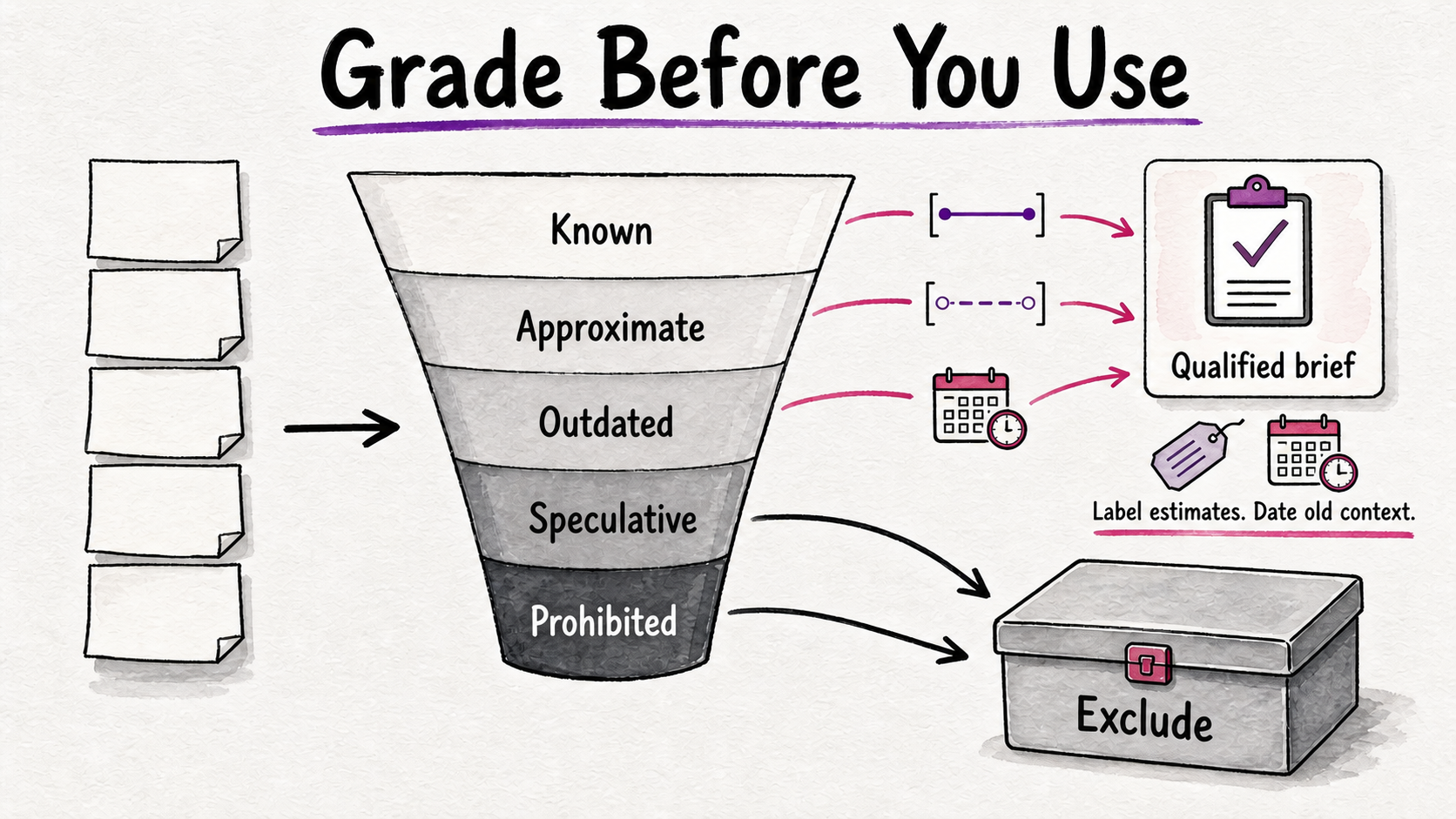
Grade Every Detail Before You Use It
Classify each detail before submission so a known nickname, approximate age, former city, and unsupported guess do not enter the brief with equal weight.
| Reliability class | Meaning | Acceptable treatment | Example |
|---|---|---|---|
| Known | Directly and reliably known | Record plainly, with a date when relevant | “Uses the name Maya Patel and the nickname May” |
| Approximate | Useful but not known exactly | Label as an estimate or range | “Approximately 35–37 years old” |
| Outdated but contextualized | Previously reliable but possibly no longer current | Retain with a date and clear limitation | “Lived in Leeds through April 2025; current city uncertain” |
| Speculative | Based on rumor, inference, or an unsupported guess | Do not present as fact or place in identity fields | “Might use another first name online” |
| Prohibited | Obtained through unauthorized, harmful, or unlawful access | Exclude completely and do not pursue | A password, login code, private message, or information taken from her phone |
Keep material contradictions visible. If apparently reliable information places her in two different cities during the same period, do not choose the location that best fits a suspicion. Check whether the dates differ and stop if the conflict cannot be explained well enough to support a fair brief.
The same principle applies to names and ages. A maiden name and current surname may both be useful when labeled correctly. Two unsupported age estimates should not be merged into a broad range merely to conceal uncertainty.
Stronger inputs may improve comparison quality, but they cannot guarantee that a profile will be found, that a possible profile belongs to your wife, or that any conduct occurred.
Choose Photos and Apps Without Overcollecting
Favor a few clear, distinct photos that you already hold responsibly. Each additional image should contribute different useful visible information, such as a different recent appearance or viewing angle. Exclude images that are heavily altered, ambiguous, unlawfully obtained, or substantially redundant.
If your only photo is unclear, do not compensate by seeking images through private access. Record the limitation and decide whether the remaining brief is still useful. Cropping tutorials, reverse-image procedures, and judgments about whether two photos show the same person are separate tasks.
Apply the same restraint to apps:
- Include Tinder when Tinder is specifically relevant.
- Include Bumble when the concern specifically involves Bumble.
- Include Hinge when Hinge is the named platform.
- If no app is known, choose a limited set rather than assuming every conceivable platform must be searched.
CheaterBusting documents Tinder, Bumble, and Hinge among its selected covered apps. It is independent of those platforms and does not claim special access to them. Confirm coverage before submission instead of assuming universal reach.
Do not create a fake profile, impersonate someone, or approach your wife through an app to test a theory. App selection defines scope; it does not authorize engagement, provocation, or direct monitoring.
Apply the Stop Rule Before You Search
The following brief is fictional and illustrates the reliability labels; it does not imply that any detail will produce a match:
- Name — known: Maya Patel.
- Nickname — known: May, regularly used by friends.
- Age — approximate: 35–37.
- Location — outdated but contextualized: Leeds, known there in spring 2026; current location unconfirmed.
- Photos — known source: Two clear, distinct portraits already held responsibly.
- Selected apps — scope choice: Tinder and Hinge because those platforms relate to the stated concern.
- Unresolved detail — speculative: A rumor that she uses another online name; excluded from the identity fields.
Proceed only when the purpose is lawful, the information is yours to use, the brief contains useful and honestly qualified details, material conflicts remain visible, and no prohibited access or conduct is necessary.
Stop when the available details are weak guesses, when identity or location information is materially contradictory, or when proceeding would require a password, login code, phone access, private-account access, private messages, impersonation, or a fake profile. Also stop if the process is becoming stalking, harassment, harmful disclosure, or unlawful surveillance.
CheaterBusting states that it uses submitted identity details with public or otherwise available information and does not require access to the subject’s passwords, private accounts, phone, or messages. Its privacy information describes these boundaries and the handling of submitted search details.
A report may contain possible matches, unconfirmed details, confidence notes, or no match. Results are not guaranteed. A possible match does not prove identity, current activity, intent, relationship status, or infidelity, while an empty result does not prove that a profile never existed.
If the brief passes the stop rule, review the methodology and then prepare one private search through the onboarding process. Move forward only while the inputs remain limited, responsibly held, and honestly labeled.
Next decision
Need broader evidence across covered apps?
Review scope, confidence limits, and pricing before starting any private search.
Continue reading
Related evidence guides
How to Check Your Partner Without Joining Dating Apps—and Know When to Stop
Choose a proportionate no-account search method, protect private information, interpret uncertain findings, and stop when further checking cannot change your decision.

How to Find Out If Your Husband Is on Dating Sites Without Joining
Compare four account-free ways to check selected dating apps, prepare only the necessary details, and assess possible matches without treating them as proof.

How to Check If Your Wife Uses Dating Apps Lawfully
Learn how to choose a proportionate search method, protect privacy, and interpret possible dating-profile matches without treating them as proof.