
How to Find Out If Your Husband Is on Dating Sites Without Joining
Compare four account-free ways to check selected dating apps, prepare only the necessary details, and assess possible matches without treating them as proof.
- Author
- CheaterBusting Team
- Reviewed
- Reviewed July 28, 2026
- Reading time
- 9 min read

In this guide
TL;DR
- You can check whether your husband may appear on dating sites without joining them through lawful public observations, exact-image retrieval, a private multi-app search, or bounded monitoring.
- Match the method to the unanswered question: current profile visibility, reuse of a particular photo, selected-app coverage, or a later visible change.
- Do not create fake accounts, impersonate anyone, access a device, use passwords or verification codes, enter private accounts, or read messages.
- A possible match is limited evidence, not proof of identity, current activity, intent, relationship status, or infidelity. No match found is not proof of absence.
Uncertainty about a spouse’s online presence can make immediate searching feel urgent, but finding a possible profile and proving conduct are very different things. A calmer approach is to define what you need to learn, choose the least intrusive method capable of addressing it, and interpret the result without turning a clue into a verdict.
Table of Contents
- Choose the question before you choose the search
- Compare four ways to check without joining
- Grade a candidate and choose a proportionate next step
- Keep the search private, lawful, and within the evidence
- FAQ
Key Takeaways
- Begin with the question that remains unanswered, not a preferred tool.
- Use only the minimum amount of lawfully available information needed to distinguish one person from another.
- Record aligned identity signals, contradictions, freshness evidence, and unknowns separately.
- Choose monitoring only when a later visible change could answer something a snapshot cannot.
- Stop at privacy, access, safety, and lawful-use boundaries.
Choose the Question Before You Choose the Search
“Is my husband on dating sites?” may refer to several narrower questions. You might want to know whether a plausible profile is visible now, whether a particular photograph appears elsewhere, whether several identifying details align across selected apps, or whether something visibly changes during a limited period.
Decide four things before searching:
- Which apps matter? Identify the dating sites or dating apps relevant to the question. Tinder, Bumble, and Hinge are examples of selected covered apps, but one app cannot represent every dating platform. Confirm the current selection on the apps covered page.
- Are you looking for presence or change? A snapshot addresses what can be found under current conditions. A bounded monitoring period is more suitable only when a later visible change would matter.
- What result would affect your next action? If neither a possible match nor no match found would change what you do, continuing may only add uncertainty.
- When will the check end? Give a snapshot or monitoring period a clear endpoint instead of searching indefinitely.
Prepare only a minimum-necessary brief: a known name or nickname, approximate age, likely city, current photos you may lawfully use, and the selected apps. These are separate identity signals, not individually decisive facts. The published methodology explains how aligned details, conflicts, missing evidence, and freshness context are considered together.
A common name may fit many people. A matching city can support another clue, while a materially different age or face can weaken a candidate. Ask how the supporting details, contradictions, and unknowns fit together—not whether one field happens to match.
Compare Four Ways to Check Without Joining
The least intrusive useful method is the one whose scope fits your question. Each of these approaches has a different purpose and evidentiary limit.
| Method | Need to join apps? | Scope | Required inputs | Effort and timing | Recurring cost exposure | Evidentiary limit |
|---|---|---|---|---|---|---|
| Lawful manual observations | Not necessarily | Public or otherwise lawfully available information | A clear identity brief and relevant apps | Can be incomplete and time-consuming; generally a snapshot | Usually none beyond your time | A visible profile does not establish who controls it, when it was used, or why it exists. |
| Exact-image retrieval | No dating-app account required | Looks for indexed copies of the same image file | A lawfully available photo | Usually a one-time task | Often no recurring cost | An exact hit supports image reuse, not identity or dating activity. No indexed result does not establish that no profile exists. |
| Private multi-app search | No | Compares several identity signals across selected covered apps | Name or nickname, approximate age, likely city, photos, and selected apps | Produces a consolidated private report | A service cost may apply | A candidate remains a possible match. Confidence notes describe signal agreement, not guilt or a guaranteed probability. |
| Bounded monitoring | No | Repeats supported checks during a defined active period | The same focused identity details and selected apps | Extends beyond the initial snapshot | Recurring billing may apply during the selected period | Monitoring may reveal a later visible change but cannot establish who caused it or why. Review the current plan terms for monitoring duration, billing cadence, renewal, and cancellation. |
CheaterBusting is the private multi-app search and monitoring option in this comparison. It uses public or otherwise available information to check selected covered apps and provide a private report containing confidence notes and unresolved details. It does not provide entry into private dating accounts or messages.
If you only need to learn whether the identical photo appears elsewhere, exact-image retrieval is the narrower fit. If you need several details compared across selected apps, a private multi-app search is better shaped for the question. If only a future visible change would matter, use a fixed monitoring period with a defined endpoint.
Grade a Candidate and Choose a Proportionate Next Step
Assess a candidate through four separate records before assigning any result class:
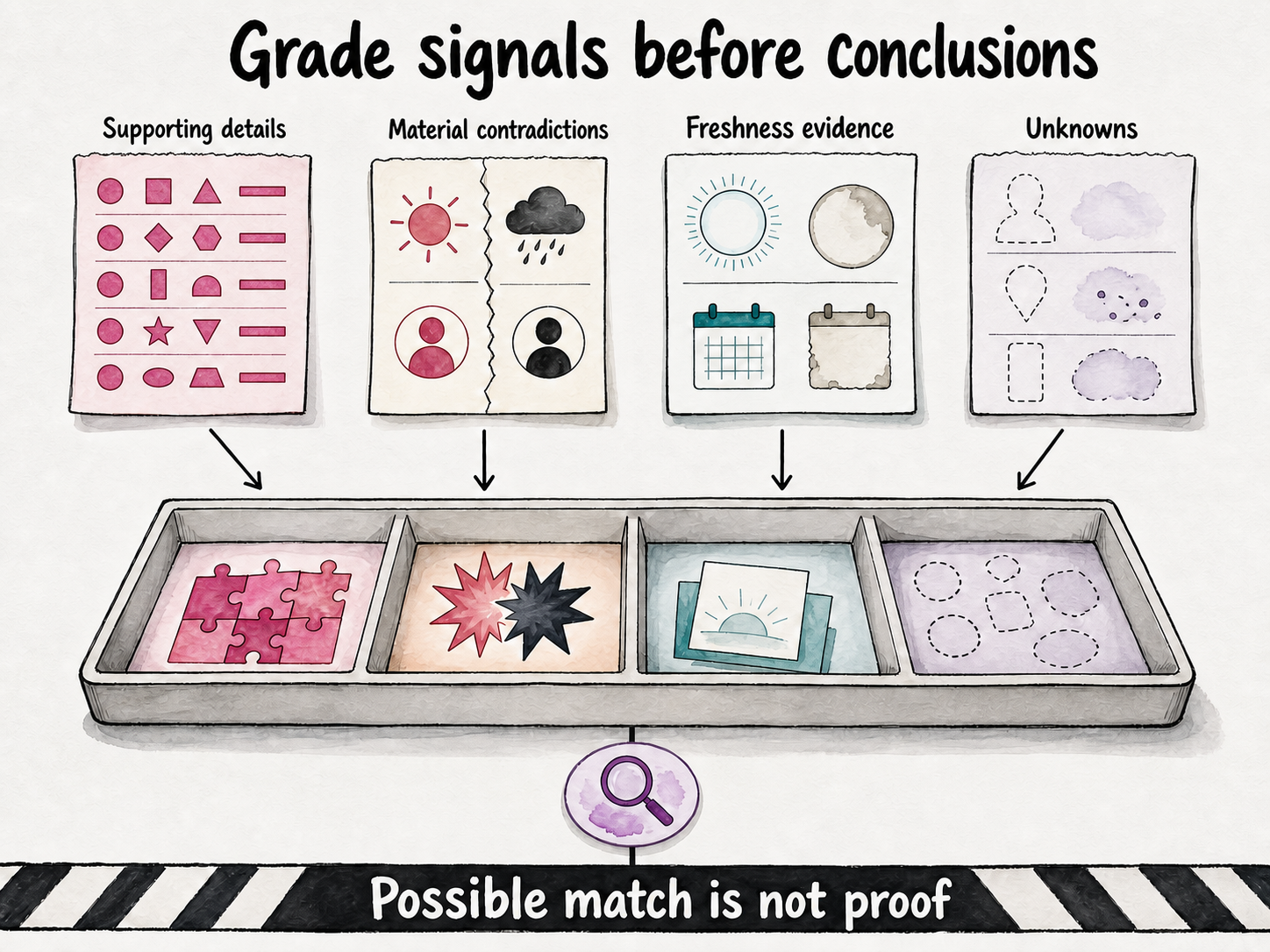
- Supporting identity details: Which names, nicknames, age details, locations, facial features, or photos align?
- Material contradictions: Which details conflict strongly enough to indicate a different person?
- Freshness evidence: Is there dependable, dated evidence of a visible change, or only an undated profile view?
- Unknowns: Which important facts could not be confirmed?
Suppose a profile uses your husband’s known nickname and a distinctive current photo, but its listed age conflicts and the city is only a partial match. Nothing dependable shows when the profile was created, changed, or controlled. Record the nickname and photo as support, the age as a contradiction, the city as uncertain, and freshness as unknown. That produces a conflicting or insufficient candidate—not a verdict. A sample report illustrates why the individual fields, conflicts, confidence, and uncertainty should remain visible.
Confidence notes are review aids. They describe how well the available signals agree and where contradictions or missing evidence weaken a candidate; they are not probabilities of guilt or guarantees of identity.
| Result class | What it means | One proportionate next action |
|---|---|---|
| Stronger alignment | Several distinctive details agree without a major unresolved contradiction | Review the full report and its limitations before deciding what the information changes. |
| Conflicting candidate | Some signals align, but a material detail points toward a different person | Verify that contradiction through a lawful, independent source without explaining it away. |
| Insufficient evidence | The available details are too common, incomplete, or uncertain | Correct a genuinely inaccurate input once, or retain the uncertainty and stop. |
| No match found | No sufficiently supported candidate was located within the available coverage and timing | Review the inputs and coverage, then avoid treating absence as proof. See what no match found means for the result’s limits. |
A possible match does not prove that the profile belongs to your husband. Even strong identity alignment does not establish present activity, account control, intent, relationship status, or infidelity. No match found means no sufficiently supported match was located under the available coverage and timing; it does not prove that no profile exists or ever existed.
Keep the Search Private, Lawful, and Within the Evidence
Use only accurate details necessary for the defined question, store them carefully, and stop when further searching would not resolve a meaningful unknown. The service’s privacy policy describes how submitted identity details and photos are used to compare against public or otherwise available profiles and build a report.
Never use your husband’s password, unlocked device, verification code, private account, or messages. Do not impersonate anyone, create a fake identity, stalk, harass, threaten, conduct unlawful surveillance, or use a result to cause harm. Consult the acceptable-use policy before proceeding, and stop if the next step would cross any access, privacy, safety, or lawful-use boundary.
FAQ
Can I check whether my husband is on dating sites without joining?
Yes. Account-free options include lawful public observations, exact-image retrieval, a private multi-app search, and bounded monitoring. Each answers a different question, and none justifies fake profiles, impersonation, credentials, or device access. The partner-search overview provides the broader spouse-focused context.
What details are needed?
Use only a known name or nickname, approximate age, likely city, current photos you may lawfully use, and the selected apps. Accurate, distinctive, necessary information is more useful than collecting unnecessary personal data.
Does a possible match prove it is him or prove cheating?
No. A possible match shows only that some available identity details align. It cannot by itself prove identity, present activity, account control, intent, relationship status, or infidelity.
What does no match found mean?
It means no sufficiently supported match was found within the available apps, information, visibility, and timing. It is not proof that no profile exists, that none ever existed, or that your husband is loyal.
Will my husband be notified?
CheaterBusting states that it does not contact, message, warn, or notify the person checked and does not attach the customer’s name to the search. That does not remove the customer’s responsibility to use the service lawfully and proportionately.
What should I do next?
Choose only the step that fits your unanswered question: review the matching method above, inspect the linked sample report, or start my private multi-app search with a defined scope and endpoint. The purpose is to obtain a limited, better-organized piece of information—not certainty the evidence cannot provide.
Next decision
Need broader evidence across covered apps?
Review scope, confidence limits, and pricing before starting any private search.
Continue reading
Related evidence guides

Dating App Search Details for a Wife: Build a Minimum-Necessary Brief
Prepare a focused search brief using reliable identity details, a time-qualified location, responsibly held photos, and only relevant dating apps.
How to Check Your Partner Without Joining Dating Apps—and Know When to Stop
Choose a proportionate no-account search method, protect private information, interpret uncertain findings, and stop when further checking cannot change your decision.

How to Check If Your Wife Uses Dating Apps Lawfully
Learn how to choose a proportionate search method, protect privacy, and interpret possible dating-profile matches without treating them as proof.