
Happn Profile Search: Assess a Possible Match Carefully
Learn how Happn profile discovery works, how to assess identity and freshness, and how to choose a proportionate, lawful next step.
- Author
- CheaterBusting Team
- Reviewed
- Reviewed July 30, 2026
- Reading time
- 11 min read
In this guide
TL;DR
- No, Happn does not provide a direct search that retrieves a chosen person by name. Its documented tools surface profiles through recommendations, proximity, shared preferences, crossed paths, and the Map.
- Separate three questions: how a candidate was discovered, whether the identity details align, and how fresh the evidence is.
- A visible profile, crossing point, or possible match does not prove current activity, intent, relationship status, or cheating.
- No result means only that no supported candidate surfaced within the relevant scope, timing, and inputs—not that no profile exists or ever existed.
- Record matches, conflicts, unknowns, and dates, then choose the smallest lawful action that could resolve one material uncertainty.
You may have a familiar name, a screenshot, and a location clue that feels too specific to ignore. Treat them as separate pieces of information: candidate discovery describes how the record surfaced, identity alignment asks whether several details point to the same person, and evidence freshness asks when the record was observed or changed. Keeping those questions separate lets you assess a possible profile without turning uncertainty into an accusation.
Table of Contents
- Can you search for a specific person on Happn?
- Test discovery, identity, and freshness separately
- Apply the location-time-identity matrix and stopping rule
- Choose the smallest lawful next step
- FAQ
Key Takeaways
- Discovery is not identification. Surfacing a candidate establishes where a record appeared, not who controls it.
- Identity alignment is not freshness. Even strong identity similarities do not establish when a profile was accessed or changed.
- Freshness is not intent. A recent observation or documented change cannot establish motives, relationship status, or cheating.
- Provenance and dates matter. Record where each clue came from, when it was observed, and when you received it.
- Contradictions stay visible. An unexplained age, city, or photo conflict should not be averaged away by several weak similarities.
- Broaden only for app uncertainty. Checking selected apps is proportionate when the identity inputs are useful but the relevant app remains unknown.
Can You Search for a Specific Person on Happn?
No—not through a direct named-person lookup. Happn’s current Terms describe profiles as automatically selected according to factors such as search preferences, profile activity, member characteristics, favorite places, and location. Its Help Center says that someone can appear on your Home Page when that person is connected, close to you, and shares your preferences. Neither process lets you enter a chosen person’s name and retrieve that account (Happn Terms of Service, Happn Help Center).
Happn also lets members revisit profiles connected with crossed paths. The Home Page presents crossed-path profiles chronologically, while the Map filters them by place. These are discovery tools for profiles Happn has already surfaced; they are not a universal directory or a name search (finding crossed-path profiles).
A profile can therefore appear without a deliberate search for that individual, and a specific person may fail to appear even when you expect them to. Official guidance ties appearance to conditions such as account use, proximity, shared preferences, and Happn’s recommendations. The absence of a profile from your Home Page or Map cannot settle whether an account exists.
Classify the record you have before interpreting it:
| Evidence source | Origin and date to record | Identity value | Freshness limit |
|---|---|---|---|
| Direct in-app discovery | Who observed it, where it appeared, and the observation time | Preserves visible profile details for comparison | Visibility at one time does not establish later access or changes |
| Dated screenshot or secondhand sighting | Original observer, capture date, receipt date, and whether context was cropped | May preserve a name, age, photo, or other visible detail | The receipt date is not necessarily the capture date |
| Web result | Publishing or indexing source and any visible date | May provide a clue for comparison | It may be stale, incomplete, misidentified, or unrelated to Happn’s in-app discovery tools |
| Private multi-app report | Submitted inputs, apps checked, report date, and stated confidence or conflicts | Can organize several available identity signals | Its value remains limited by inputs, coverage, available information, and timing |
For every source, record both the observation date and the date you received or found it when possible. A screenshot sent today may have been captured months earlier. An undated result has little value for deciding whether anything is current.
The source also affects identity value. Direct observation preserves more context than a verbal description, but it still cannot prove who controls a profile. A private report can organize aligned details, conflicts, missing information, and freshness context; its confidence note remains an assessment rather than a verdict (methodology).
Test Discovery, Identity, and Freshness Separately
A careful Happn profile search assessment has three passes. Complete them in order so that one emotionally powerful clue does not answer a question it cannot support.
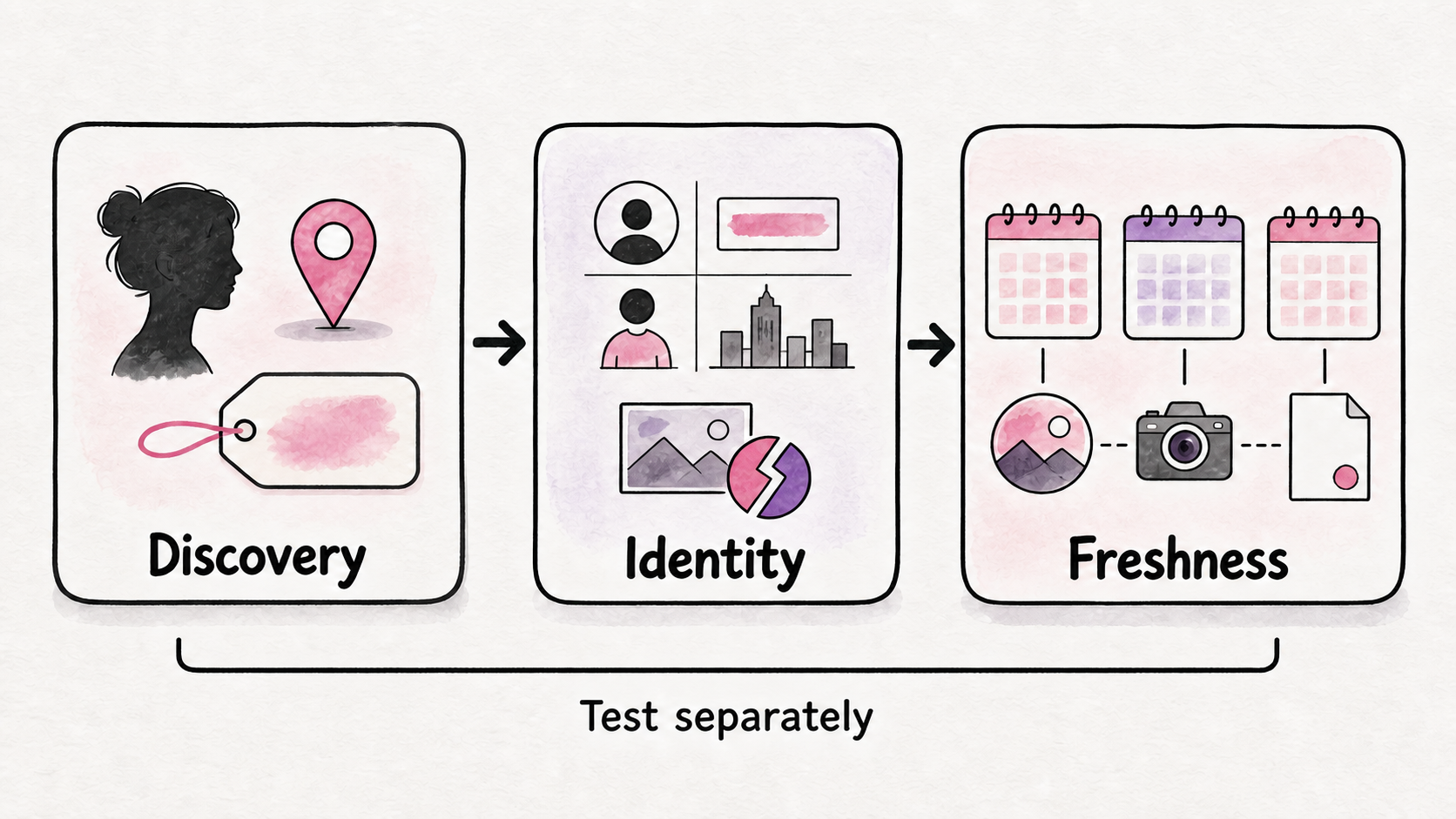
1. Candidate discovery: What surfaced, where, and through whom?
Record whether the candidate appeared directly in Happn, in a screenshot, through a secondhand description, in a web result, or in a private report. Note the observer, the surrounding context, and all available dates.
Happn says its Home Page can show crossed-path profiles when preferences are mutual, as well as profiles within a wider area when few users are nearby. The Map is specifically for profiles connected with crossed paths (Home Page profiles, Happn Map). Consequently, appearance on the Home Page alone does not establish that two people crossed paths.
2. Identity alignment: Do several independent details point to the same person?
Consider the details together:
- Name or nickname: A distinctive known nickname may be useful; a common first name is weak by itself.
- Age: Alignment can support a candidate. A material discrepancy remains a conflict unless there is a credible explanation.
- City: A consistent city adds context, but relocation, travel, broad location labels, or stale information may make it ambiguous.
- Photos: A clear, familiar image can be significant when other details also align. A blurred, old, filtered, or generic image should not carry the assessment alone.
- Location context: Overlap may justify further review, but proximity cannot prove identity.
Independent agreement matters. A common first name and a large city may add little; a known nickname, compatible age, recognizable photo, and consistent city are more informative if no material conflict is being ignored. Confidence should describe agreement among signals, not a probability or guarantee (confidence scoring).
Happn’s profile-certification badge has a narrower meaning: the company says it compares a member’s face with their profile photos. It does not establish the truth of every profile detail or answer questions about current use, intent, or relationship status (Happn Privacy Policy).
3. Evidence freshness: What is actually dated or documented to change?
Separate identity from timing. Record the observation date, the capture date when known, and any visible change documented between comparable observations. A different photo or changed visible detail may support only the conclusion that something changed between two dates. It does not identify who made the change or why.
Happn says a “Now” label means the viewer and profile are currently crossing paths and close to one another, without revealing exact distance. That label supports a narrow proximity observation at that moment; it does not prove identity, account control, intent, or continuing activity afterward (Happn’s “Now” explanation).
Profile visibility by itself does not prove recent use. Nor can visibility, location overlap, or a well-aligned identity establish exclusivity, relationship status, or cheating. Private-search results likewise carry limits on accuracy, completeness, and timeliness and should not be treated as proof of behavior (terms).
Apply the Location-Time-Identity Matrix and Stopping Rule
Use this qualitative worksheet to preserve what each clue contributes. It is an assessment aid, not a numerical score or an official Happn tool.
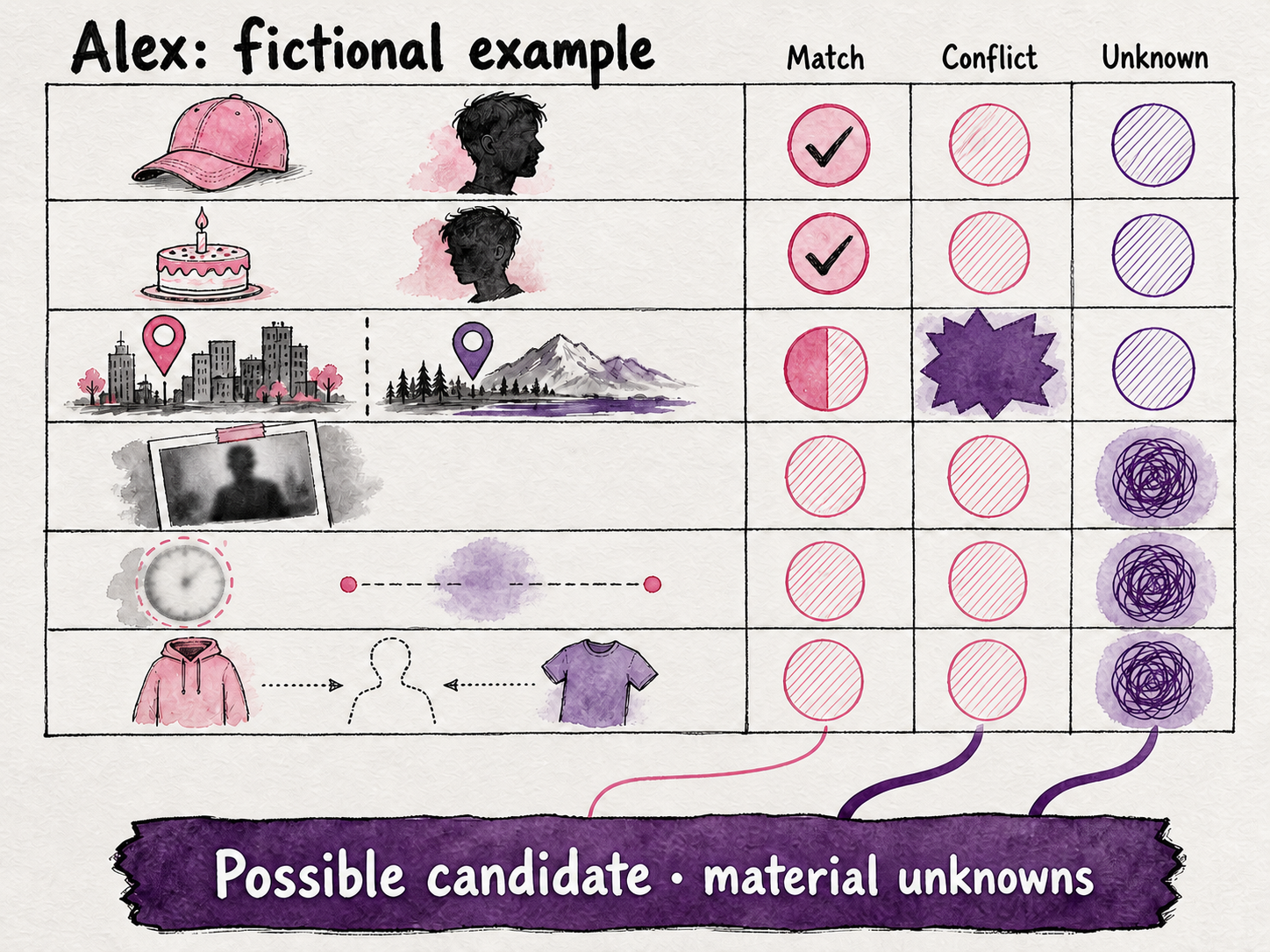
The following case is fictional and illustrative. “Alex” does not represent a customer or real searched person.
| Clue | Source | Source or observation date | Match | Conflict | Unknown | What the clue can establish |
|---|---|---|---|---|---|---|
| Nickname “Lex” | Screenshot sent by a friend | Received July 12; capture date unknown | ✓ | A known nickname appears on the candidate | ||
| Age 34 | Same screenshot | Capture date unknown | ✓ | The displayed age aligns with the approximate known age | ||
| City or location context | Friend’s description | Reported July 12 | Partial | ✓ | The broad area overlaps, but the stated city differs | |
| Photo | Cropped screenshot | Capture date unknown | ✓ | The image is too unclear for a reliable comparison | ||
| Observation time | Friend’s message | July 12 | ✓ | The message is dated; the original sighting is not | ||
| Visible changes | No comparable second record | — | ✓ | No change can be established |
Review contradictions first, rather than counting checkmarks. The city conflict might have an ordinary explanation, but none is documented. The undated capture and unclear photo also leave identity and freshness unresolved. The appropriate conclusion is possible candidate with material unknowns, not “confirmed profile.”
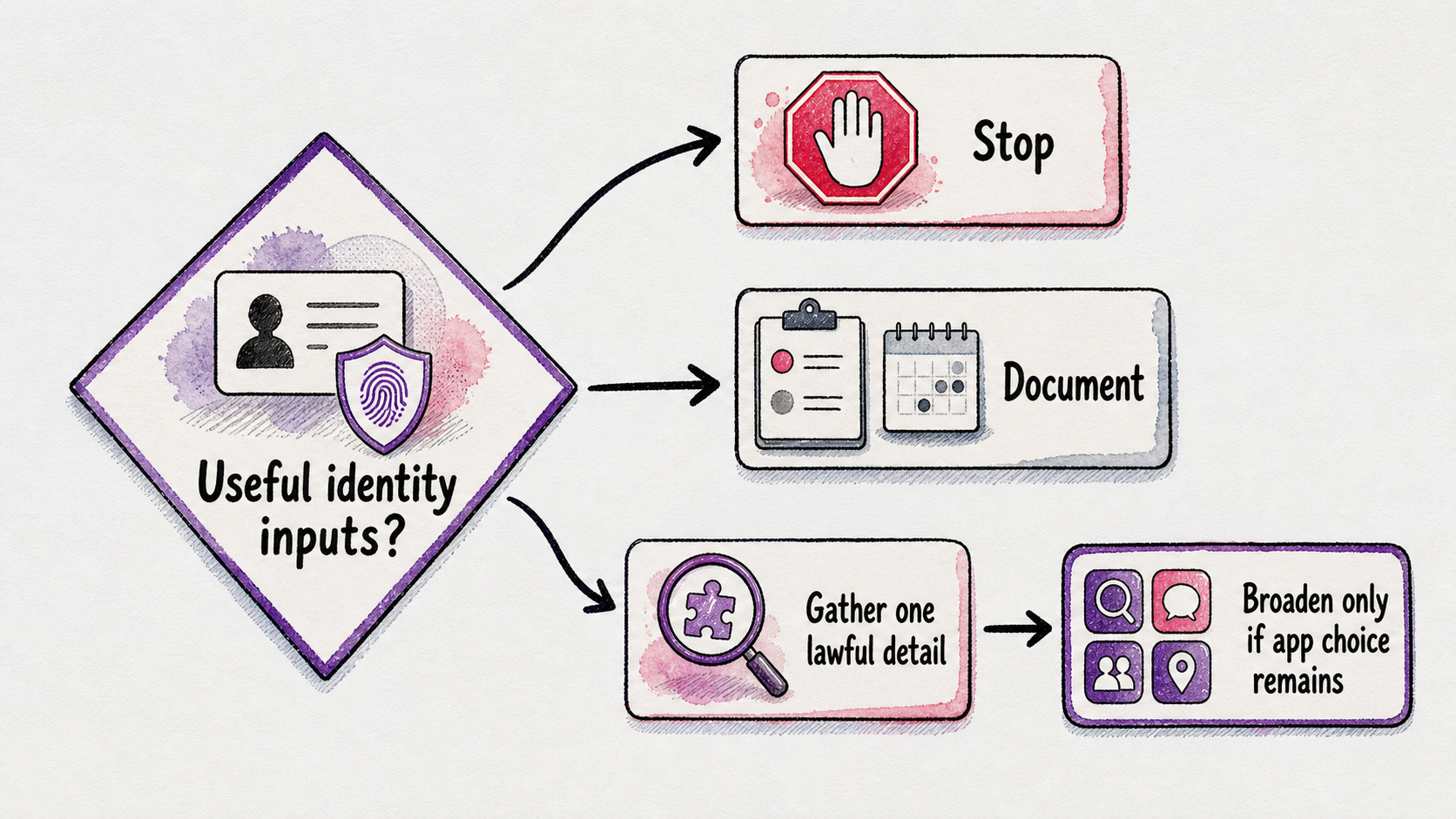
Map the completed worksheet to one action:
- Stop when a material contradiction remains, the source is unreliable, or more checking would not change a responsible decision. Stop as well if proceeding would require deception or access to private information.
- Document when the observation is relevant but incomplete. Preserve the original record, its source, and its dates without adding conclusions it cannot support.
- Gather one lawful detail when a specific input could resolve the main uncertainty. That might be a confirmed age, a known nickname, a clearer lawfully available photo, or the original screenshot date.
- Broaden the search only when identity inputs are reasonably useful and uncertainty about the relevant app is the remaining problem. More apps cannot repair weak or contradictory identity evidence.
Repeated checking can feel productive without adding independent information. Ten views of the same undated screenshot remain one undated source. Repeating a search with unchanged weak inputs is also unlikely to address the original weakness. A nothing-found outcome remains limited by the information, timing, and coverage involved (no-match guidance).
Choose the Smallest Lawful Next Step
Repeatedly checking Happn may not resolve uncertainty about whether a person appears on a different dating app. If the matrix shows useful identity alignment but leaves app choice as the principal unknown, one bounded search across selected apps may be more proportionate than repeating the same manual check.
CheaterBusting accepts inputs such as a name or nickname, age, city, and photos. Its private report may contain possible matches, confidence notes, unconfirmed details, monitoring updates during an active paid period, or a nothing-found result (homepage, plan inclusions).
Neither outcome is proof. A possible match requires interpretation, while nothing found means no supported match appeared within the selected apps, submitted inputs, timing, and available information. It does not establish that no profile exists or ever existed.
Keep every step lawful and bounded. Do not seek passwords, login codes, device access, private accounts, or messages. Do not impersonate anyone, intercept communications, track movements, harass, threaten, or disclose findings to cause harm (acceptable-use policy).
The service states that it uses public or otherwise available information and does not require access to the searched person’s phone, messages, or private accounts (privacy policy). Treat it as an independent private-search service, not as Happn or a source of special access to Happn.
Before proceeding, state the precise question another search could answer. If the question is whether a city conflict can be resolved, gather that lawful detail first. If useful identity details exist and the question is whether they align on another selected app, a bounded private report may fit. Set a review date and stopping rule before you start my private search.
FAQ
Can you search Happn by name?
No. Happn’s documented discovery system automatically surfaces profiles using factors such as preferences, characteristics, activity, favorite places, location, and crossed paths. It does not provide a direct field for entering a chosen person’s name and retrieving that account. The Home Page and Map can help you revisit profiles Happn has surfaced, but they are not named-person lookup tools.
What makes a possible Happn match more credible?
Several independent details should align, such as a known name or nickname, compatible age, relevant city context, and a sufficiently clear photo. Retain every conflict and unknown. A material unexplained contradiction can leave identity unresolved even when several weaker details match.
Does finding a profile mean it is active?
No. Finding a profile establishes only that it was observable through a particular source at a particular time, if that time is known. Visibility does not establish recent access, who controls the account, why it appeared, relationship status, or cheating.
What does no result mean?
It means no supported match was found within the search’s scope, timing, supplied identity details, and available information. It does not prove that no profile exists, that none ever existed, or that one could not appear later.
When should someone check multiple apps instead?
Consider a selected-app search when useful identity inputs exist but the remaining uncertainty concerns which dating app may be relevant. If the name, age, city, or photo evidence is weak or contradictory, correct one lawful input or stop first. Searching more apps does not convert poor identity evidence into a reliable match.
Next decision
Need broader evidence across covered apps?
Review scope, confidence limits, and pricing before starting any private search.
Continue reading
Related evidence guides
Can You Search Bumble Without an Account? What Manual Checks Miss
Bumble does not offer a specific-person search. Compare lawful discovery routes and learn why neither a possible match nor an empty result is proof.
Raya Profile Search: Assess Source, Match, and Freshness
Evaluate a possible Raya profile by separating source quality, identity alignment, freshness, conflicts, and the next lawful step.
Can You Search Raya by Name? How to Test the Clue
Learn what Raya officially documents about name search, how to assess a claimed result, and when a name clue is strong enough to pursue.