
Can You Search Raya by Name? How to Test the Clue
Learn what Raya officially documents about name search, how to assess a claimed result, and when a name clue is strong enough to pursue.
- Author
- CheaterBusting Team
- Reviewed
- Reviewed July 23, 2026
- Reading time
- 10 min read
In this guide
TL;DR
- No—not as an officially documented capability. As of August 5, 2026, Raya’s public official documentation does not describe a feature that lets someone enter a person’s name to retrieve that profile.
- Raya references discovery functions, including a Directory search, but does not publicly define that function as direct people-by-name lookup. Do not treat the word “search” as proof of a name-search feature.
- A documented in-app feature is not interchangeable with a web result, an old screenshot, or an unsupported third-party lookup claim.
- Test a name or nickname for provenance, distinctiveness, and currency before deciding whether it deserves further attention.
- No result does not prove that no Raya profile exists or ever existed. Age, city, and suitable lawfully available photos can add context, but they are not proof.
You may have a name from a screenshot, a web result, or someone who says they found a Raya profile. That can feel specific while still leaving two separate questions unanswered: whether the claimed method represents a real platform capability and whether the name meaningfully identifies anyone. Keeping those questions separate helps you evaluate the clue without turning uncertainty into an accusation or false reassurance.
Key Takeaways
- Check current official Raya documentation before trusting any claim about how Raya can be searched.
- Raya does not publicly document direct people-by-name lookup as a current capability.
- Classify the source before evaluating the name attached to it.
- Set aside a common, stale, unexplained, or poorly sourced name.
- Treat a missing result as inconclusive, not as evidence of absence or loyalty.
- Continue only when several lawfully obtained details could corroborate the clue.
Can You Search Raya by Name? Start With the Source
The direct answer is no—not as a capability established by Raya’s current public documentation. Raya’s official materials reference discovery functions and a Directory search, but they do not state that a user can enter a person’s name and retrieve that person’s profile. A directory may support many kinds of discovery, so its existence cannot be expanded into a people-by-name claim without an official description saying so.
This is a conclusion about what Raya publicly documents, not a claim that every version of the app works identically for every member. Raya’s terms note that some features may vary by factors such as user segment, location, preferences, and testing. The defensible conclusion remains narrow: direct name lookup should not be presented as a documented Raya feature.
That distinction matters because “I searched Raya by name” can describe several very different events:
| Source type | What it could establish | What it does not establish |
|---|---|---|
| Documented in-app feature | The platform officially describes a control and its intended function | That a vaguely described directory or discovery tool accepts names |
| Web result | A search engine associated a query with a page, image, or text fragment | That the result came from Raya’s current app or belongs to the person in question |
| Dated screenshot | A screen displayed certain information when the image was captured | That the image is authentic, complete, current, or correctly attributed |
| Third-party lookup claim | A person or service reports that it performed a check | The method, coverage, timing, access, accuracy, or identity of a possible match |
A web page containing a person’s name near the word “Raya” is not automatically a Raya name-search result. Search engines can connect words drawn from unrelated, incomplete, or outdated material. The result establishes only that the search engine returned the item for that query.
A screenshot also needs careful boundaries. Keep the capture date separate from the date when the image was received or found. An image shared today could depict an earlier observation. If the capture date is unknown, the image cannot safely support a present-tense claim. Raya’s terms also prohibit taking or sharing screenshots from the app, which is another reason not to treat a circulated image as a routine or authoritative search method.
A third-party claim should be judged by what the provider actually says it checks. A name field, polished report, or confident label does not establish special access to Raya or prove that the service used an official name-search feature. It also does not establish that a possible profile belongs to a particular person.
Run the Name Through a Capability-and-Clue Gate
Evaluate the method before evaluating the apparent match. This capability gate prevents a familiar name from making a weak source appear stronger than it is.
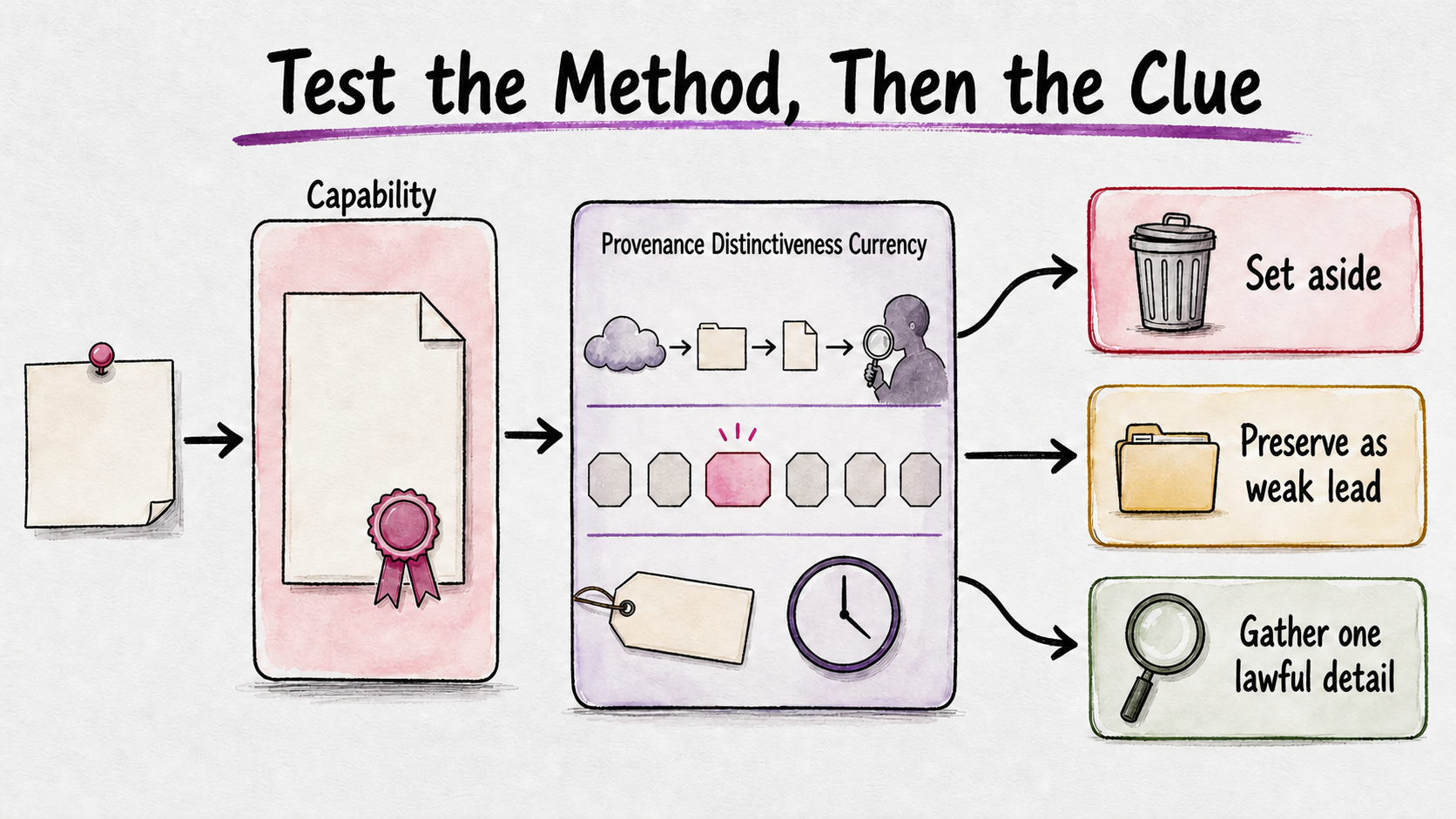
First ask whether the clue came from a current function that Raya officially describes. If someone merely says they used “search,” determine whether they mean an in-app function, an ordinary web query, a screenshot, or an independent service. Do not assume that these methods have the same scope or reliability.
If the capability is unclear, the item can be preserved as an unverified lead, but it should not be described as a Raya name-search match. Then test the name itself on three points:
-
Provenance: Who observed or produced the clue, and through what source? A clearly explained observation has better provenance than a copied image or unsupported assertion. Provenance does not make the clue true, but it tells you what can and cannot be checked.
-
Distinctiveness: How much does the name narrow the possible candidates? A common first name usually contributes little by itself. A distinctive nickname may contribute more if you already know the person uses it. An unusual but unfamiliar nickname is not identifying merely because it stands out.
-
Currency: When was the underlying information observed or collected? Use the observation or capture date, not the date the clue reached you. If the date is missing, treat the clue as unable to establish anything about the present.
Consider a hypothetical illustration: someone forwards an undated image displaying the first name “Alex” and says it came from Raya. The origin is unclear, the name is common, and the observation date is missing. The sensible decision is to set the clue aside. Recognizing the name does not repair those weaknesses.
In another hypothetical, a reliable first-hand account includes a clear observation date and a distinctive nickname you already know the person uses. That may justify gathering one corroborating detail. It still does not establish who created or controlled a possible profile, whether it remains current, how it was used, or what anyone intended.
The gate should produce one of three restrained decisions:
- Set the clue aside when the claimed capability is unsupported or the name is common, stale, or poorly sourced.
- Preserve it as a weak lead when part of the origin is known but the clue cannot be corroborated.
- Gather one lawful corroborating detail when the source is credible, the name is meaningfully distinctive, and the observation is current enough to matter.
A name match alone proves none of identity, account control, current activity, intent, or infidelity. It is one possible identifying signal, not a conclusion.
Why No Name Result Does Not Rule Out a Raya Profile
A missing result describes the outcome of a particular check within its available scope and timing. It does not reconstruct a person’s complete profile history, and it cannot establish that a profile is absent now or never existed.
The same logical limit applies to a web search or an independent service. Each method can report only what it was able to examine. Without evidence, do not assign a reason for a missing result. A no-result screen does not by itself show that a profile was deleted, paused, hidden, overlooked, or never created.
Raya’s official terms describe controls that can prevent new members from seeing a profile, including a hide feature and paused account status. Those documented controls demonstrate why visibility and existence are separate concepts, but they do not explain any particular missing result. You would need specific evidence before attributing an outcome to either setting.
The emotional conclusion must remain just as narrow. “Nothing found” is not evidence of loyalty, just as a possible match is not proof of infidelity.
CheaterBusting applies similar limits to its own reports. Its sample-report guidance distinguishes “no supported match found” from the much broader claim that a person has no dating profile. Its published limitations also say that a result is not guaranteed and that an empty result does not prove a profile never existed. Review the result limitations.
A single check is a snapshot of what was available to that method at that time. Repeating the same weak query may reproduce the same limited observation rather than strengthen the conclusion. If another check would not change your decision, pause instead of treating repeated absence as accumulating proof.
When a Name Clue Is Strong Enough to Pursue
A name clue may deserve broader assessment when it can be compared with several independent, lawfully obtained details. Useful context can include:
- a known name or nickname with a credible origin;
- an approximate age that helps distinguish plausible candidates;
- a relevant city or location context; and
- suitable photos that are lawfully available and clear enough for careful comparison.
This is a threshold for further assessment, not a complete identity test. Broad alignment may justify another careful step. A material conflict—such as an implausible age or unrelated city—reduces the clue’s value and may be a reason to stop. Missing information should remain marked as missing rather than quietly converted into agreement.
Use only images you already possess or can lawfully access. Clear and reasonably current photos offer more context than blurry group shots, distant figures, heavily altered images, or pictures from many years ago. Even a strong resemblance should not carry the conclusion by itself.
CheaterBusting is one independent option after a clue reaches this threshold. It lists Raya among selected covered apps and describes checks involving a name or nickname, city, age, photos, and recent activity or updates. It also states that it is independent of the covered platforms and receives no special access. Review its covered-app approach.
The service says it compares submitted details with public or otherwise available dating-app profiles; it does not request passwords or access private accounts, phones, or messages. Its reports provide possible matches, confidence notes, conflicts, and information that could not be confirmed. These are aids for interpreting uncertainty, never verdicts about identity, account control, present activity, intent, or cheating. See how the matching process is described.
Before continuing, ask what each possible outcome would change. If a possible match and a nothing-found report would both be treated as proof of an existing belief, another search is unlikely to resolve the underlying uncertainty. Evidence is useful only when its limits will be respected.
The defensible stopping rule is simple: set aside weak or conflicting clues; preserve uncertain ones without escalating them; and pursue broader assessment only when a credible name, plausible age, relevant city, and suitable lawfully available photos can be compared together. Whatever the result, keep the conclusion no broader than the evidence supports.
Next decision
Need broader evidence across covered apps?
Review scope, confidence limits, and pricing before starting any private search.
Continue reading
Related evidence guides
Can You Search Bumble Without an Account? What Manual Checks Miss
Bumble does not offer a specific-person search. Compare lawful discovery routes and learn why neither a possible match nor an empty result is proof.
Raya Profile Search: Assess Source, Match, and Freshness
Evaluate a possible Raya profile by separating source quality, identity alignment, freshness, conflicts, and the next lawful step.

Happn Profile Search: Assess a Possible Match Carefully
Learn how Happn profile discovery works, how to assess identity and freshness, and how to choose a proportionate, lawful next step.