
How to Check If Your Wife Uses Dating Apps Lawfully
Learn how to choose a proportionate search method, protect privacy, and interpret possible dating-profile matches without treating them as proof.
- Author
- CheaterBusting Team
- Reviewed
- Reviewed July 28, 2026
- Reading time
- 9 min read

In this guide
TL;DR
- Check only public or otherwise available information. Do not obtain passwords or login codes, access her phone or private accounts, or read private messages.
- Create a minimum-necessary search brief using reliable details rather than guesses.
- Compare manual checking, a private multi-app snapshot, and ongoing monitoring by app scope, effort, timing, billing, and evidentiary limits.
- Keep profile presence separate from visible freshness: finding a candidate does not establish recent activity.
- A possible match and a nothing-found result are both bounded evidence, not verdicts about identity, intent, or infidelity.
Wondering whether your wife uses dating apps can make an ambiguous detail feel more conclusive than it is. A proportionate approach begins by defining the question, selecting the least intrusive method capable of addressing it, and recording what the result supports, contradicts, or leaves unknown—without assuming misconduct.
Table of Contents
- Key Takeaways
- Start With Four Questions and a Minimum-Necessary Search Brief
- Choose the Smallest Method That Can Answer the Question
- Classify the Result Without Turning It Into a Verdict
- Keep the Search Private, Proportionate, and Lawful
- FAQ
Key Takeaways
Several independent signals should be weighed together. A familiar first name is weak by itself; an expected city, approximate age, known nickname, and recognizable photos can provide more useful identity context when they align.
Profile presence and visible freshness are different questions. Presence means that a candidate profile surfaced. Visible freshness means observable activity or update context suggests recency, when that information is available. A surfaced profile without dependable timing does not establish current use.
Monitoring adds time coverage, not certainty. It repeats supported checks during a defined period but cannot guarantee discovery or establish who controlled a profile, why it existed, or what someone intended.
Contradictions and unknowns must remain visible. If photos and city align but a reliable age conflicts, record the conflict instead of explaining it away. Likewise, nothing found is not proof of absence; it only describes the result within the available apps, details, and timing.
Start With Four Questions and a Minimum-Necessary Search Brief
Searching before deciding what a result would mean invites confirmation bias. Write down four questions first:
- Which selected covered apps are relevant? If the concern names one app, that may be the proportionate scope. If several apps genuinely matter, confirm which platforms are included on the current apps-covered page. Do not assume that every dating platform is searchable.
- Which identity details are reliable? Separate known information from guesses. Useful details can include an accurate name or known nickname, approximate age, likely city, and current photos you may lawfully use.
- Is the question profile presence or visible freshness? Profile presence means a candidate surfaced. Visible freshness means observable activity or update context is available. Presence alone does not establish current use.
- Which result would change the next action? Decide whether you need to distinguish stronger alignment from coincidence, recognize insufficient evidence, or observe whether something changes later. If every outcome would lead to indefinite checking, the search is not adequately bounded.
Turn those answers into a minimum-necessary brief: accurate name or known nickname, approximate age, likely city, current lawfully available photos, and only the selected apps relevant to the concern. Do not fill missing information with speculative nicknames, uncertain locations, or invented dates.
CheaterBusting’s multi-app identity methodology explains how multiple details can be reviewed together while conflicts, missing information, and freshness context remain distinct. Its partner-search page is the starting point for readers considering that service route.
Accuracy matters more than volume. Extra but unreliable information can widen the candidate pool without making identification clearer. Label uncertain details as uncertain, and review the onboarding information before submitting anything so the chosen scope and required inputs are clear.
Choose the Smallest Method That Can Answer the Question
Choose a method according to how many apps matter, whether one point in time is enough, how much work is reasonable, and what billing commitment is involved.
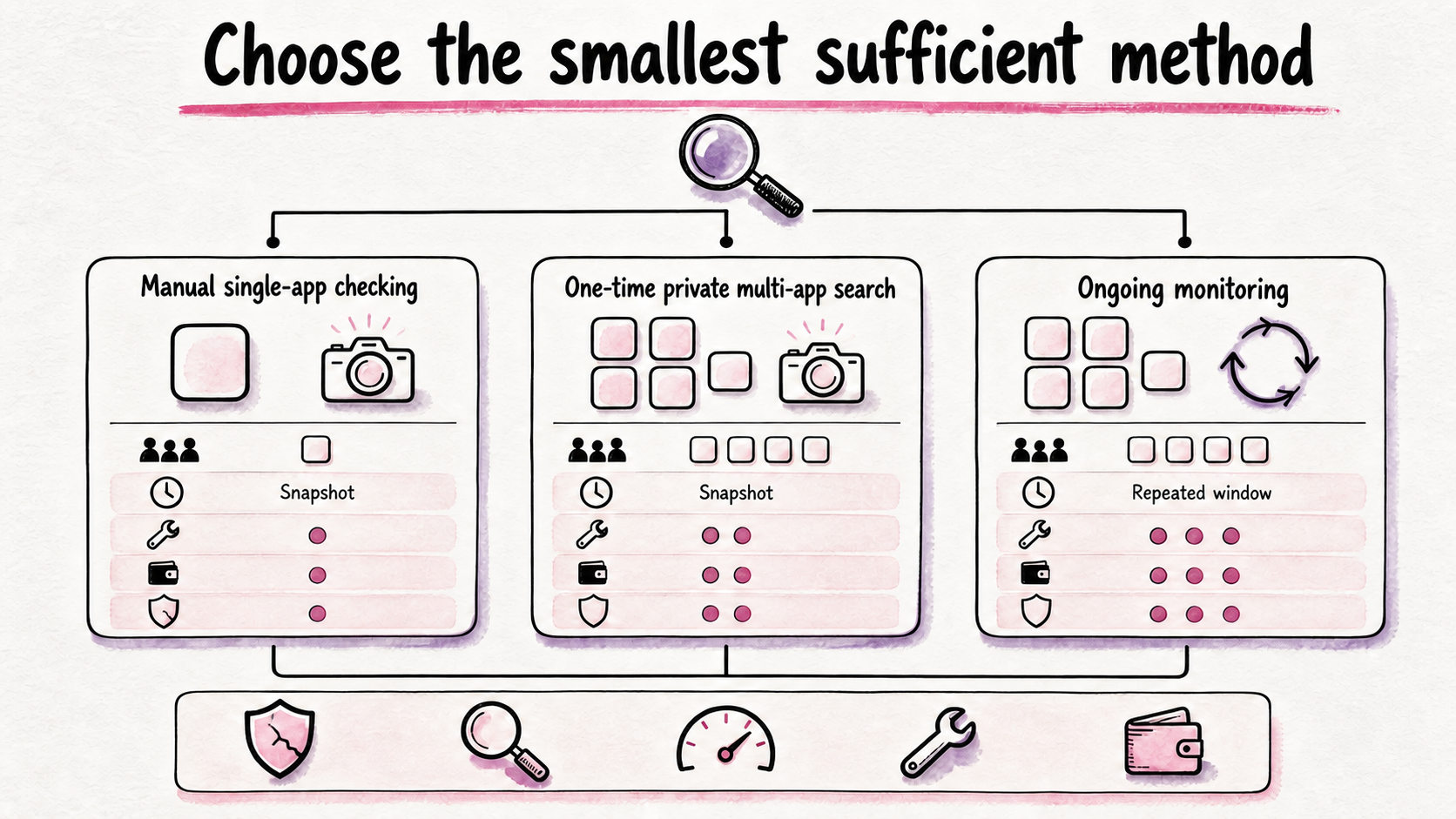
| Method | Scope | Required data | Timing or window | Reader effort | Billing implications | Evidence limitations |
|---|---|---|---|---|---|---|
| Manual single-app checking | One app at a time | Information lawfully usable through that app’s available features | Present snapshot | Can be time-consuming and incomplete, especially across several apps | App-specific conditions may vary | One app says little about others, and timing may remain unclear |
| One-time private multi-app search | Several selected apps | A reliable minimum-necessary identity brief and app selection | One snapshot | Less repeated setup than separate manual checks | Provider terms may include a one-time charge | Can miss later appearances or changes and cannot prove conduct |
| Ongoing monitoring | Selected apps checked repeatedly during a defined period | The same reliable brief plus a chosen monitoring period | Repeated supported checks during an active paid period | Less repeated manual work, although results still require interpretation | Review duration, renewal, and cancellation terms | Adds time coverage but does not guarantee discovery, identity, activity, or intent |
Manual checking can be proportionate when one named app is the entire question. Its weakness is fragmentation: repeated searches require more effort, and the reader must apply the same cautious matching standard each time.
A private multi-app search is a snapshot. It may suit a question involving several selected apps when only the present search window would affect the decision, but it should not be mistaken for continuous coverage or proof of activity.
Monitoring fits when a later appearance or observable change would genuinely affect the next step. CheaterBusting states that its paid plans begin with the same selected-app search and include monitoring during the active billing period; duration changes the monitoring window and billing cadence rather than the matching method. Review the current pricing and renewal terms before choosing a period. No monitoring period guarantees that a profile will be discovered or establishes conduct.
Classify the Result Without Turning It Into a Verdict
Separate supporting details, contrary evidence, and unknowns before assigning a result class. This prevents one emotionally powerful clue from erasing a meaningful conflict.
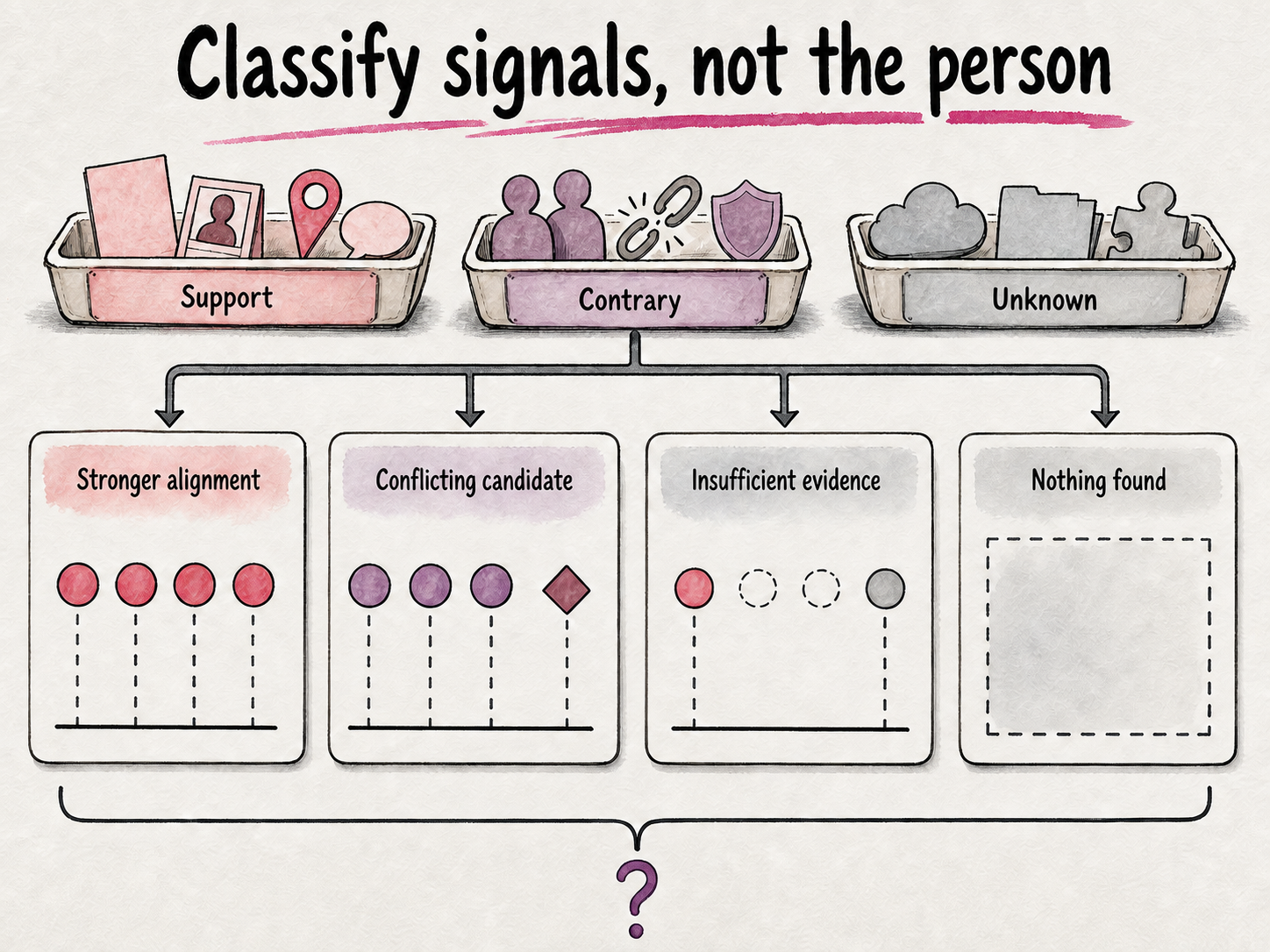
| Result class | Meaning | Responsible interpretation |
|---|---|---|
| Stronger alignment | Several independent details support the candidate with no unresolved material conflict | A stronger possible match, not proven identity or conduct |
| Conflicting candidate | Meaningful support exists alongside a material contradiction | Unresolved; preserve the contradiction rather than explaining it away |
| Insufficient evidence | Too few reliable details are available or too many facts remain unknown | No responsible identification can be made from the available information |
| Nothing found | No supported match surfaced within the available scope and timing | A bounded search result, not proof that no profile exists or ever existed |
Consider a hypothetical candidate with familiar photos and the city where your wife lives. Those details provide support. If the displayed age conflicts with reliable information and no dependable timing is visible, record the photos and city as supporting details, the age as contrary evidence, and timing as unknown. Classify the result as a conflicting candidate—not a confirmed identity or confirmed current profile.
A confidence note describes how well available signals agree. It is not an accuracy probability, a measurement of guilt, or a guarantee. Even stronger alignment does not prove that your wife controls the profile, uses it now, has a particular intention, or has been unfaithful. Review the sample report to see how result fields, conflicts, and uncertainty may be presented.
The same restraint applies to an empty result. As the explanation of what “no match found” means makes clear, nothing found means no supported match surfaced within the available coverage and timing. It does not establish that a profile is absent from every app, unavailable under different details, or never existed.
Keep the Search Private, Proportionate, and Lawful
Submit only necessary details that you possess and may lawfully use for the defined purpose. CheaterBusting states that submitted names, nicknames, ages, locations, photos, and notes are compared with public or otherwise available profiles. Its privacy policy states that its process does not request passwords, login codes, phone access, private-account access, or messages.
Treat those access boundaries as hard limits. Do not enter an account without authorization, access a device without permission, obtain private messages, or impersonate someone. Do not stalk, harass, threaten, expose, or harm anyone. Read the service’s acceptable-use terms before proceeding. Product rules do not guarantee that every possible use is legal in every jurisdiction; seek qualified local advice if your circumstances raise a legal question.
CheaterBusting states that the searcher’s name is not attached and that the person being checked is not contacted, messaged, warned, or notified. That limits disclosure but does not expand what information a searcher is entitled to access.
Before beginning, inspect the matching criteria and sample report. Decide which selected apps matter, confirm that one bounded search could change a real decision, and avoid escalating into repeated checking merely because uncertainty remains. If monitoring is genuinely necessary, examine its duration, renewal terms, and evidence limitations first.
A calm next step is: Start my private multi-app search only after confirming that its scope, inputs, and limitations fit the question.
FAQ
Can I check whether my wife uses dating apps without her password or phone?
Yes. Public or otherwise available information can be checked without accessing her phone, accounts, passwords, login codes, or private messages. Stop if a method requires unauthorized access, deception, or impersonation.
Will she be notified?
CheaterBusting states that it does not attach the searcher’s name to the search or contact, message, warn, or notify the person being checked. Review the current privacy terms before submitting information.
Which details are useful?
Use an accurate name or known nickname, approximate age, likely city, current photos you may lawfully use, and selected relevant apps. Reliable distinguishing details are more useful than a long list of guesses.
Does a possible match prove she is active or cheating?
No. A possible match does not prove identity, current activity, who controlled the profile, intent, relationship status, or infidelity. Visible freshness remains unknown unless dependable activity or update context is actually available.
What does nothing found mean?
It means no sufficiently supported match surfaced within the apps, identifying details, accessible information, and timing of that search. It does not prove that no profile exists now or ever existed.
When does monitoring fit better than a snapshot?
Monitoring may fit when a later appearance or meaningful visible change would alter a defined next decision. Choose a limited period and review its billing and renewal terms. Monitoring repeats checks; it does not guarantee discovery or turn an ambiguous candidate into proof.
Next decision
Need broader evidence across covered apps?
Review scope, confidence limits, and pricing before starting any private search.
Continue reading
Related evidence guides

Dating App Search Details for a Wife: Build a Minimum-Necessary Brief
Prepare a focused search brief using reliable identity details, a time-qualified location, responsibly held photos, and only relevant dating apps.
How to Check Your Partner Without Joining Dating Apps—and Know When to Stop
Choose a proportionate no-account search method, protect private information, interpret uncertain findings, and stop when further checking cannot change your decision.

How to Find Out If Your Husband Is on Dating Sites Without Joining
Compare four account-free ways to check selected dating apps, prepare only the necessary details, and assess possible matches without treating them as proof.