
Partner Says Their Dating Profile Is Deleted: 5 Steps
Weigh a dating-profile deletion claim, separate identity from recency, and choose a lawful next step that fits the evidence.
- Author
- CheaterBusting Team
- Reviewed
- Reviewed July 20, 2026
- Reading time
- 11 min read
In this guide
TL;DR
- Clarify what your partner means by “deleted” before deciding whether a sighting conflicts with the claim.
- Describe exactly what was observed, including its source and date, without adding an explanation.
- Assess likely identity and evidence of recent change as two separate questions.
- Give a dated material change more weight than an unchanged profile, but never treat either as proof of intent or cheating.
- Choose the least intrusive lawful action that could answer the remaining question.
Your partner says the dating profile is gone, then a familiar face appears in a screenshot, search result, or app sighting. The difficult part is deciding whether an old or uncertain signal truly conflicts with what you were told. A five-step method can separate the claim from the observation, weigh identity and recency independently, and lead to a proportionate next action without forcing an uncertain signal into a verdict.
Table of Contents
- Key Takeaways
- Use Five Steps to Weigh a Deletion Claim
- Apply the Ladder to Three Signals
- Match the Next Step to Evidence Quality
- Know What a Private Multi-App Search Can Add
- FAQ
Key Takeaways
- Clarify the claim before interpreting the technology. Removing an app, pausing visibility, deactivating a profile, and deleting an account are not interchangeable actions.
- Identity and recency answer different questions. Familiar photos can support identity confidence without showing when the profile was used.
- A dated change is more informative than visibility alone. It may narrow when the visible profile state changed, but it cannot establish who changed it or why.
- Conflicting details should affect confidence. A different city, age, or name should not be ignored or treated as an automatic explanation.
- Stronger evidence supports a more specific response, not a harsher accusation. The useful goal is a better question and a proportionate next step.
Use Five Steps to Weigh a Deletion Claim
The ladder begins with the words used and ends with an action matched to the evidence. Work through it in order. Skipping directly from a familiar profile to a conclusion blends several unanswered questions together.
1. Clarify the Claim and Record the Observation
First, ask what action “deleted” refers to. Your partner may mean removing the app from a phone, changing profile visibility, deactivating an account, or completing an account-deletion process. Those actions may have different effects.
A precise question is more useful than an argument about terminology: “When you said you deleted it, did you remove the app or delete the account?” For a fuller explanation, review the difference between a deleted app, deleted account, or paused profile.
Platform controls and terminology differ and may change. Use the platform’s current official help documentation for any specific claim about deletion, pausing, deactivation, visibility, or recurrence. Profile visibility alone cannot reveal which account action occurred.
Next, replace “the profile is still there” with the narrowest accurate description. Was it a current in-app view, an undated screenshot, a possible search match, or a profile someone remembers seeing? Record the source and when it reached you. That date is not automatically the date the profile was created, changed, or used.
Keep the observation separate from its possible explanation. A screen may show a photo, name, age, city, or bio. It rarely explains the account’s history, who controlled it, or what the person intended.
2. Assess Identity and Recency Separately
Ask first whether the profile likely belongs to the same person. A common name and approximate age provide weak identity confidence. Several familiar photos, a known nickname, the expected age and city, and consistent personal details form a stronger combination.
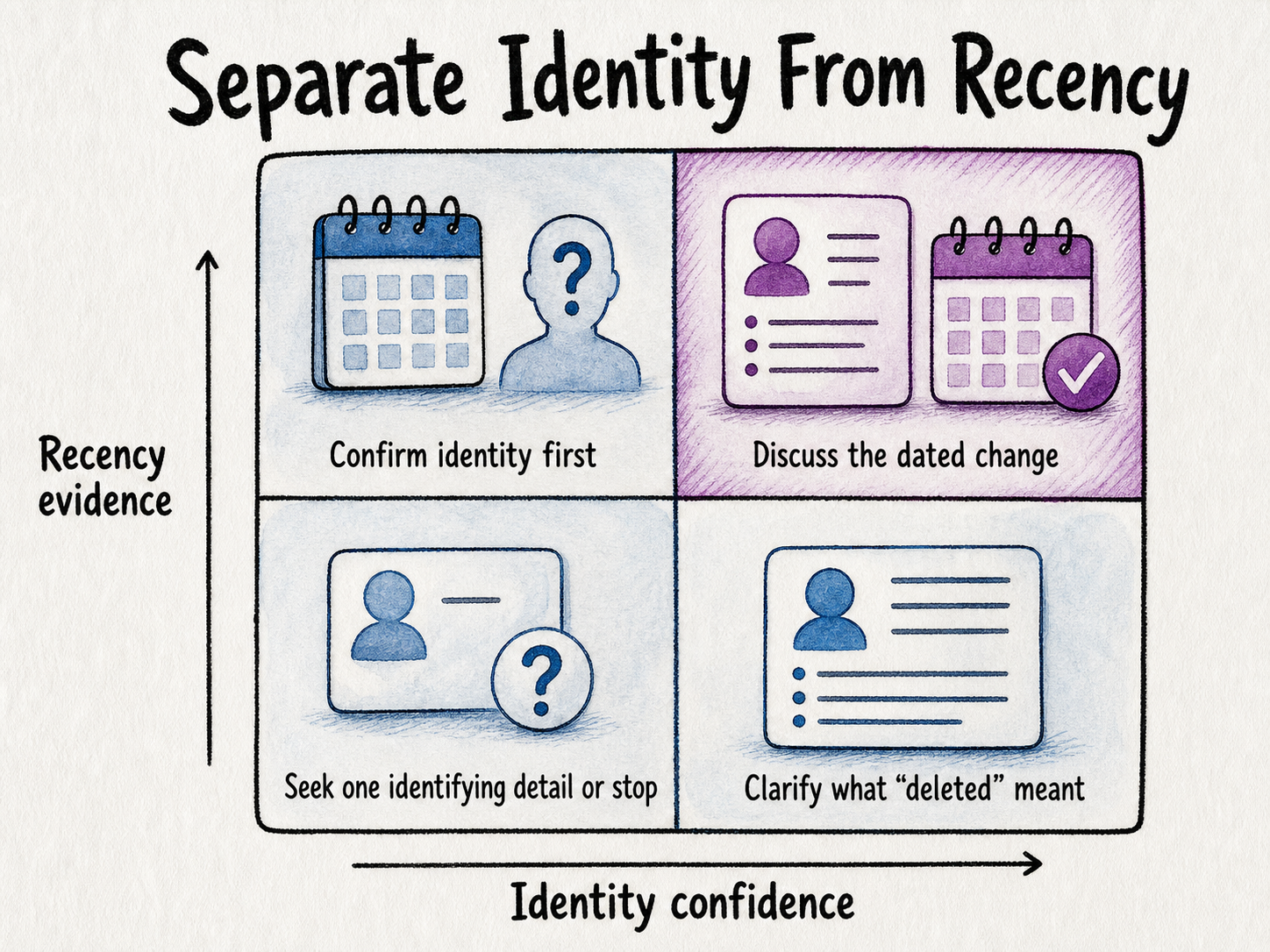
Conflicting information must remain part of the assessment. A different city might be an old entry, an editable detail, a travel location, or evidence that the candidate is someone else. Without another reliable signal, none of those explanations should be selected as fact.
Then assess recency independently. An unchanged profile can look unmistakably familiar while saying little about recent use. A photo or bio detail known to have appeared after the relationship began carries more information about when the visible profile state changed.
A specific change observed at a known time is stronger recency evidence than a static sighting. It still cannot show who made the change, whether anyone exchanged messages, what the account holder intended, or whether infidelity occurred.
3. Choose the Least Intrusive Useful Action
Name the unresolved question before choosing an action. If “deleted” remains vague, clarify the claim. If identity confidence is weak, seek one independent identifying detail or stop. If identity appears strong but recency remains unknown, consider whether a limited lawful check could add anything useful.
When a recent material change is well supported, a direct conversation can focus on the observation: “This profile includes a photo taken last month. Can you help me understand how it appeared after you said the account was deleted?” This is more precise than accusing someone based on profile visibility alone.
The ladder does not produce a cheating or loyalty verdict. It helps you identify what is known, what remains uncertain, and which response is proportionate to the evidence.
Apply the Ladder to Three Signals
Consider this hypothetical cross-app example. Alex says a dating profile was deleted early in the relationship. Months later, three different signals appear.
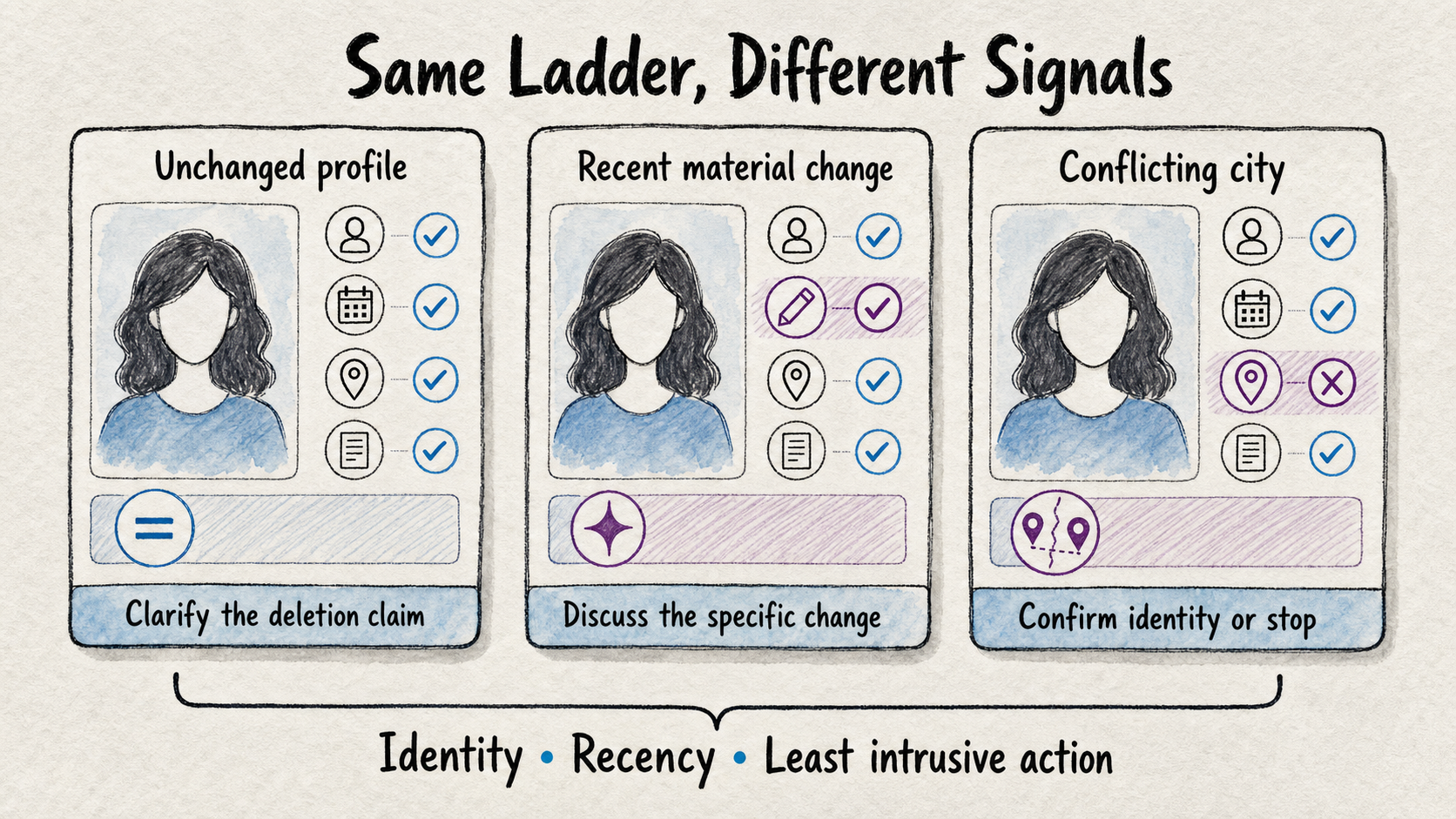
An unchanged profile: The first profile has Alex’s familiar photos, expected age, and former city. Nothing visible is known to have changed since before the relationship.
Several aligned details may support identity confidence, but recency evidence remains weak. The proportionate response is to clarify what Alex meant by deletion. If the sighting is Tinder-specific, see what it means when a Tinder profile still appears. An unchanged sighting does not justify a claim of recent use.
A recently altered profile: Another observation shows a photo taken during the relationship or a bio detail linked to a recent event. Identity confidence may already be strong, and the material change adds recency information.
A focused conversation is now more useful because there is a specific fact to discuss. The change still cannot establish who uploaded it, what happened privately, or why it was added. If a profile disappears and later returns, use the guidance on what to do when a dating profile reappears after months rather than reconstructing events from memory.
Familiar photos with a conflicting city: A third candidate appears to show Alex, but its city conflicts with Alex’s location and other details are sparse.
The conflict affects identity confidence. It provides no useful recency information by itself. Another independent signal is needed before treating the profile as Alex’s. For a Bumble-specific sighting, the next resource is how to assess a Bumble profile that is still visible.
Each signal goes through the same three questions: Is this likely the same person? Is there evidence of a recent material change? What is the least intrusive action that could resolve the remaining uncertainty?
Match the Next Step to Evidence Quality
Evidence quality should rise before intrusiveness does. Use this matrix to connect the unresolved question with a limited, useful response.
| Evidence state | Main question | Least intrusive useful action | What it may add | What it cannot establish |
|---|---|---|---|---|
| Vague deletion claim, no clear sighting | What did “deleted” mean? | Ask one precise account-state question | A claim that can be compared with later facts | Whether a profile exists or was recently used |
| Familiar but unchanged profile | Is this old visibility or a current state? | Clarify the claim or make one limited lawful check | Better identity context | Recent activity, intent, cheating, or loyalty |
| Candidate with conflicting details | Is this the same person? | Seek one independent identifying signal or stop | Higher or lower identity confidence | Who controls the profile or when it was used |
| Likely identity plus a dated material change | How did the change occur? | Have a direct, fact-based conversation | An explanation tied to a specific observation | Private activity, intent, or a complete account of events |
| Repeated dated changes | Is the profile changing over time? | Consider narrowly limited monitoring | Later observable changes | Messages, intent, cheating, or loyalty |
A conversation is immediate and requires no additional personal data, but it may not resolve technical uncertainty about account state. It is often the right first action when the original statement is vague or when there is one specific change to discuss.
A one-time check provides a snapshot. Monitoring may detect later observable changes, but it prolongs data collection and can extend emotional uncertainty. It is often disproportionate when candidate identity is weak, no material change exists, or continued checking is replacing a needed conversation without answering a defined question.
More accurate names, nicknames, age information, locations, and photos may improve comparisons. Providing more inputs also increases the personal data shared. Review what a service collects, how it uses that information, and whether checking continues before proceeding.
Keep firm privacy boundaries. Use only public or otherwise available information for a lawful purpose. Never enter someone’s phone or account, obtain credentials or security codes, intercept messages, or use information to stalk, threaten, harass, expose, or intimidate anyone.
Know What a Private Multi-App Search Can Add
A private multi-app search may help when the unresolved question is broader than one sighting: do known details align with possible profiles across supported apps?
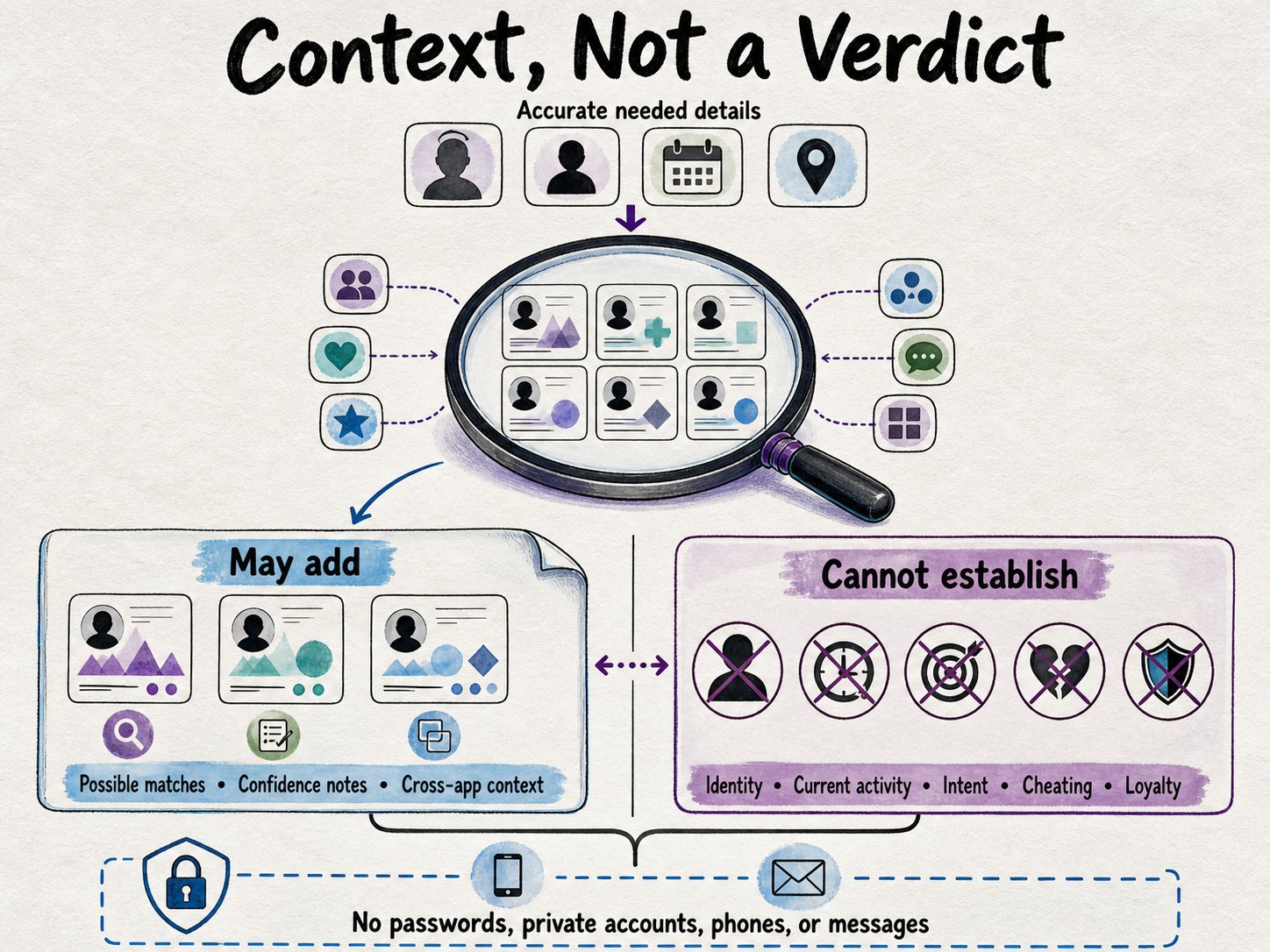
CheaterBusting describes a method that compares submitted details with public or otherwise available dating-app information. Its website says name, nickname, age, city, photos, facial features, profile recency, and cross-app presence can be considered together. Its onboarding explanation gives the most weight to photos and facial features because text fields can be shared or changed. This is the company’s stated method, not a guarantee of accuracy.
A report may contain possible matches, confidence notes, unconfirmed details, duplicate handling, or a nothing-found outcome. For example, aligned photos, age, and city may support a stronger possible match than familiar photos paired with conflicting biographical information. Confidence describes the quality of the comparison. It cannot prove identity, current activity, intent, cheating, or loyalty.
The service’s terms say results are not guaranteed and depend on public or otherwise available information. Information may be incomplete, incorrect, unavailable, or out of date. A nothing-found report therefore means the search did not locate a matching profile through its available sources and method. It does not mean no profile exists.
CheaterBusting also states that it does not require passwords or login codes and does not access private accounts, phones, or messages. Use is limited to adults and lawful purposes. These boundaries matter because concern about a relationship does not create permission to enter another person’s device or account.
Before purchasing or supplying personal information, define the question the search would address. Review the matching method, privacy terms, no-guarantee language, billing terms, and whether checking continues after the first report. If one lawful multi-app comparison could add useful context, submit only accurate details needed for the comparison and read every result as guidance, not a verdict.
FAQ
Can a visible profile verify that an account was not deleted?
No. Visibility is an observation, but it does not reveal the account state or explain how a platform handles deletion, pausing, deactivation, or profile display. Consult the platform’s current official documentation before relying on a technical explanation.
Which matters more, a familiar photo or a recent profile change?
They answer different questions. A familiar photo may strengthen identity confidence. A change connected to a known date may strengthen the recency assessment. Neither establishes who controlled the profile or why it changed.
What does a conflicting city mean?
It lowers or redirects identity confidence. The city could be old, editable, connected to travel, or evidence of a different person. Seek another independent signal rather than choosing the most reassuring or alarming explanation.
What does a nothing-found result mean?
It means a search did not locate a matching profile through its available information and method. It does not prove that no profile exists, that an account was deleted, or that a partner is loyal.
When is monitoring disproportionate?
Monitoring is difficult to justify when identity confidence is weak, the profile appears unchanged, or no later observation could answer a defined question. It also deserves caution when repeated checking increases distress or substitutes for a direct conversation.
What should I do next?
Choose the matrix row closest to what you actually know. Clarify a vague claim, use the relevant account-state or app-specific resource, or consider one lawful private comparison only when it addresses a clear unresolved question. The next step should resolve uncertainty where possible, not declare a verdict about your partner.
Next decision
Need broader evidence across covered apps?
Review scope, confidence limits, and pricing before starting any private search.
Continue reading
Related evidence guides
Deleted App vs Deleted Dating Account: What It Means
Learn what deleted, paused, and deactivated may mean, then ask one precise question without treating profile visibility as proof.
Build a Tinder Activity Timeline Without Overstating Evidence
Organize Tinder screenshots and report updates by source, time, duplicates, and gaps to find the newest defensible observation.

Is a Dating Profile Photo Search Private and Safe?
Assess photo, policy, access, and payment risks before choosing to upload less data, change providers, or stop.