
Build a Tinder Activity Timeline Without Overstating Evidence
Organize Tinder screenshots and report updates by source, time, duplicates, and gaps to find the newest defensible observation.
- Author
- CheaterBusting Team
- Reviewed
- Reviewed July 20, 2026
- Reading time
- 11 min read
In this guide
TL;DR
- Inventory every lawfully obtained screenshot, email, and report before interpreting any of them.
- Record the source, capture time, receipt time, observed field, literal observation, inference, confidence, and unresolved gap separately.
- Consolidate exact duplicates. Keep materially different captures, but flag records that may come from the same underlying observation.
- Mark periods without observations as unknown. Silence does not establish that a profile was inactive, paused, deleted, or absent.
- Retain only the sensitive material needed for a defined lawful purpose, restrict access, and delete unnecessary copies securely.
- Finish by naming the newest defensible observation and the questions the chronology cannot answer.
Two screenshots show different profile photos, but one was forwarded several days after it was captured. A later report email introduces another date, followed by no new match. Read in arrival order, these records may appear to tell a clear story. A provenance-first Tinder activity timeline reveals the narrower truth: what was observed, when it was observed, where each record came from, and what remains unknown.
Table of Contents
- Key Takeaways
- Start with provenance, not conclusions
- Separate observations, duplicates, and unknown intervals
- Apply the method to two fictional evidence sequences
- Close the record safely and choose the next step
- FAQ
Key Takeaways
- The newest file is not necessarily the newest observation. A delayed email or forwarded screenshot can arrive long after capture.
- Two copies of one event remain one event. Extra copies may add provenance, but they do not add independent support.
- Confidence should describe the reliability of the source or a bounded inference. It should never become a score for current activity, intent, or cheating.
- More observations can improve context without making the chronology complete.
- Sensitive screenshots and reports create privacy risk. Keep the minimum needed and set a deletion point.
Start with provenance, not conclusions
Begin by placing every record in an inventory. Do not sort by the date a file entered your inbox or photo library until you know what that date represents. A screenshot might have been captured on Monday, forwarded on Thursday, and saved on Friday. Those are three different events, but only Monday describes when the visible information was captured.
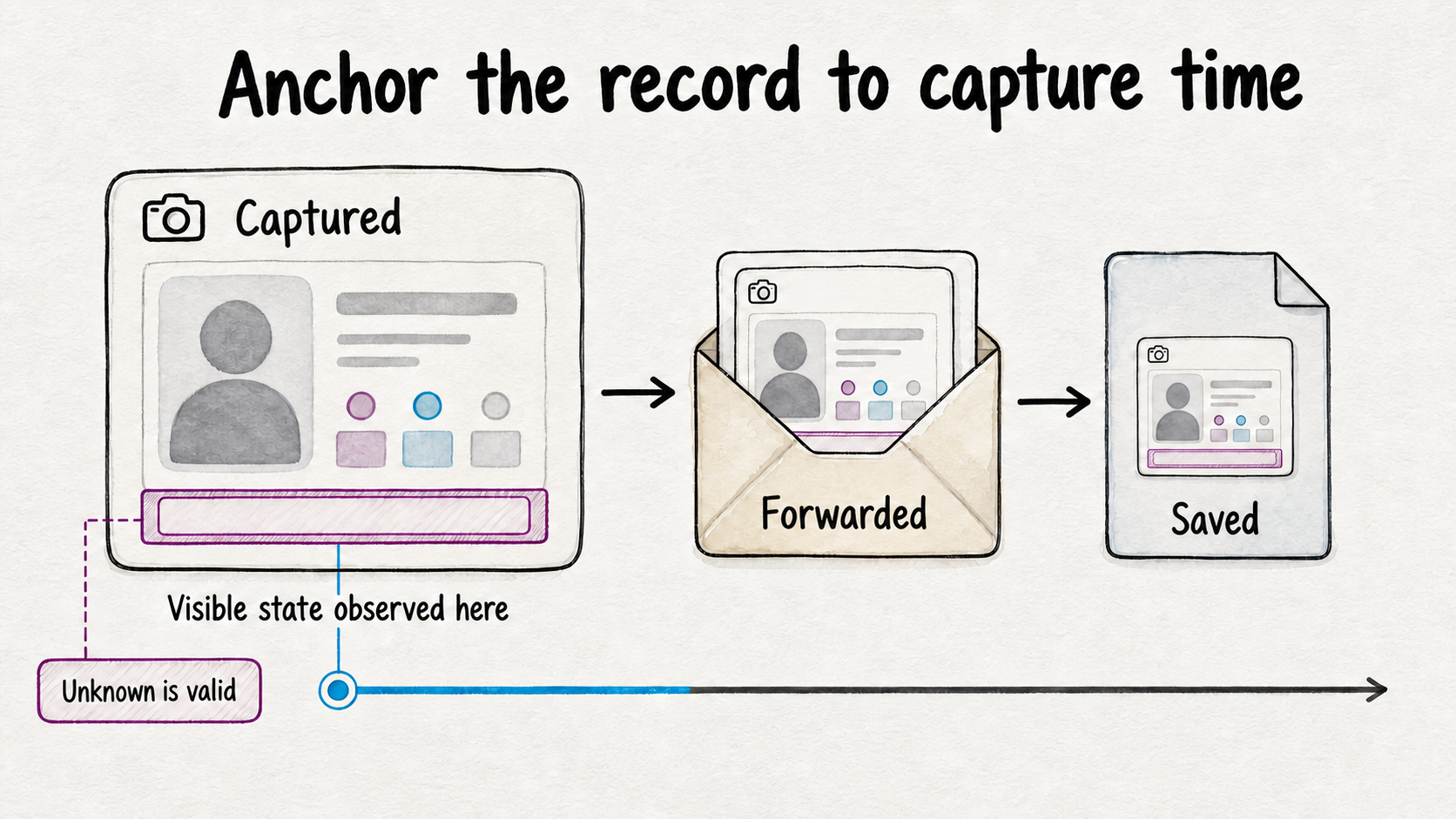
Use the original timestamp exactly as shown, including its timezone when available. You may add a normalized time in a consistent timezone for sorting, but preserve the original value beside it. If the capture time is unavailable, write “unknown.” An honest blank is safer than precision reconstructed from memory.
Use this reusable template:
| Record ID | Source | Capture date and time | Viewed or received | Observed field | Literal observation | Inference | Confidence | Unresolved gap |
|---|---|---|---|---|---|---|---|---|
| R-01 | Original screenshot, report email, or other lawful source | Exact timestamp and timezone, or unknown | When you personally viewed or received it | Photo, label, report status, or other specific field | Only what is visibly shown or expressly reported | A narrow statement supported by the observation | Confidence in provenance or the narrow inference | Missing time, unclear origin, possible duplicate, or other limit |
The source column should describe the chain of custody in plain language. “Screenshot from phone” is weak if you know it was forwarded. “Screenshot forwarded by Sam on May 8; original capture time unknown” preserves the important limitation. Assigning a record ID lets you discuss the entry without repeatedly copying names, photos, or other identifying details.
Keep the literal observation separate from the inference. For example, “The first visible profile photo differs between R-01 and R-02” is an observation. “The photo was changed between the two capture times” is an inference, and it is supportable only if the records concern the same profile state and have reliable capture times. Deciding what an individual photo or profile field suggests belongs in a separate field-level assessment. The timeline’s job is to order the records and preserve their limits.
A report update is handled the same way. CheaterBusting states that it continues checking and updates reports when results change, while providing confidence notes and identifying details that could not be confirmed. Those elements can become timeline entries, but the email receipt time should not be treated as the profile capture time unless the report identifies it. No fixed update schedule should be assumed. Review the stated process on the CheaterBusting how-it-works page.
Separate observations, duplicates, and unknown intervals
Once the records have sources and dates, classify each one before drawing a sequence.
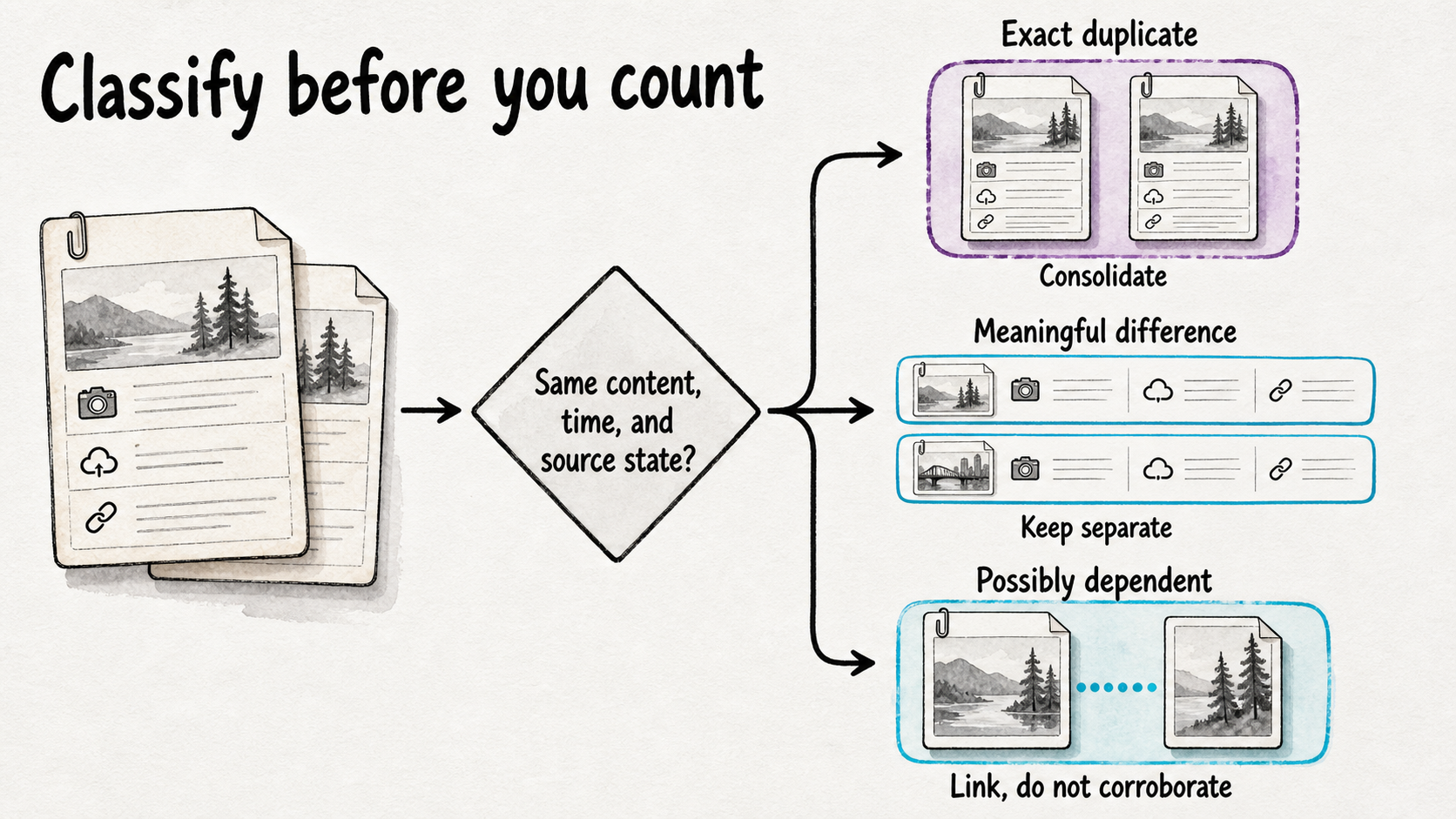
Keep materially different captures as separate rows. A second capture deserves its own row when it shows a different visible state, a different capture time, or additional source information that changes what can be established. This rule preserves chronology without ranking which profile field is a stronger sign of freshness.
Consolidate exact duplicates. If two files show the same content, crop, timestamp, and source state, record one underlying observation. Note both file paths or receipt routes in the source field if they help explain provenance, then remove redundant working copies when they are no longer needed.
Flag possible dependence. Two records can look different yet still come from one underlying observation. For example, a forwarded screenshot and a cropped export may show the same original capture. Keep the provenance trail, mark the relationship as “possibly dependent,” and do not count the records as independent corroboration.
A useful duplicate decision rule is:
- Compare visible content and timestamps.
- Check whether one file was forwarded, cropped, exported, or embedded in a report.
- Consolidate exact copies into one observation.
- Preserve separate rows for meaningful differences.
- Mark uncertain relationships instead of assuming independence.
Next, add unknown intervals explicitly. If R-03 was captured on May 1 and the next observation is dated June 12, write “No observations recorded from May 2 through June 11.” That statement describes your record. It does not mean the profile was inactive, absent, paused, or deleted during that period.
Use confidence carefully. “High confidence that this email was received on June 12” concerns provenance. “Moderate confidence that R-01 and R-02 show different captured states” is a bounded inference. Neither statement supports a conclusion about present activity or cheating.
Apply the method to two fictional evidence sequences
The following examples are fictional. They demonstrate chronology mechanics, not customer outcomes or claims about Tinder behavior.
Example 1: Two screenshots with different photos
Maya has two screenshots that appear to show the same reasonably identified profile. Screenshot A arrived in a message on April 14 but includes an original capture timestamp of April 10 at 8:42 p.m. Screenshot B was captured directly on April 12 at 7:15 a.m. The first visible photo differs between the screenshots.
| Record ID | Source | Capture date and time | Viewed or received | Observed field | Literal observation | Inference | Confidence | Unresolved gap |
|---|---|---|---|---|---|---|---|---|
| R-01 | Forwarded screenshot; original timestamp visible | Apr. 10, 8:42 p.m., timezone unknown | Apr. 14 | First photo | Person standing beside a red wall | Earlier captured state shows photo A | Moderate: capture date visible, timezone missing | Original source and timezone unknown |
| R-02 | Direct screenshot | Apr. 12, 7:15 a.m., local time | Apr. 12 | First photo | Close-up portrait | Later captured state shows photo B | High for file provenance | No observations between captures |
The defensible statement is: “Two captures dated April 10 and April 12 show different first photos.” The timeline does not establish who made a change, exactly when it occurred, or what the profile shows now. If field-level interpretation is needed, assess that separately rather than converting the chronology into a freshness score.
Suppose Maya also saved a cropped copy of R-02 from the same message thread. The crop has no new timestamp or visible content. It should be listed as another copy linked to R-02, not entered as independent evidence.
Example 2: A report update followed by no later match
Jordan receives a report update on June 3 describing a possible match with a confidence note. A report viewed on June 20 shows no later matching result. The update does not provide a separate profile capture time.
| Record ID | Source | Capture date and time | Viewed or received | Observed field | Literal observation | Inference | Confidence | Unresolved gap |
|---|---|---|---|---|---|---|---|---|
| R-03 | Report update email | Unknown | June 3, 9:10 a.m. | Possible match and confidence note | Report identifies a possible match and lists unconfirmed details | A possible match was reported by June 3 | High for receipt; bounded by the report note | Underlying observation time unknown |
| R-04 | Later report view | Unknown | June 20, 6:30 p.m. | Report state | No later matching result appears | The viewed report contained no later result at that time | High for viewing; low for any broader inference | June 3 to June 20 remains unknown |
R-04 does not cancel R-03, prove that a profile disappeared, or establish inactivity during the interval. It records only a later reporting state. Reports and updates can add context, but they may not provide a complete or timely record and cannot prove cheating.
Close the record safely and choose the next step
A well-organized chronology can still create harm if it retains unnecessary photos, names, locations, or report copies. Evidence hygiene therefore includes deletion as well as accurate recordkeeping.
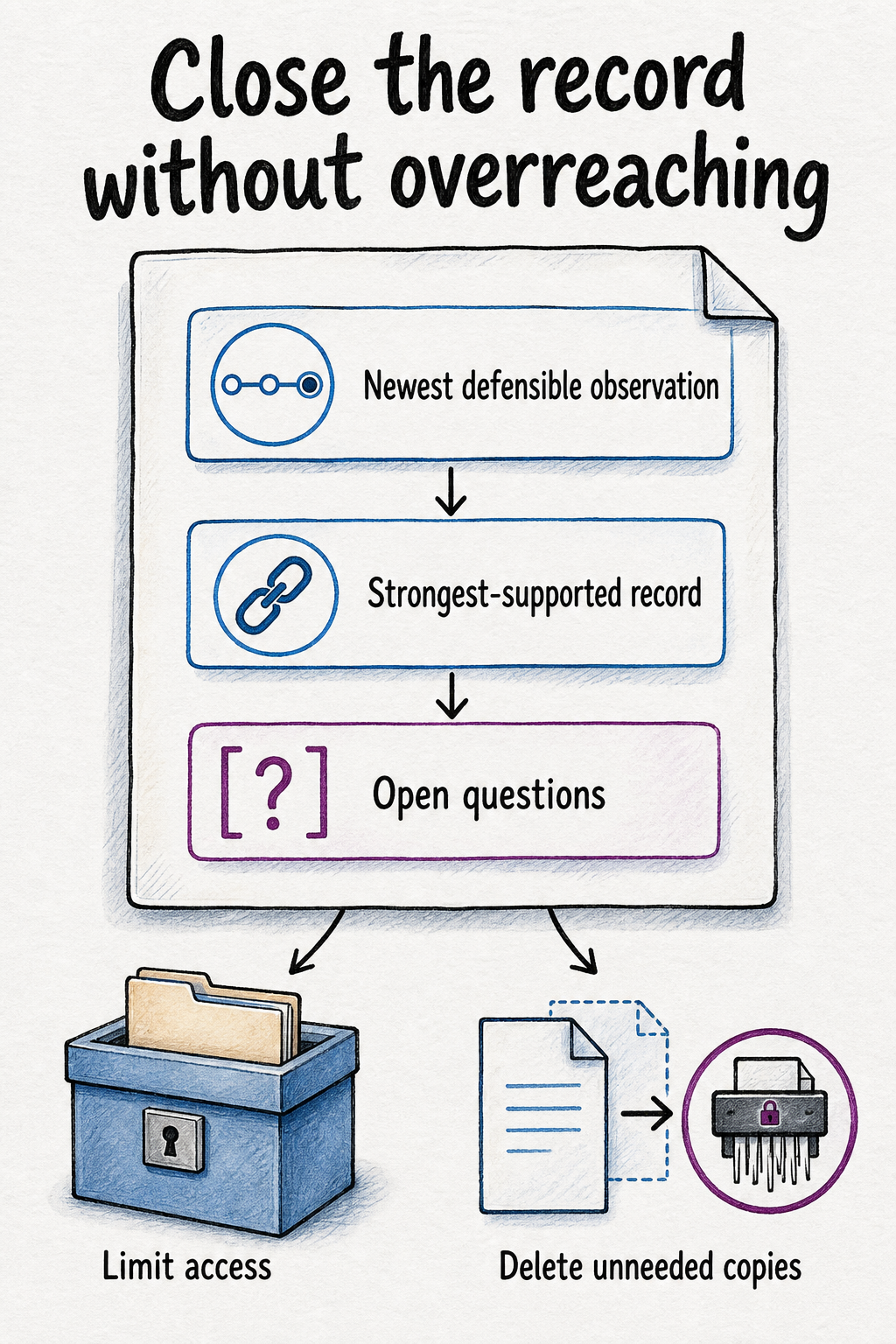
Use this closing checklist:
- Replace unnecessary identifying details with record IDs in the working timeline.
- Keep files in controlled storage rather than shared albums, open folders, or group messages.
- Limit access to people who have a legitimate reason to see the material.
- Avoid making extra copies or distributing sensitive screenshots.
- Set a deletion point tied to the lawful purpose. There is no universal retention period, so keep records only while they are genuinely needed.
- Delete redundant and unneeded copies securely when that purpose ends.
Do not obtain passwords or login codes, access someone’s phone or private account, intercept messages, stalk, harass, threaten, or disclose sensitive material harmfully. CheaterBusting says it does not request credentials or access private accounts, phones, or messages, as explained in its privacy policy. Its acceptable-use policy also prohibits stalking, harassment, threats, password theft, unlawful surveillance, device access, message interception, and harmful disclosure. These policies describe service restrictions, not a legal ruling for every location.
Finish the timeline by writing three short statements:
- Newest defensible observation: Name the latest record with a supported observation time, or state that only its receipt time is known.
- Strongest-supported record: Identify the entry with the clearest provenance, even if it is older.
- Open questions: List missing capture times, dependent sources, unknown intervals, and unconfirmed details without trying to fill them.
Then decide whether more lawful context is proportionate. More observations may clarify the sequence, but they cannot guarantee completeness. If broader multi-app report context would be useful, first review how CheaterBusting handles updates, confidence notes, and unconfirmed details. Any resulting record should enter the same timeline as a sourced observation, never as a verdict.
FAQ
Can a Tinder activity timeline prove that someone is active now?
No. It can establish a chronology of sourced observations and show which one is newest. It cannot turn an earlier profile sighting, label, change, or report state into proof of present activity, intent, or cheating.
Should two identical screenshots count as two observations?
No. Treat them as two copies of one underlying observation. Preserve their separate receipt paths when useful for provenance, but do not count the second copy as corroboration.
What does a later nothing-found result establish?
It establishes the result reported or viewed at that later time, subject to the report’s limits. It does not prove that no profile existed, that an earlier result was wrong, or that the person was inactive during the interval.
How long should screenshots and reports be kept?
Keep them only as long as needed for a defined lawful purpose. Minimize identifiers, restrict access, avoid unnecessary sharing, and delete redundant or unneeded copies securely. Seek qualified local advice if legal preservation duties may apply.
Where should a Recently Active label or claimed profile change be interpreted?
Record the wording, source, and capture time in the timeline. Interpret a Recently Active label or the possible significance of a photo, bio, age, or distance difference in the dedicated topic guidance rather than inside the chronology. A timeline should preserve those observations without turning them into an overall currentness verdict.
Next decision
Need broader evidence across covered apps?
Review scope, confidence limits, and pricing before starting any private search.
Continue reading
Related evidence guides

Is a Dating Profile Photo Search Private and Safe?
Assess photo, policy, access, and payment risks before choosing to upload less data, change providers, or stop.
Partner Says Their Dating Profile Is Deleted: 5 Steps
Weigh a dating-profile deletion claim, separate identity from recency, and choose a lawful next step that fits the evidence.
CheaterBusting vs CheaterFinder: Choose or Wait?
Compare documented app coverage, reports, privacy, monitoring, and payment terms before choosing CheaterBusting or CheaterFinder.