
Dating App Activity Status Meaning: A Cross-App Evidence Guide
Learn how to interpret dating app activity statuses across Tinder, Bumble, Hinge, Facebook Dating, and Grindr without confusing visibility, profile changes, identity, or private behavior.
- Author
- CheaterBusting Team
- Reviewed
- Reviewed July 29, 2026
- Reading time
- 10 min read

In this guide
TL;DR
- A dating app activity status is a platform-specific signal, not a universal definition of “online.”
- Record the exact wording and observation time, then check the platform’s documented window and display rules.
- Keep identity confidence separate from timing: a precise status on the wrong profile proves nothing about the person you have in mind.
- A missing dot or label does not automatically establish inactivity.
- No status proves a swipe, match, message, intention, meeting, or infidelity.
Seeing an activity indicator can feel like a direct answer when the situation is emotionally charged. A sound interpretation starts with two narrower questions: how specifically does the platform define the timing signal, and how confidently can the profile be connected to the person in question?
Table of Contents
- Key Takeaways
- Separate the Five Signals
- Cross-App Comparison
- Two-Axis Interpretation Method
- Six-Field Observation Record
- Worked Example
- FAQ
Key Takeaways
- Definitions are platform-specific. Similar words, dots, and badges can represent different events, time windows, audiences, or display conditions.
- Visibility is not activity. A profile sighting establishes that the profile appeared through a particular source, not when its owner last used the app.
- A profile difference is not an action timestamp. Two records may show that something changed between observations without identifying the exact edit time, editor, reason, or later conduct.
- Account state is separate from behavior. Removing an app from a device, pausing visibility, deactivating an account, and deleting an account are distinct concepts.
- Timing and identity limit each other. A precise time window attached to an uncertain identity remains weak evidence. A strong identity match cannot supply timing that the platform does not document.
- Missing labels require display rules. Absence is inconclusive unless the platform explains when the indicator appears, who can see it, and whether it can be hidden.
Separate the Five Signals Before Interpreting a Status
An activity status is wording or an indicator that a platform uses to communicate a defined form of presence or recency. Its meaning extends only as far as the platform’s definition for that exact feature.
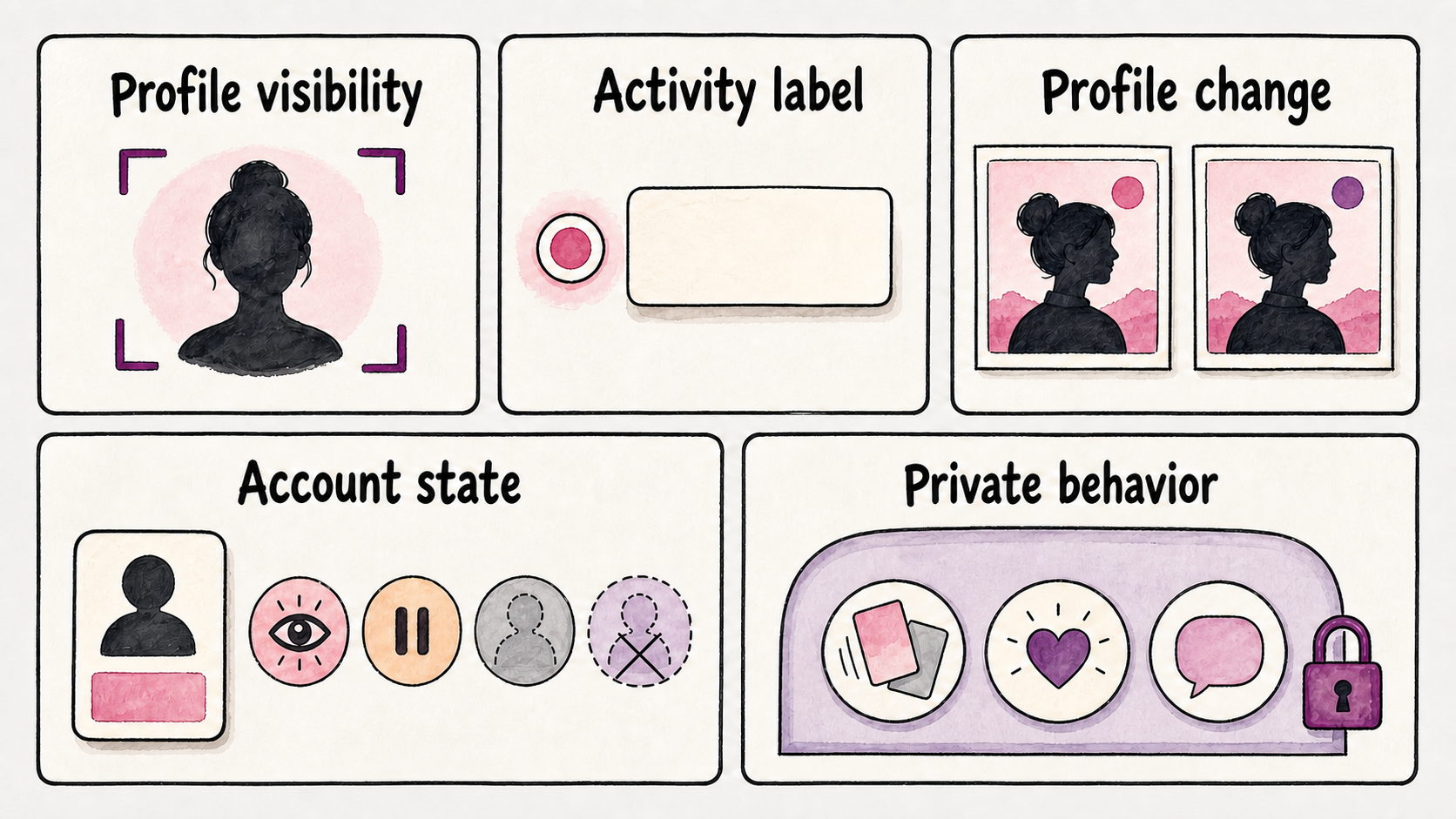
Before drawing a conclusion, classify the observation:
-
Profile visibility: A profile appeared in an app, screenshot, search result, or report. This establishes a sighting through that source. It does not establish a last-login or last-action time.
-
Activity label: The interface displayed exact wording, a timestamp, or an activity-related indicator. Preserve it exactly instead of translating it into “online.”
-
Observed profile change: A photo, biography, age, location, or other visible field differs between two records. The records establish a difference, but not necessarily when, why, or by whom the field was changed.
-
Account state: The platform may describe an account as visible, paused, deactivated, or deleted. Those states are different from whether its mobile app remains installed on a device.
-
Current private behavior: Swiping, matching, messaging, arranging a meeting, and forming an intention are private actions. A public-facing signal does not identify which, if any, of those actions occurred.
These categories can coexist, but they are not interchangeable. A visible profile without a status is visibility evidence. A changed photo is a difference between observations. Neither becomes proof of current private behavior simply because it raises concern.
Compare Activity Statuses App by App
The dating app activity status meaning must be established separately for each app and each exact indicator. The comparison below distinguishes the one dated definition supported by the available evidence from labels that require a current app-owned definition before they can support a timing claim.
| App | Exact label supported by dated evidence | Supported timing meaning | Display or privacy control | Source owner and status | Verified or indexed | Responsible reading |
|---|---|---|---|---|---|---|
| Tinder | Recently Active, represented in the cited secondary guide as a green dot | The guide describes potential matches as having been online within the preceding 24 hours | The same guide says activity-status sharing can be turned off | CheaterBusting, secondary explanation of Tinder’s feature; use current Tinder documentation as the controlling definition | Indexed July 22, 2026 | Supports only the stated recency window for the observed profile. It does not identify a particular action. An absent dot does not establish inactivity. |
| Bumble | No exact activity label is defined by dated app-owned evidence here | No timing window can be assigned responsibly | No control behavior is established | Bumble must own the controlling definition | Not verified | Record the exact interface wording and treat its timing as undefined until matched to current Bumble documentation. Do not translate it using Tinder’s definition. |
| Hinge | No exact activity label is defined by dated app-owned evidence here | No timing window can be assigned responsibly | No control behavior is established | Hinge must own the controlling definition | Not verified | Preserve the exact label or indicator and check its current Hinge definition before making a recency claim. |
| Facebook Dating | No exact dating-specific activity label is defined by dated app-owned evidence here | No timing window can be assigned responsibly | No dating-specific control behavior is established | Meta must own the controlling Facebook Dating definition | Not verified | Do not assume a Facebook or Messenger activity indicator has the same meaning or audience within Facebook Dating. |
| Grindr | No exact online or recency label is defined by dated app-owned evidence here | No timing window can be assigned responsibly | No control behavior is established | Grindr must own the controlling definition | Not verified | Record the exact wording, timestamp, or symbol and apply only the current Grindr definition for that feature. |
This matrix does not imply that the apps lack activity features. It shows the conclusion each observation can currently support. Tinder’s dated secondary explanation permits a narrow 24-hour interpretation of its named indicator, subject to the current app-owned definition. For the other four apps, a dot, timestamp, or phrase should remain unclassified until its exact wording is matched to current documentation from that platform.
The source date and observation date serve different purposes. The source date tells you when a definition was checked; the observation date tells you when the indicator appeared. Preserve both because platform wording and controls can change.
A missing indicator is equally limited. Before treating absence as inactivity, establish whether the feature is optional, audience-limited, available only in certain contexts, or removable through a privacy control. If those conditions are not known, the absence supports no reliable timing conclusion.
Use Two Axes to Cap Confidence
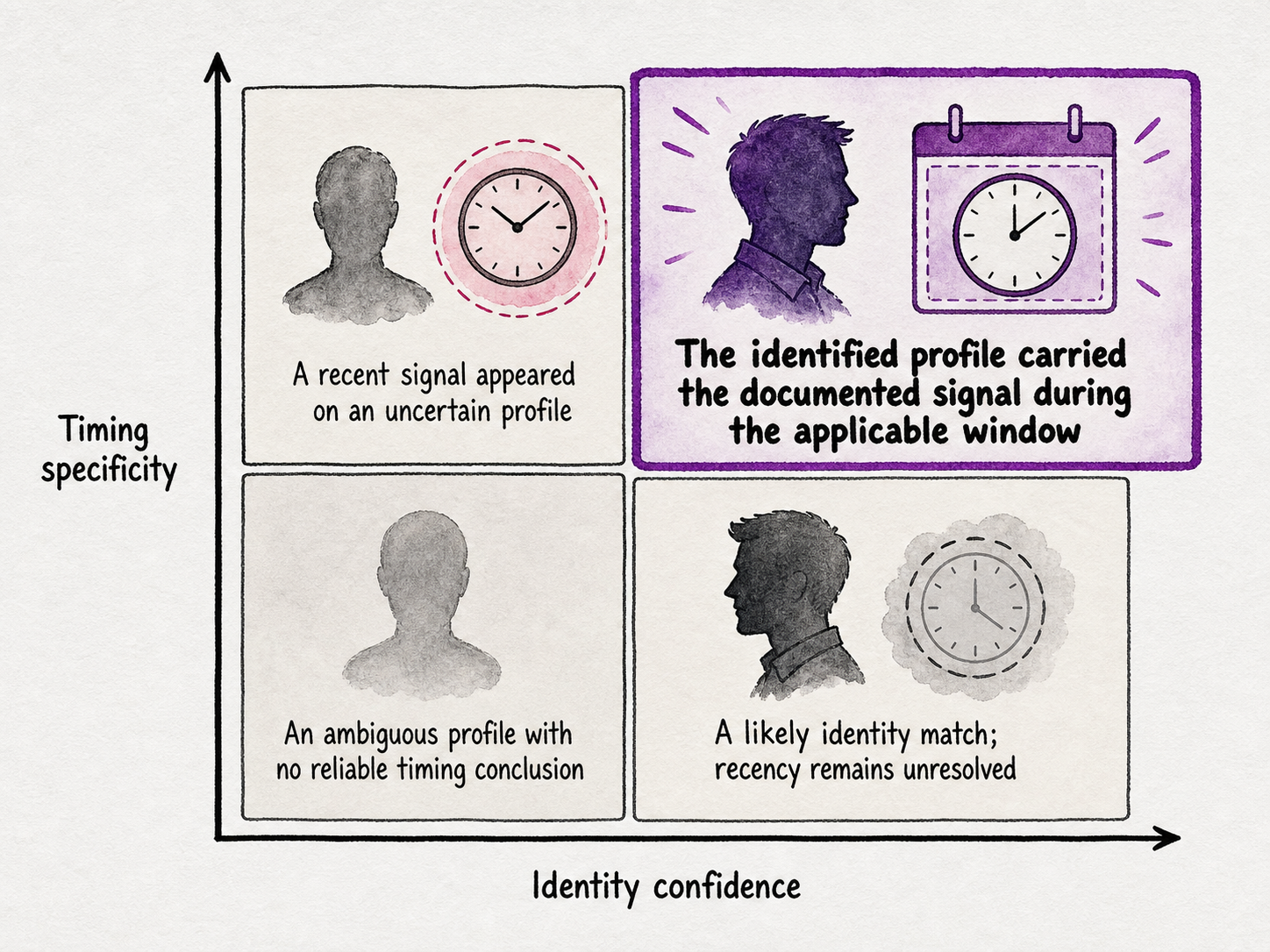
Assess every observation on two independent axes.
Axis one: timing specificity. A simple profile sighting has little timing value. An undated change or vague recency phrase may narrow the possibilities slightly. An exact label with a current documented window and a known observation time provides the strongest timing signal—but only within that window.
Axis two: identity confidence. A common first name or general resemblance provides little confidence. Confidence can rise when independent details align, such as a name or nickname, age, city, and distinctive photos. Missing details and conflicts must remain visible rather than being explained away.
The weaker axis caps the conclusion:
| Timing specificity | Identity confidence | Maximum responsible conclusion |
|---|---|---|
| High | Low | A recent signal appeared on an uncertain profile |
| Low | High | A likely identity match was visible, but recency is unresolved |
| High | High | The identified profile carried the documented signal during the applicable window |
| Low | Low | An ambiguous profile was observed with no reliable timing conclusion |
Even the high-and-high result does not establish a swipe, match, message, intention, meeting, or relationship violation. It supports only the platform-defined signal on the identified profile.
Record the Six Facts That Preserve Meaning
Create one record for each observation:
- App: Name the specific platform.
- Exact status wording: Copy the label, timestamp, or indicator description exactly.
- Source: State whether it was seen directly, in a screenshot, or in a dated report.
- Observation time: Record when the indicator was actually visible. If a screenshot was forwarded later, preserve the original capture time if available.
- Documented window: Add only the window stated in current app-owned documentation. Include the documentation owner and verification date. If no definition can be matched, record the window as undefined.
- Identity confidence: List the details that agree, conflict, or remain unconfirmed.
Do not merge separate observations into a single story. Each record must support its own timing and identity conclusions before it can contribute to a broader chronology.
Worked Cross-App Example
Suppose a Tinder screenshot clearly displays the named Recently Active indicator at a known time. The dated secondary explanation associates that indicator with the preceding 24 hours, but the profile contains only a common first name, a broad age match, no confirmed city, and one unclear photograph. The timing signal is comparatively specific, while identity confidence is low. The supported conclusion is that an uncertain profile carried the indicator—not that a particular person was recently active.
A second observation on another app contains a distinctive photograph, matching nickname, matching age, and matching city. Identity confidence is much stronger, but the profile is merely visible and no exact activity label has been matched to a current app-owned definition. That record supports a possible identity match while leaving recency unresolved.
Combining the observations does not repair either weakness. The Tinder indicator cannot supply identity confidence, and the strong identity match on the other app cannot manufacture a time window. Neither observation supports a conclusion about private actions or infidelity.
When additional context would materially affect a decision, CheaterBusting says it can compare candidates across selected covered apps using multiple identity details, preserve conflicts and missing evidence, and provide confidence notes. It describes using public or otherwise available information without requiring passwords, private-account access, messages, or the subject’s device. Results may include a possible match or no supported match, with repeated checks during the active paid period.
Those outcomes have strict limits. A possible match is not proof of cheating, and no supported match does not establish that no profile exists or ever existed. The smallest useful next step is usually to preserve the six-field record, consult the relevant app’s current documentation, and resolve the weaker axis before considering a lawful private search.
FAQ
Does an activity status mean someone is online now?
Only if the platform’s current definition for that exact status says so. A label may instead describe a broader recency window. Do not replace the platform’s wording with “online now.”
Does a missing dot or label mean inactivity?
Not automatically. The indicator may be optional, hidden, audience-limited, context-dependent, or governed by another display rule. Without a documented rule for absence, inactivity remains unproven.
Can profile visibility prove recent use?
No. Visibility establishes that the profile appeared through a particular source. It does not, by itself, establish a last-login time or recent private action.
Can a profile change identify when or why it was changed?
Two dated observations may establish that a visible field changed between them. They do not necessarily identify the exact edit time, the person who made the change, its purpose, or later behavior.
Can a status or private search prove cheating?
No. A status communicates only its platform-defined signal. A private search may organize possible matches and identity evidence, but neither a possible match nor an activity indicator proves cheating.
What should be recorded before drawing a conclusion?
Record the app, exact status wording, source, observation time, documented window with its owner and verification date, and identity confidence. Then let the weaker of timing specificity and identity confidence determine the strongest conclusion the evidence can support.
Next decision
Need broader evidence across covered apps?
Review scope, confidence limits, and pricing before starting any private search.
Continue reading
Related evidence guides
Active vs Recently Active on Tinder: What the Evidence Supports
Learn what Tinder’s Recently Active indicator supports, why a generic Active reference has no verified meaning here, and how capture time and identity affect interpretation.
How Long Do Dating Profiles Stay Visible? A Lifecycle Test
Use a five-part lifecycle test to judge what a dating-profile sighting, later update, or no-match result can safely establish.
How to Tell if a Tinder Profile Is Current
Use five evidence layers to assess Tinder profile currency, separate identity from timing, and choose a proportionate next step.