
How Long Do Dating Profiles Stay Visible? A Lifecycle Test
Use a five-part lifecycle test to judge what a dating-profile sighting, later update, or no-match result can safely establish.
- Author
- CheaterBusting Team
- Reviewed
- Reviewed July 29, 2026
- Reading time
- 10 min read
In this guide
TL;DR
- There is no evidenced universal period for how long dating profiles remain visible. Duration depends on the named platform, the claimed account action, any visibility controls, and how the profile was observed.
- A visible profile does not by itself prove recent use, identity, account control, intent, relationship status, or infidelity.
- Only current official platform documentation can establish platform-specific deletion, pause, visibility, or retention behavior. Without it, the behavior remains unknown.
- A material profile change can strengthen timing evidence when two reliable, dated observations establish the difference. It does not reveal who made the change or why.
- A no-match result means no sufficiently supported match was found within that search’s coverage and timing—not that the profile was deleted or never existed.
Seeing a familiar face on a dating app after being told the account is no longer used can feel like a direct contradiction. The useful question, however, is not “How many days should this profile last?” but “What does this particular observation establish, and which facts are still missing?”
Table of Contents
- Use the five-part dating-profile lifecycle test
- What four common observations can—and cannot—establish
- Choose the smallest lawful next step that could change the decision
- FAQ
Key Takeaways
- Profile visibility and present activity are different claims. A sighting records what appeared through a source, not necessarily when the account was last used.
- Identity and timing require separate judgments. Several matching details may support identity while the age of the observation remains unresolved.
- Capture time matters more than receipt time. A screenshot received today might have been captured much earlier.
- Changes need a dated baseline. A different photo, bio, age, location, or other field has useful timing value only when the earlier and later observations are comparable and reliably dated.
- Further checking needs a decision purpose. Seek another observation only if a possible result could change what you do next.
Use the Five-Part Dating-Profile Lifecycle Test
A dating-profile lifecycle is the sequence of observable profile states and changes. It is not a guaranteed platform retention schedule or a countdown to disappearance.
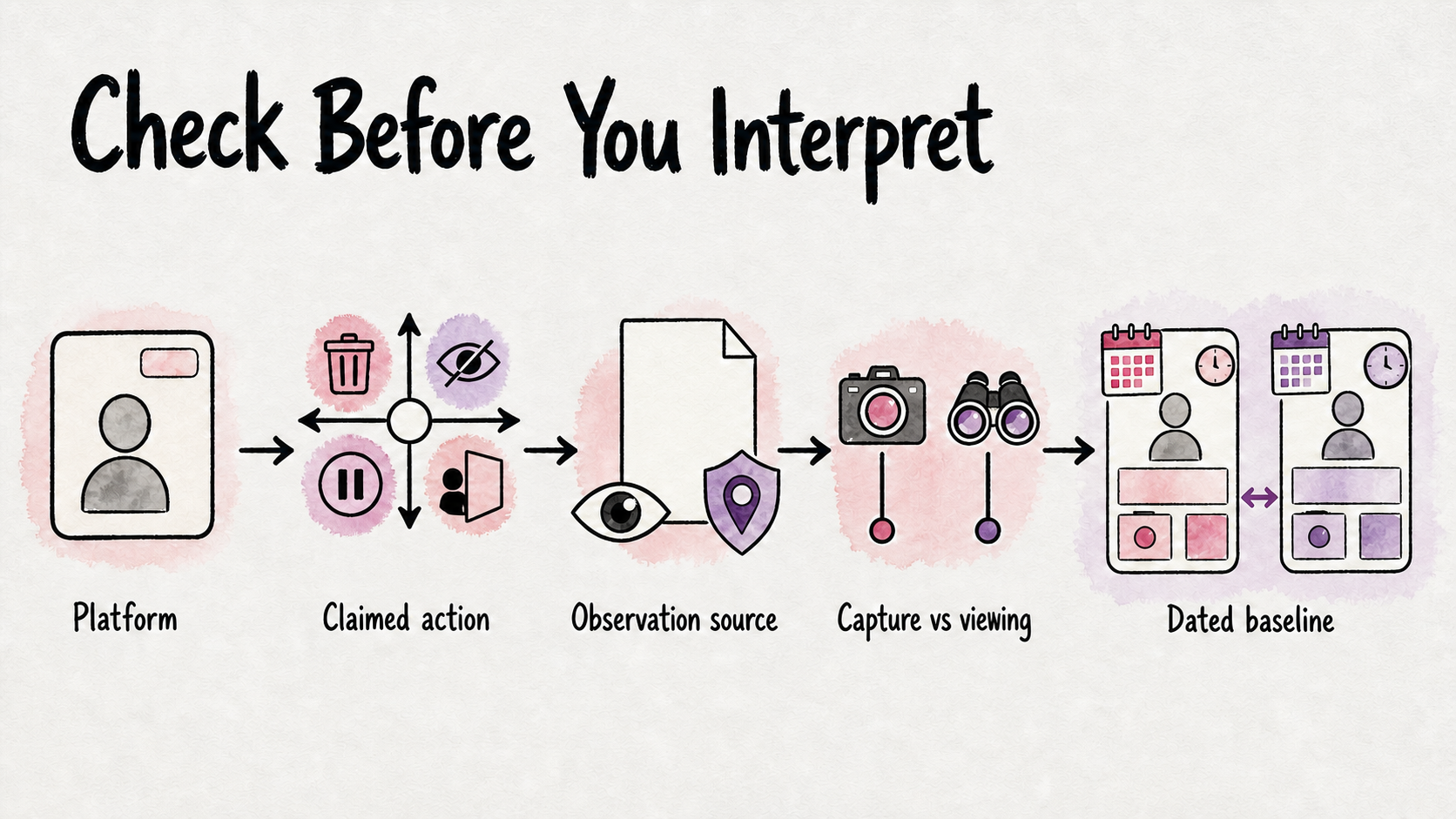
Tinder, Bumble, Hinge, and other services should not be treated as though they share one expiration rule. Even within one app, “stopped using it” can describe several actions. Use this five-part test before assigning meaning to a sighting.
-
Identify the platform. Record whether the observation concerns Tinder, Bumble, Hinge, or another named service. Do not transfer a rule, label, or expectation from one app to another.
-
Define the claimed action. “I got rid of it” could refer to uninstalling the app, completing an account-deletion process, pausing a profile, or changing a visibility setting. These actions are not interchangeable. Removing software from a device is different from deleting the underlying account, while pause and visibility controls depend on the named platform’s current official documentation. The separate deletion-terminology guide provides a fuller explanation of these distinctions.
-
Establish the observation source. Was the profile seen directly in an app, preserved in a screenshot, or returned by a third-party search? A dated in-app sighting and an undated image do not carry the same timing value. Record who observed it and whether the source can establish when it appeared.
-
Separate capture time from viewing time. Record when the profile was observed or captured, when the record was sent, and when you viewed it. A screenshot received on Friday is not necessarily evidence of a Friday sighting. If capture time cannot be established, timing confidence should remain low.
-
Compare material changes with a dated baseline. Look for observable differences in photos, bio text, age, location, or other profile fields. A change has useful timing value only when two reliable, comparable observations are dated. Even then, the comparison does not establish the exact edit time, who controlled the account, present activity, or the reason for the change.
Consider an illustrative example: someone sends you a Bumble screenshot on Friday. Record Bumble as the platform, clarify whether the claimed action was uninstalling, deletion, pausing, or another visibility change, identify who captured the image, and determine whether Friday is the capture date or merely the delivery date. Then compare it with a dated earlier record, if one exists. Without those details, “the profile appeared after Friday” may exceed what the evidence supports.
| Platform | What can define deletion or visibility behavior? | If current official documentation is unavailable |
|---|---|---|
| Tinder | Tinder’s current official documentation | Treat the rule and duration as unknown |
| Bumble | Bumble’s current official documentation | Treat the rule and duration as unknown |
| Hinge | Hinge’s current official documentation | Treat the rule and duration as unknown |
| Another dating app | That platform’s current official documentation | Treat the rule and duration as unknown |
Do not label a profile “inactive” merely because someone says it is old. Inactivity is a claim about use; an unchanged profile is an observation about visible content. The separate guide to inactive Tinder profile visibility addresses that narrower Tinder-specific question.
What Four Common Observations Can—and Cannot—Establish
The following matrix presents illustrative applications of the test, not documented cases or proof of how any platform behaves.
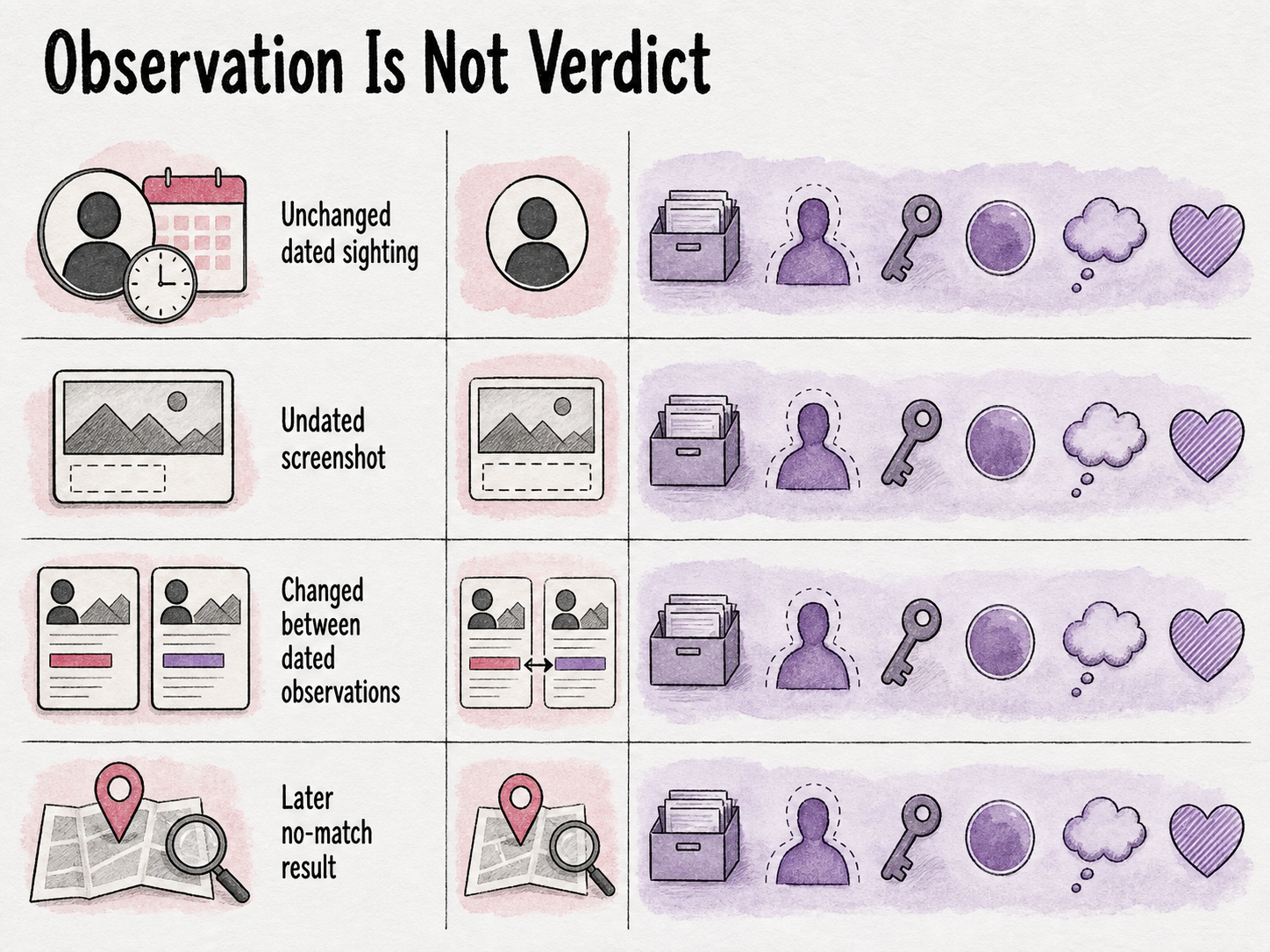
| Observation | Identity value | Timing value | Supported statement | Unresolved questions |
|---|---|---|---|---|
| Unchanged profile seen in-app on a known date | Depends on the combined name, age, city, photos, and other matching details | Establishes a dated sighting, not the age of the content | A profile with these visible details appeared through this source on this date | When the content was created, when the account was last used, who controls it, and why it appeared |
| Undated screenshot | May provide identity context if the visible details overlap | Weak or unavailable | The image depicts a profile with certain visible details | Capture date, source, completeness, and whether it reflects a later account state |
| Materially changed profile shown by two reliable dated observations | Identity must be assessed across both records | Stronger because the change occurred between two dated observations | A visible field differed between the dated baseline and later observation | Exact edit time, account controller, present activity, intent, relationship status, and infidelity |
| Later no-match result | No supported match was established by that search | Establishes the result at that search point only | No sufficiently supported match was found within the method’s coverage and timing | Whether a profile was unavailable, outside coverage, changed, deleted, missed, or never existed |
Keep the conclusions separate. Identity confidence concerns whether the visible profile corresponds to the person in question. Timing confidence concerns how well the evidence dates a sighting or change. Neither establishes account control.
Account control is also different from present activity. Present activity is different from intent. None of these conclusions establishes infidelity. Identity may be strongly supported while timing remains unresolved, and stronger timing evidence may still leave control and purpose unknown.
A material update can carry more timing value than unchanged content, but only when two reliable dated observations establish the comparison. The narrow conclusion is that an observable field changed between those observations—not that a particular person made the change, was actively dating, or was unfaithful.
A no-match result requires the same restraint. It reports what the search supported under particular coverage and timing conditions, not universal absence. The separate explanation of what “No Match Found” means examines this limit in greater depth.
Choose the Smallest Lawful Next Step That Could Change the Decision
A one-time search is a snapshot of what its method can find within its coverage, timing, and available information. It may add a dated observation, but it cannot settle every question about account state or behavior.
Monitoring adds opportunities for later observable findings during a defined active period. A later material change may strengthen a timeline, while an unchanged or empty result may leave the main uncertainty intact. Monitoring cannot guarantee completeness, reveal private behavior, or establish intent or infidelity. The separate recurrence-timeline guide explains how to organize repeated observations without turning recurrence into proof, while the monitoring-scope overview describes the limits of continued checks.
CheaterBusting offers a private search across selected covered dating apps. It uses multiple matching signals, including name or nickname, age, city, photos, and available activity or update context, then presents possible matches with confidence notes and visible uncertainty. A possible match is guidance, not proof, and a no-match result is not proof of absence.
The service uses public or otherwise available information. It does not require passwords, phone access, access to private accounts, or messages, and it does not contact the person being checked. Only lawful uses of public or otherwise available information are appropriate.
For more detail before deciding whether a broader search is useful, review the CheaterBusting methodology overview and sample report. The methodology explains the search and matching boundaries; the sample report shows how identity-signal overlap, freshness context when available, confidence, and uncertainty can be presented without turning a possible match into a verdict.
Before seeking anything else, complete this sentence: “Another observation would change my decision if it showed…” Name a concrete possibility, such as a reliably dated material profile change. If no possible result would affect your assessment, more checking is unlikely to help.
Choose the smallest suitable step:
- Clarify what account action was actually claimed.
- Preserve the source and capture date of the existing observation.
- Compare it with one reliable, dated baseline.
- Conduct a bounded search using lawful public or otherwise available information.
- Monitor for a defined period only if a later observable change could matter.
- Stop when another result would not change your response.
Set a review point before beginning. Decide what evidence you are seeking, how it could change the assessment, and when you will stop. If broader cross-app evidence would genuinely affect your next decision, review the methodology and sample report or consider a private multi-app search. Treat any result as information to assess, not a substitute for context, personal safety, or a careful conversation.
FAQ
How long do dating profiles remain visible?
There is no evidenced universal period. The defensible answer depends on the named platform, the exact account or visibility action, the observation source, and current official platform documentation. Without documentation for the exact behavior, a fixed duration would be speculation.
Can an old dating profile still appear?
A dated sighting may contain photos or text that look old or remain unchanged. Appearance alone cannot date the profile, establish its account state, or explain why it appeared through a particular source.
Does a visible profile prove recent use?
No. At most, it establishes that a profile with certain visible details was observed through a particular source at a known time. Recent use, identity, account control, intent, relationship status, and infidelity remain separate questions.
What makes a later observation stronger timing evidence?
Reliable observation dates, comparable sources, a supported identity assessment, and a material change against a dated baseline. Even then, the evidence supports only the observable change and the interval in which it occurred.
What does a no-result establish?
It establishes only that no sufficiently supported match was found within that search’s coverage and timing. It does not prove deletion, loyalty, permanent absence, or that a profile never existed.
Why not give separate expiration periods for Tinder, Bumble, and Hinge?
Platform-specific deletion, pause, visibility, recommendation, or retention claims require each platform’s current official documentation. When documentation for the exact question is unavailable, the behavior and duration should be treated as unknown.
Next decision
Need broader evidence across covered apps?
Review scope, confidence limits, and pricing before starting any private search.
Continue reading
Related evidence guides
Active vs Recently Active on Tinder: What the Evidence Supports
Learn what Tinder’s Recently Active indicator supports, why a generic Active reference has no verified meaning here, and how capture time and identity affect interpretation.

Dating App Activity Status Meaning: A Cross-App Evidence Guide
Learn how to interpret dating app activity statuses across Tinder, Bumble, Hinge, Facebook Dating, and Grindr without confusing visibility, profile changes, identity, or private behavior.
How to Tell if a Tinder Profile Is Current
Use five evidence layers to assess Tinder profile currency, separate identity from timing, and choose a proportionate next step.