
How to Assess a Grindr Photo Match Without Overclaiming
Use a practical photo-evidence worksheet to assess image quality, compare visible details, record conflicts, and label uncertainty.
- Author
- CheaterBusting Team
- Reviewed
- Reviewed July 17, 2026
- Reading time
- 11 min read
In this guide
TL;DR
- Check image age, crop, clarity, angle, and source before judging resemblance.
- Record visible details separately for each photo. Write “unknown” when the image does not show enough.
- Use matching age and city only to support a usable comparison, not to repair a poor one.
- Preserve conflicts instead of explaining them away.
- Label the evidence weak, possible, or corroborated. These labels do not prove identity or behavior.
A familiar face in a Grindr photo can feel conclusive within seconds, especially when the stakes are personal. Yet an old screenshot, tight crop, or familiar expression may contain far less usable information than your reaction suggests. A short photo-evidence worksheet can slow that reaction just enough to show what is visible, what is missing, and how much weight the comparison can reasonably carry.
Table of Contents
- Key Takeaways
- Prepare the Images and Set a Confidence Ceiling
- Record Visible Details in a Photo-Evidence Worksheet
- Add Context and Preserve Conflicting Details
- Classify the Evidence and Choose the Next Action
- How CheaterBusting Uses Photos With Other Signals
- FAQ
Key Takeaways
- The condition of the images comes first. A poor candidate image places a ceiling on confidence before any similarities are considered.
- Observation and interpretation belong in separate steps. Write down what you can see before deciding what it means.
- Context has a supporting role. Matching age and city can strengthen usable photo evidence, but common details cannot identify someone.
- Unknown is a valid result. A hidden ear, blurred mark, or uncertain photo date should not be converted into agreement.
- Speed carries a cost. A quick visual judgment feels easier, but a documented comparison exposes missing information that intuition may ignore.
Prepare the Images and Set a Confidence Ceiling
Begin with two images already lawfully available to you: the Grindr profile image and a reference photo of the person you know. Give them neutral labels such as Image A and Image B. Avoid labels like “profile photo” and “proof photo” in your notes, since those words can push the conclusion before the comparison begins.
For each image, record:
- Where it came from
- When you obtained it
- When you believe it was taken, if known
- Whether it is an original, screenshot, crop, or repost
- Whether filters or edits are visible or suspected
- Whether the face is clear, partly hidden, or too small to assess
Separate the date obtained from the estimated age of the photo. A screenshot saved today may contain a photo taken years ago. If the image date is uncertain, write “unknown” rather than estimating from appearance.
Next, describe the visual limits. Note blur, compression, harsh lighting, shadows, camera angle, facial expression, eyewear, obstruction, and missing areas caused by cropping. These are not minor technical concerns. They determine which comparisons are possible.
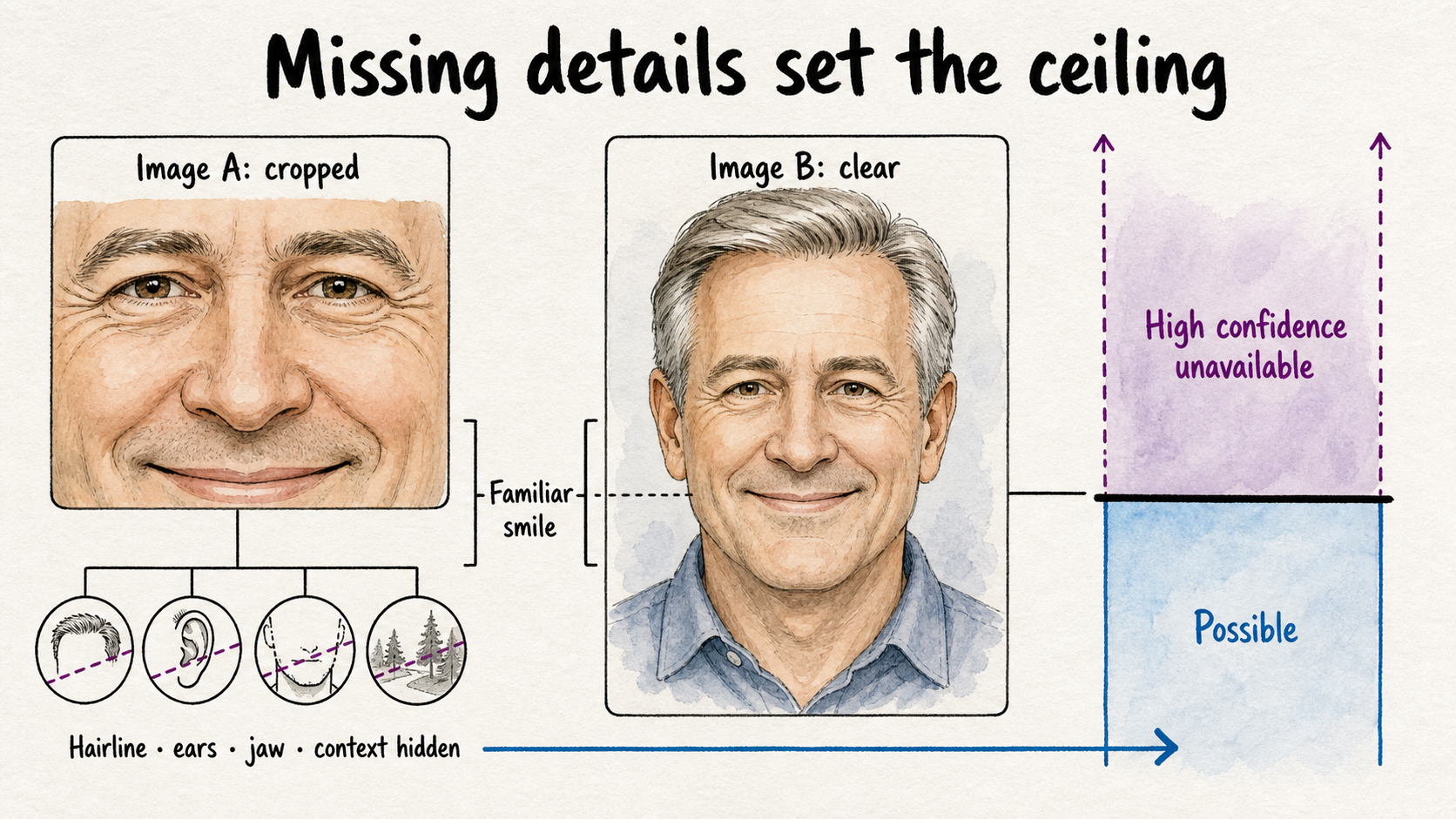
Consider an illustrative example: the Grindr image appears to be an older photo cropped closely around the eyes, nose, and smile. The reference image is recent and clear. The smile feels familiar, but the candidate image hides the hairline, ears, jaw outline, and most surrounding context. Its age may also account for differences in grooming or facial shape.
That photo cannot support a high-confidence comparison simply because one expression looks familiar. The missing information sets a ceiling. At most, the image may justify further comparison if other visible details are usable.
The same rule applies when comparing two clear photos taken from sharply different angles. One front-facing image and one shadowed side view may each look good alone, yet still be poor comparators. Image quality is not only sharpness. It is whether the two photos expose enough of the same areas under reasonably comparable conditions.
There is no authoritative image-comparison guidance in the cited material for assigning similarity percentages, biometric thresholds, or accuracy rates. Do not create a points system that gives scientific-looking precision to a visual judgment. Describe the limits plainly and let those limits constrain the conclusion.
Record Visible Details in a Photo-Evidence Worksheet
Once you know what the images can show, record observations before interpreting the resemblance. A compact worksheet keeps emotional recognition from becoming a statement of fact.
| Worksheet field | Image A | Image B | Comparison note |
|---|---|---|---|
| Source and date obtained | |||
| Estimated photo age | Match, conflict, or unknown | ||
| Original, screenshot, crop, or repost | |||
| Quality and visibility limits | |||
| Face shape as visibly presented | Agreement, conflict, or unknown | ||
| Hairline or hair pattern | Agreement, conflict, or unknown | ||
| Ears, brows, nose, or smile | Record only what both images show | ||
| Clearly visible marks or accessories | Agreement, conflict, or unknown | ||
| Age field | Match, conflict, or unknown | ||
| City field | Match, conflict, or unknown | ||
| Photo-specific conflicts | |||
| Evidence label | Weak, possible, or corroborated |
The feature rows are prompts, not a claim that any one trait uniquely identifies a person. Use only details that are genuinely visible in both images. Avoid guessing at measurements, symmetry, or details concealed by shadow, filters, facial hair, or crop.
Write observations in literal language. “Both images show a small gap between the upper front teeth” is an observation if the detail is clear. “That is definitely his smile” is an interpretation. “The ears match” is unsupported if one image does not show the ears.
Appearance can also vary with expression, grooming, age, angle, and lighting. A beard may hide the jaw. Raised eyebrows may alter the visible eye area. A wide smile changes the cheeks and mouth. Record these conditions alongside the feature instead of treating every difference as a conflict.
This step takes longer than deciding by instinct. That is the point. The worksheet does not remove uncertainty, but it makes the source of that uncertainty visible.
Add Context and Preserve Conflicting Details
After completing the visual rows, add age and city as limited supporting fields. For each, use only three entries: matches, conflicts, or unknown.
Suppose two similar-looking people are both around the same age and live in the same city. Those agreements make the comparison more relevant, but they remain common facts. They do not convert resemblance into identification. If the photos show only common traits under poor conditions, the result may still be possible rather than corroborated.
Context cannot recover visual information removed by a crop or hidden by blur. A matching city does not reveal an obscured ear. A matching age does not establish when either image was taken. Treat context as support for usable visual evidence, never as a replacement for it.
Conflicts require the same restraint. Record only those that directly change the interpretation of the photographs, such as:
- The stated age does not fit the known dates of the images.
- One photo appears much older than first assumed.
- A potentially useful feature is hidden by the candidate image’s crop.
- A visible detail appears different, but lighting or angle prevents a fair comparison.
- One image is clear while the other is too compressed to test the apparent difference.
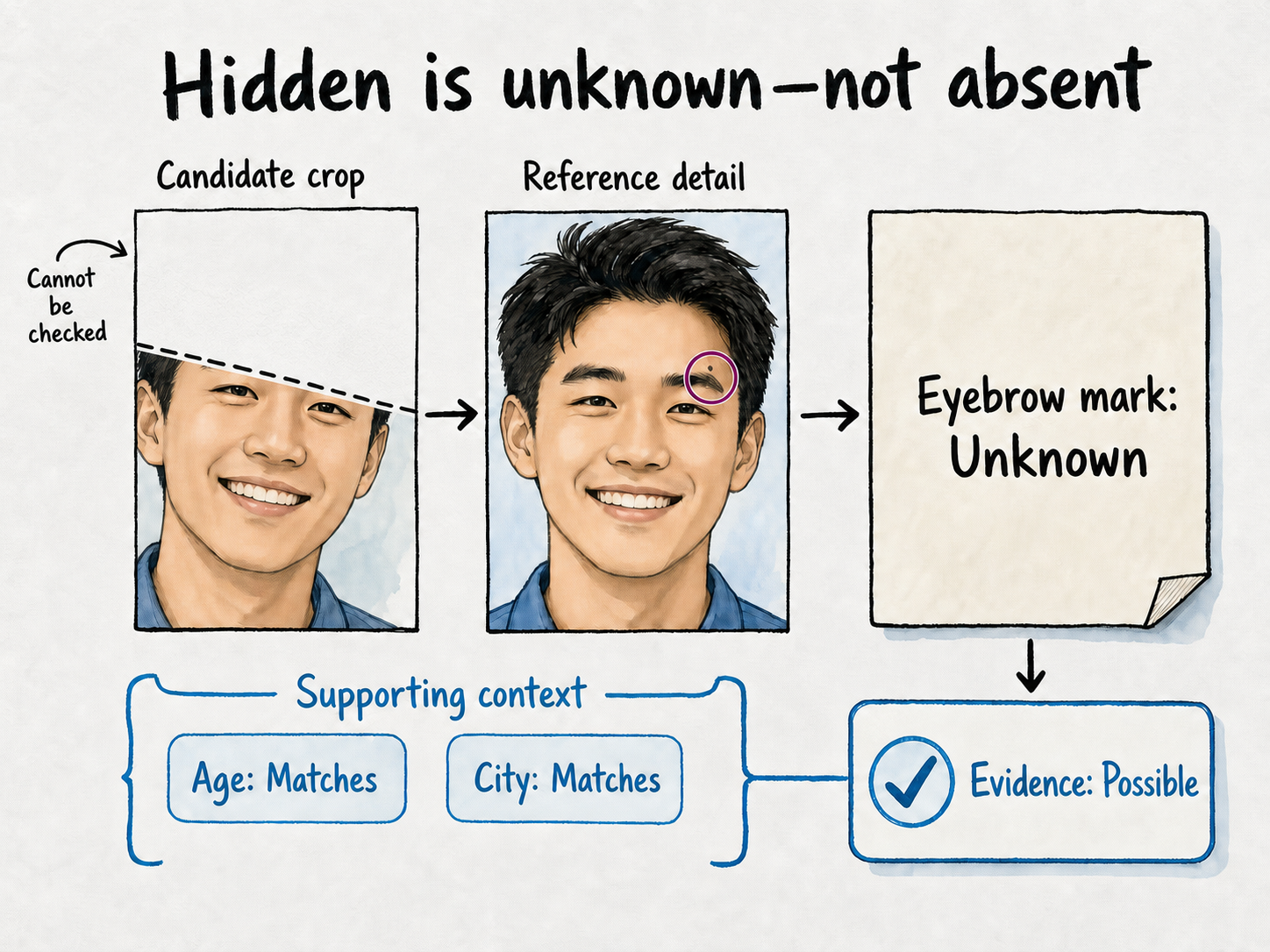
Do not force every row into “match” or “conflict.” If the candidate image hides a mark visible in the reference photo, the entry is unknown. Absence from view is not evidence that the feature is absent.
For example, imagine a clear recent reference photo showing a small mark near the left eyebrow. The Grindr screenshot has been compressed and cropped just above that area. The two images show a similar smile and brow shape, and the listed age and city agree. The proper record is not “mark matches.” It is “mark cannot be checked because of crop.” The comparison may remain possible because a material detail is unresolved.
Broader questions about names, biographies, competing identities, or every possible profile inconsistency require a wider wrong-match review. Keep this worksheet focused on facts that change the quality of the photo comparison.
Classify the Evidence and Choose the Next Action
Review the worksheet as a whole. Do not count matching rows or calculate a percentage. Instead, assign one qualitative label based on image usability, observable agreement, limited contextual support, and unresolved conflicts.
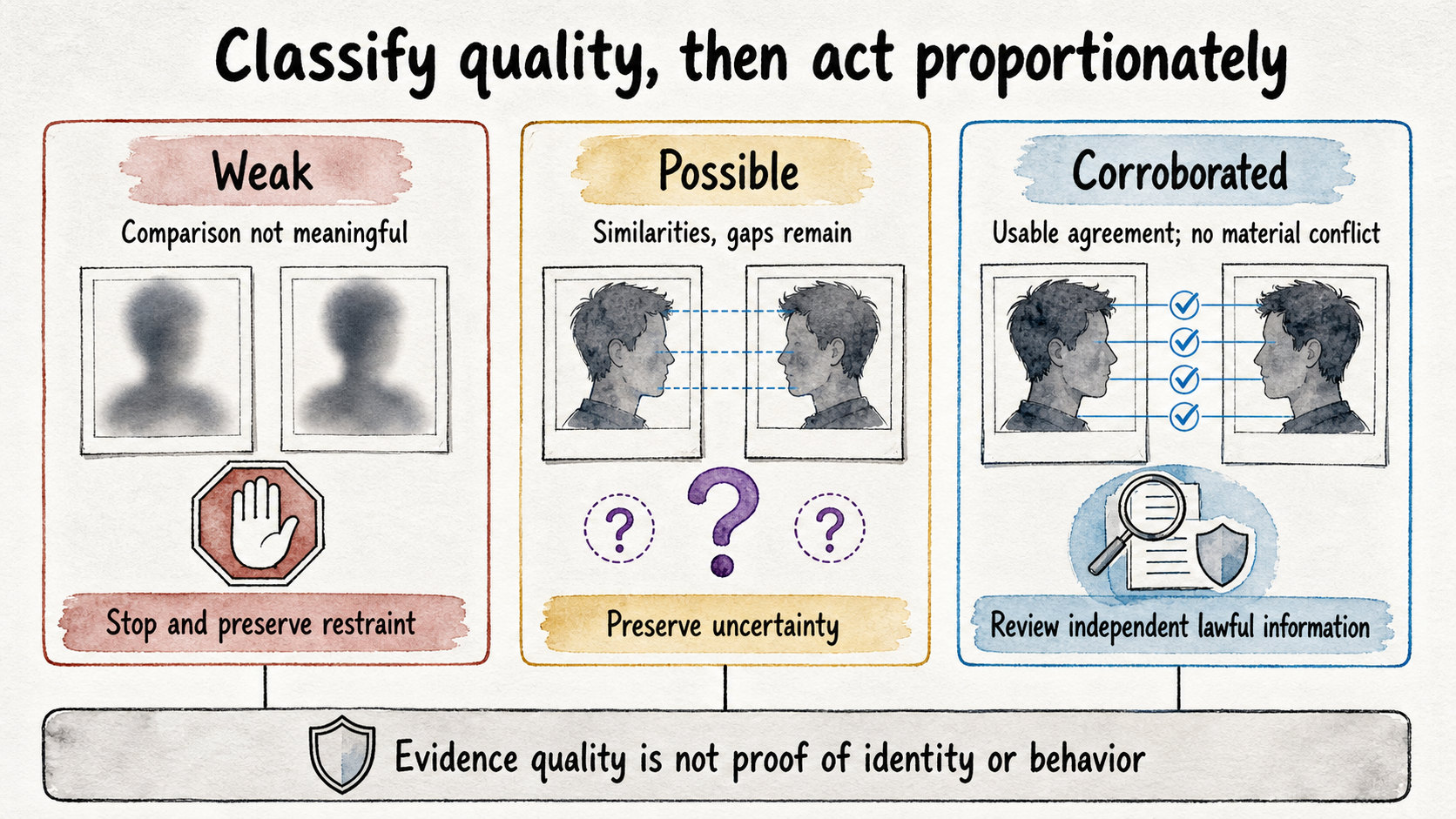
Weak evidence means the images do not permit a meaningful comparison. The face may be too small, blurred, obscured, heavily filtered, old, or tightly cropped. A few familiar traits do not overcome those limits.
If the evidence is weak, save the worksheet and stop treating the resemblance as actionable information. Seek a clearer lawful image only if one becomes available through an appropriate source. Do not fill the gaps with assumptions.
Possible evidence means the photos allow some comparison and show relevant similarities, but the result remains underdetermined. The visible traits may be common, context may be limited, or important details may remain hidden or in conflict.
The older cropped-photo example would usually remain weak or possible, depending on what is visible. Likewise, two similar-looking people of comparable age in the same city can still produce only a possible classification. Matching context narrows the question, but it does not resolve the image.
If the evidence is possible, preserve that wording. A possible match deserves neither dismissal nor an identity claim. The proportional next step is to retain the worksheet, note what information would change the assessment, and wait for better lawful evidence if the decision genuinely requires it.
Corroborated evidence means the images are usable and reasonably comparable, several meaningful visible details agree, age and city provide consistent support, and no material photo-specific conflict remains unresolved.
Corroborated is the strongest label in this worksheet, but it is still an evidence-quality classification. It does not prove who owns the profile. It also says nothing by itself about recent activity, intent, relationship agreements, or cheating.
The practical value of the label is proportional action. Weak evidence calls for restraint. Possible evidence calls for preserved uncertainty. Corroborated evidence may justify reviewing additional lawful, independent information, but it still does not support a behavioral verdict.
How CheaterBusting Uses Photos With Other Signals
For readers who want a private multi-signal check after completing the worksheet, CheaterBusting describes a process that accepts photos, age, city, and other identifying details. Its onboarding page says photos and facial features receive the most weight in its matching process. That is a first-party description of its method, not independent validation of photo-matching accuracy. Review the onboarding inputs and statement.
The company also says it weighs name, age, city, and photos together rather than relying on resemblance alone. Its reports are described as showing confidence for a possible match and identifying details that could not be confirmed. You can review how the dating app checker compares multiple signals before deciding whether that process fits your needs.
The privacy boundary matters as much as the matching method. CheaterBusting states that it does not request passwords or access private accounts, phones, or messages. It also says the person being checked is not contacted or notified. These are the company’s current published privacy statements, so read the privacy policy before submitting personal information.
Most importantly, the company describes a confidence assessment as guidance rather than proof of behavior or cheating. A tool can organize signals and report uncertainty, but it cannot decide what a profile means within a relationship. CheaterBusting also states that it is independent and not connected to Grindr or other dating apps.
Before starting a search, save your worksheet and its uncertainty label. If the evidence is weak or possible, do not quietly promote it to corroborated because a service is available. If you proceed, inspect the confidence notes and unconfirmed details with the same care you used for the images.
FAQ
Can a photo alone identify the owner of a Grindr profile?
No. A photo can support a resemblance assessment, but face-only similarity should not be treated as conclusive identification. Crop, age, angle, expression, lighting, compression, and common visible traits can all leave identity unresolved.
What if my only reference photo is old or tightly cropped?
Record its estimated age and missing areas, then lower the confidence ceiling. If the crop hides the details needed for comparison, classify those fields as unknown. The evidence may remain weak even when the visible portion feels familiar.
Does matching age and city make the photo conclusive?
No. Age and city are supporting fields. Both can be shared by many people, and neither can repair an unusable image. They matter most when the photos are already clear enough for a meaningful comparison.
What should I do if the worksheet remains weak or possible?
Keep the label and save the reasons behind it. Seek a clearer lawful image only if the unresolved question warrants another step. Do not access devices, accounts, or private messages, and do not convert missing information into a claim.
Can a corroborated Grindr photo match prove recent activity or cheating?
No. Corroborated means the available photo evidence is comparatively strong within this worksheet. It does not establish when the profile was used, why it exists, who controls it, or whether any behavior occurred.
Next decision
Need broader evidence across covered apps?
Review scope, confidence limits, and pricing before starting any private search.
Continue reading
Related evidence guides
cb-seo-app-specific-profile-search
Can You Search Grindr by Username? Test the Clue First
Learn whether a possible Grindr username deserves further checking, which details reduce mistaken identity, and when to set the clue aside.
cb-seo-photo-no-account-search
How to Prepare a Photo for a Dating Profile Search
Choose clear, lawful, nonredundant photos, crop them responsibly, and recognize when an image is too weak or inappropriate to upload.
cb-seo-photo-no-account-search
How to Reverse Image Search a Dating Profile Photo
Run a two-service photo search, inspect source pages, and interpret exact matches, lookalikes, and empty results responsibly.