
CheaterBusting vs Social Catfish: Which Search Fits?
Choose based on whether you need dating-app profile evidence or help checking whether an online identity is consistent.
- Author
- CheaterBusting Team
- Reviewed
- Reviewed July 18, 2026
- Reading time
- 13 min read
In this guide
TL;DR
- First decide whether you need to locate a possible dating-app profile or assess whether an online identity is consistent.
- A dating-app-focused search fits the first question when it covers the relevant apps and accepts enough accurate details to distinguish a plausible match from a coincidence.
- An identity-consistency search fits the second question only when the service’s current official pages describe a search and report that directly address your concern.
- A possible match is not proof of identity, control, activity, intent, or infidelity. Nothing found does not establish loyalty or rule out every profile.
- Check current privacy, renewal, cancellation, and refund terms before paying. Choose neither service when its documented process cannot answer your question.
You may have a name, recent photos, a likely city, and one troubling inconsistency. That may feel like enough to begin searching, yet it leaves two distinct questions: does information matching this person appear on a dating app, or do the details behind an online identity form a consistent picture? Separating those questions first helps you avoid paying for an impressive-looking report that never resolves the concern that brought you there.
Table of Contents
- Key Takeaways
- Start With the Question You Need Answered
- Match the Search Evidence to the Question
- Follow the Decision Tree Through Two Scenarios
- Check Boundaries and Terms Before You Act
- FAQ
Key Takeaways
- Possible dating-app presence and identity consistency are separate jobs. Evidence useful for one may say little about the other.
- Accurate details reduce ambiguity. A common name is weak evidence. Recent photos, nicknames, an age range, and a likely city can help distinguish a possible dating-profile match from a coincidence.
- The result must fit the decision. A profile candidate, confidence note, image association, or identity-related record would address different questions. They should not be treated as interchangeable.
- Continued checking matters only when the target information may change. It can help when a profile appears, disappears, or changes later, but it cannot compensate for choosing the wrong kind of search.
- Policies are part of product fit. Review how submitted information is handled, what conduct is prohibited, when a plan renews, how cancellation works, and whether payments are refundable.
Start With the Question You Need Answered
The CheaterBusting vs Social Catfish decision begins with a fork, not a feature count.
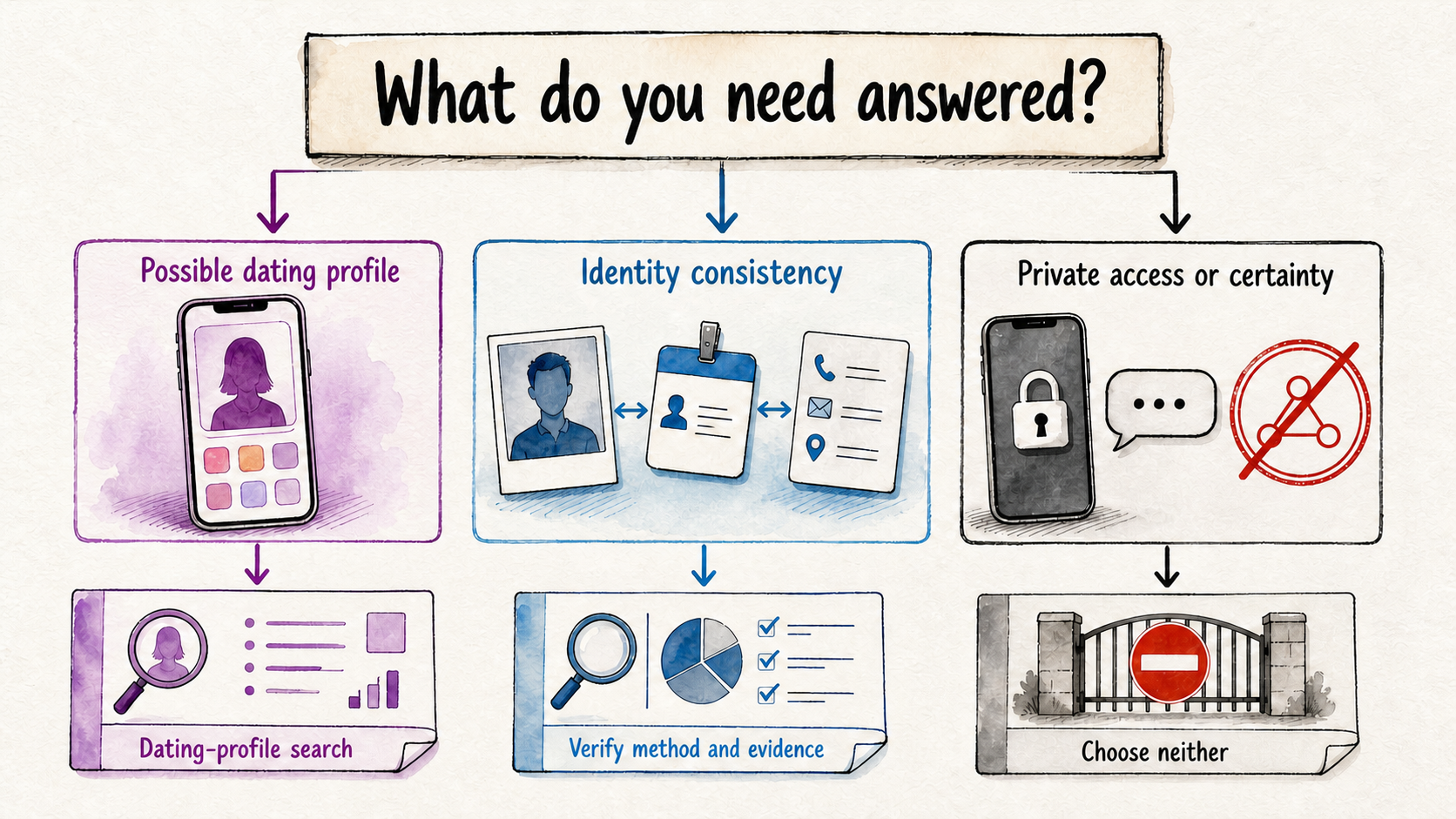
Branch one: You want to check supported dating apps for a possible profile. You may know a partner’s name or nickname, approximate age, city, and appearance. A useful result would be a possible profile connected through several matching signals, accompanied by an explanation of what agrees and what remains uncertain.
This branch calls for a service built around dating-profile discovery. CheaterBusting documents that job: users provide identifying details and photos, choose supported apps, and receive a report based on public or otherwise available dating-app information. The company lists Tinder, Bumble, Hinge, OkCupid, Plenty of Fish, Facebook Dating, Match, Badoo, Grindr, Raya, Tantan, and Happn among the apps it checks. Because coverage may change, confirm that each app relevant to your concern still appears on the live apps-covered page before paying.
Branch two: You want to assess whether an online identity is consistent. Perhaps photos, contact details, names, or biographical claims do not align, and a suspected dating profile is not the main issue. Dating-app coverage alone cannot settle that question. You need a current search method that accepts the material you possess, explains what sources or categories it examines, and states what its report can and cannot establish.
Social Catfish is often considered for this second kind of question. Before choosing it, inspect its current official product pages. Identify the exact search method relevant to your concern, what material it accepts, what the report contains, how recent the information may be, and what limitations apply. Do not assume that a broad label or a report with many entries confirms that separate details belong to the same person.
Choose neither service if you expect access to a private account, phone, password, login code, or messages. The same stop rule applies if you want certainty about who controls an account, why a profile exists, whether it is active now, or whether someone has been unfaithful. Search findings can guide further judgment, but they cannot establish those conclusions alone.
Match the Search Evidence to the Question
After choosing a branch, examine whether each service can return evidence that bears directly on it.
| Decision point | Dating-app profile branch | Online-identity branch |
|---|---|---|
| Core question | Does information matching this person appear on specified dating apps? | Do the available identity details form a consistent picture? |
| Helpful material | Recent photos, names or nicknames, age range, likely city, and relevant app choices | The exact image, identifier, or detail accepted by the current official search method |
| Useful result | Candidate profiles, matching signals, confidence guidance, and details that remain unconfirmed | An explained association between the submitted material and relevant identity information, including source and uncertainty limits |
| Timing | Continued checking may help if profiles appear or change later | Confirm whether the service provides a one-time result, continuing service, or another delivery schedule |
| Reason to stop | A required app is absent, the known details are too weak, or the expected conclusion concerns conduct | The needed search method, information category, source, or limitation is not clearly described |
CheaterBusting says it compares several signals rather than relying on a name alone. Its setup accepts names, nicknames, age or age range, city or location, photos, sex, dating preferences, and notes. The company says photos and facial features receive greater weight because names, ages, and other profile text can be changed or shared by different people.
That combination can make a dating-profile candidate more informative. For example, a matching photo, nickname, age range, and city together usually warrant more attention than a shared first name. Even several aligned details do not make the identification conclusive. Photos can be copied, profile text can be false, locations can be broad, and someone other than the subject may control an account.
CheaterBusting describes a private, plain-language report that can show possible matches or a nothing-found result. It provides confidence guidance, identifies details that could not be confirmed, and removes duplicate results. The company also says checking continues during the paid plan, with the full report and important updates delivered by email.
That delivery model fits a question that may change over time. A profile might become visible, disappear, or change after an initial check. Continued checking improves the chance of receiving later information within the service’s supported scope, but it does not guarantee complete, correct, current, or continuously available results.
For the identity-consistency branch, apply the same demand for specificity to Social Catfish. Confirm its current search methods, accepted material, report contents, information sources, delivery schedule, and stated limitations on official pages. If you cannot draw a clear line from what you possess to evidence that would help answer your question, pause rather than filling the missing details with assumptions.
A report that spans many categories is not automatically more useful. Numerous loose associations can create extra review work while leaving the central identity question unresolved. A focused dating-profile report can also be the wrong choice when the concern has nothing to do with dating apps. Scope creates value only when it matches the unresolved question.
Follow the Decision Tree Through Two Scenarios
The following situations are illustrative. They show how to apply the decision rule, not customer outcomes or measured service performance.
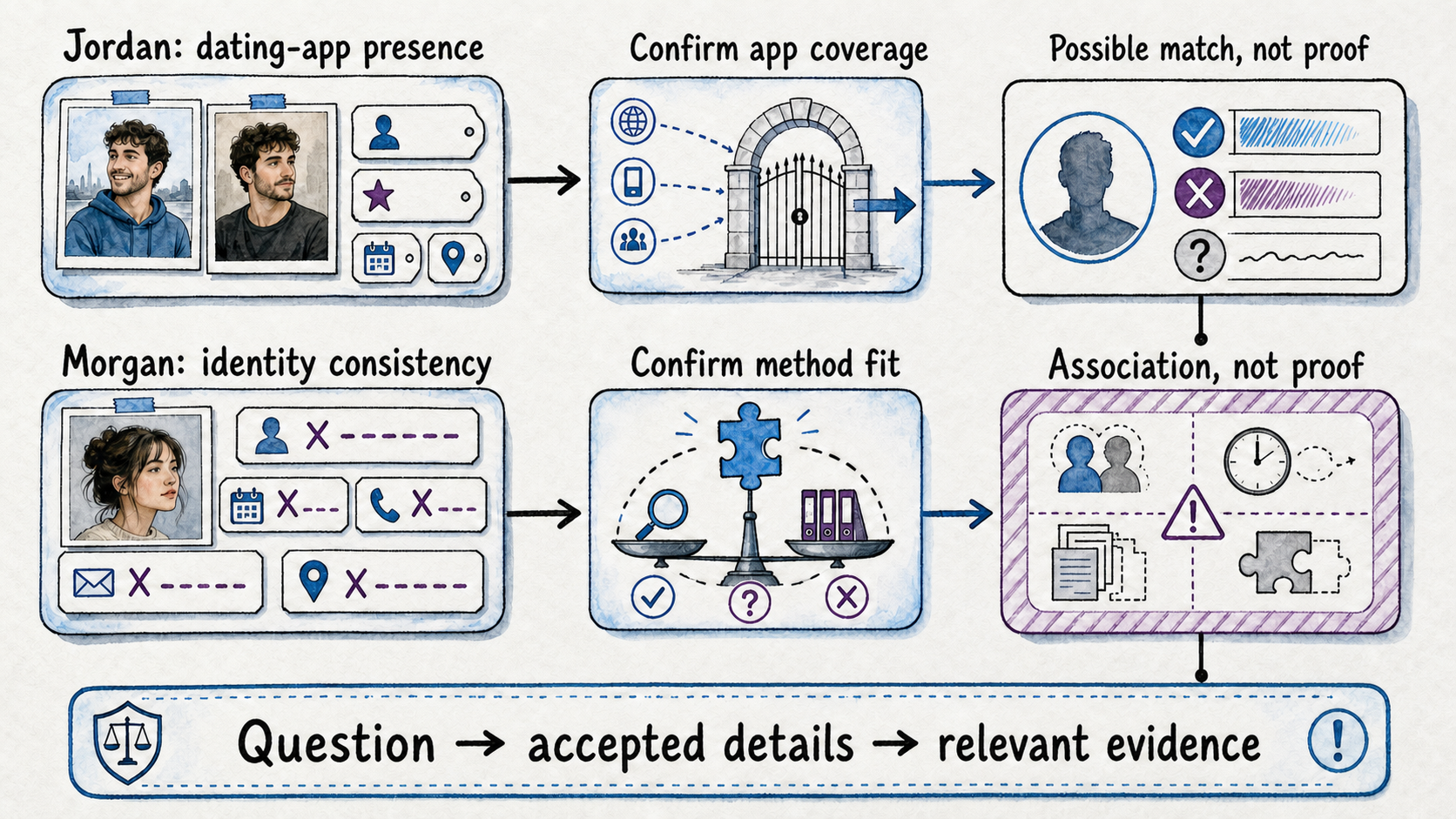
Scenario A: Searching major dating apps for a partner
Jordan has a partner’s usual name, one nickname, an approximate age, a likely city, and two recent photos. The concern is narrow: Jordan wants to know whether information matching that person appears on Tinder, Bumble, Hinge, or another relevant dating app.
That question belongs on the dating-app branch. Jordan should first confirm that every app of concern is currently supported. The next step is to provide the strongest accurate details lawfully available, with particular attention to clear, recent photos and known name variants. CheaterBusting’s documented process is designed around this combination of multi-app coverage and profile-matching details.
Suppose the report returns a candidate with a similar photo and city but a different age. Jordan should review the confidence guidance along with every conflicting or unconfirmed field. The measured conclusion is that a possible match requires careful assessment. It does not prove that the partner created or controls the profile, still uses it, plans to meet anyone, or has been unfaithful.
If the report says nothing was found, Jordan still cannot conclude that no profile exists. A profile may be unavailable, changed, outside the supported scope, or genuinely absent. Continued checking during an active plan may produce an update later, but it cannot eliminate those possibilities.
Scenario B: Checking whether an online identity is consistent
Morgan is communicating with someone online whose photos and personal details do not align. Morgan wants to assess whether the available information forms a consistent picture. Finding a spouse on several dating apps is not the central task.
That concern belongs on the identity-consistency branch. Morgan should inspect Social Catfish’s current official pages and find the precise search method that accepts the material already available. Before purchasing, Morgan should establish what the report contains, where its information may come from, how current it may be, how delivery works, and what the company says about accuracy and identity conclusions.
If the official description connects Morgan’s known details to relevant evidence, that route may fit better than a dating-app-focused search. If it does not explain that connection, Morgan should choose neither. Purchasing a search merely because it appears broad may return unrelated associations without clarifying the original inconsistency.
Even a result linking several details requires cautious interpretation. Shared names, recycled contact details, old records, copied photos, and incomplete information can create misleading connections. Morgan should not treat an aggregated or automated result as conclusive proof that an online person is genuine or deceptive.
Both scenarios yield the same practical rule: choose the branch first, then confirm that the service accepts the strongest details you have and returns evidence relevant to the decision. Compare prices only after passing that test. A lower-cost search that answers a different question is still a poor purchase.
Check Boundaries and Terms Before You Act
A service may fit your question yet fail your privacy, legal, or payment requirements. Apply one final purchase gate before submitting personal information.
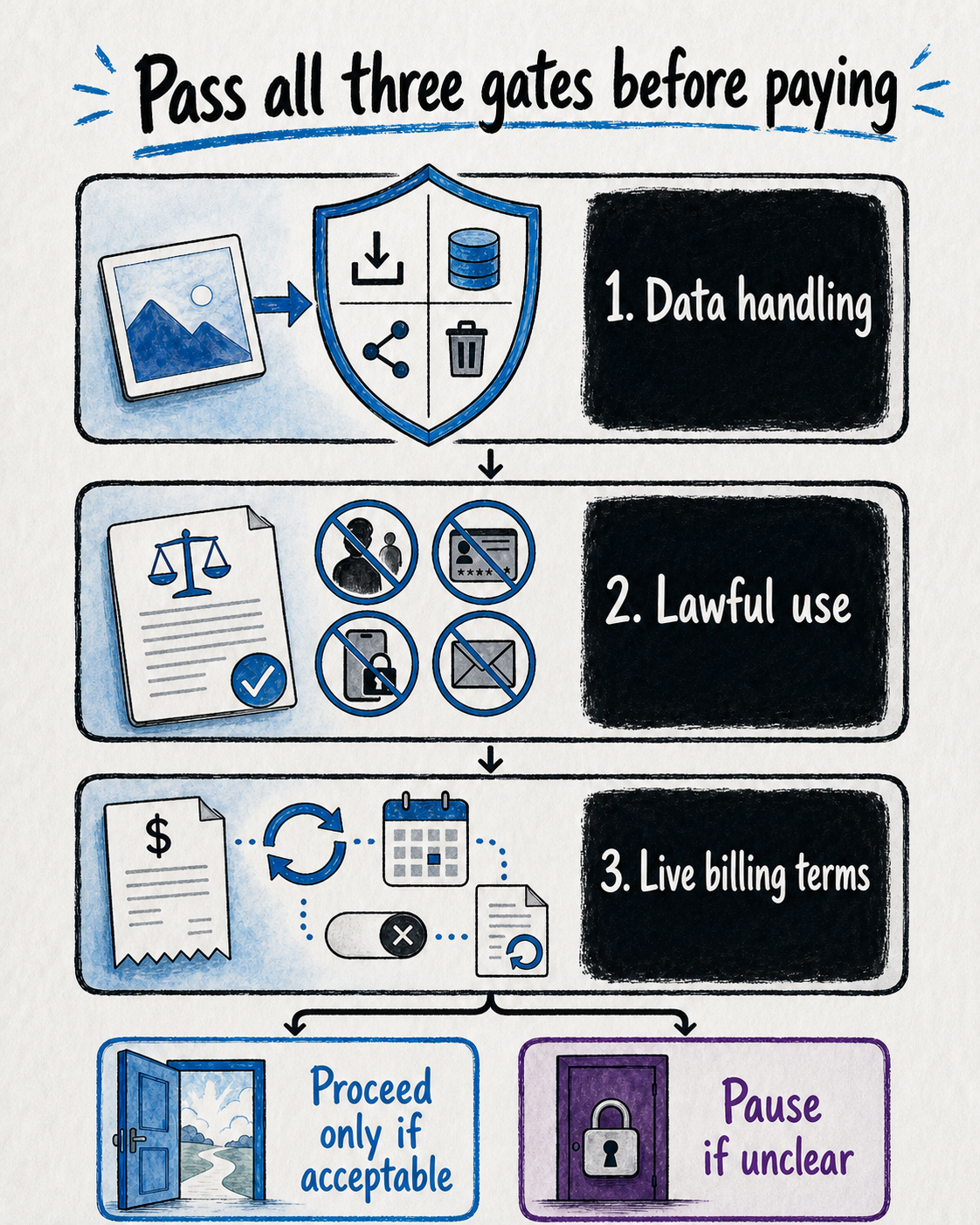
First, confirm the information boundary. CheaterBusting says it checks public or otherwise available dating-app information against details provided by the user. It says it does not request passwords or security codes, access private accounts, phones, or messages, or claim access to secret or private databases. The company also says the person being checked is not contacted or notified.
Read the current privacy policy before providing names, photos, notes, or identifying details. A private search should still have acceptable rules for collection, use, storage, sharing, and deletion. Company privacy statements describe policy commitments, not a reason to skip reading the terms yourself.
Second, confirm lawful use. CheaterBusting requires users to be at least 18 and prohibits stalking, harassment, threats, credential theft, unlawful surveillance, device access, message interception, and harmful disclosure. The company says it is independent of the dating apps it checks and offers its service without guaranteed results.
Apply equivalent scrutiny to Social Catfish. Read its current privacy and legal policies before submitting an image, identifier, or another person’s information. Confirm permitted uses, relevant consumer-reporting restrictions, retention or deletion choices, any subject-notification practices, and stated accuracy or completeness limits. Pause if a policy leaves an important privacy concern unanswered.
Third, inspect the live commercial terms. CheaterBusting’s published policy describes monthly, three-month, and yearly subscription options. It lists rates of $19.99 per month, $14.99 per month on a three-month plan, and $9.99 per month on a yearly plan. Plans renew automatically until cancelled, cancellation stops the next renewal, access continues through the already-paid period, and payments are generally final and non-refundable to the fullest extent permitted by law.
Those prices and conditions can change. Verify the checkout total, full billing commitment, renewal date, cancellation procedure, continued-access rule, and refund language immediately before paying. Do not assume that a promotional display changes the underlying renewal or refund terms.
Check the same points for Social Catfish directly: current price, billing period, whether charges recur, any introductory terms, renewal amount, cancellation timing and method, and refund rules. An old review, search snippet, or remembered offer is not reliable enough for a payment decision.
Your next action should be proportionate:
- If the unresolved question is possible presence on supported dating apps, confirm the live app list, prepare accurate details and recent photos, review the policies, and consider one private multi-app search.
- If the question concerns online-identity consistency, proceed only when Social Catfish’s current official pages show that a specific search and its resulting evidence fit that job.
- If either route depends on unclear coverage, unacceptable data handling, uncertain billing, or a conclusive verdict, choose neither service.
If your decision is actually between two dating-profile search models, use the focused CheaterBusting vs OopsBusted comparison instead.
FAQ
Can either service prove cheating or verify an identity conclusively?
No. CheaterBusting explicitly says it cannot prove cheating by itself. A possible profile match does not establish who controls an account, when it was used, why it exists, or what someone intended. Treat any identity-search result according to the limitations stated for that specific product, not as automatic proof that a person is genuine or deceptive.
What does a possible match or nothing-found result mean?
A possible match means some submitted details align with a result. Review the photos, names, age, city, conflicting fields, and confidence guidance together. A shared name or similar location alone can produce a coincidence.
Nothing found means the search returned no match within its stated scope and availability. It does not establish that no profile exists, that every relevant source was checked, or that a partner is loyal.
What should I verify immediately before paying?
Confirm the exact search method, included apps or sources, report contents, delivery timing, update schedule, privacy policy, lawful-use rules, total price, billing period, automatic renewal, cancellation procedure, access after cancellation, and refund terms. Review the conditions displayed at checkout because commercial details may change.
When should I choose neither service?
Choose neither when you need private-account access, messages, device data, certainty about identity, proof of intent, or a conclusion about infidelity. You should also wait when a required app, search method, information source, result type, privacy condition, or billing term remains unclear. A limited answer you can interpret responsibly is better than a purchase built on assumptions.
Next decision
Need broader evidence across covered apps?
Review scope, confidence limits, and pricing before starting any private search.
Continue reading
Related evidence guides
CheaterBusting vs CheaterFinder: Choose or Wait?
Compare documented app coverage, reports, privacy, monitoring, and payment terms before choosing CheaterBusting or CheaterFinder.
Verify Dating-Profile Search Terms Before You Pay
Separate documented terms from unanswered purchase questions before choosing a dating-profile search service.
Compare Dating-Profile Search Coverage Before You Pay
Compare documented app coverage, monitoring, report evidence, privacy, and billing terms before choosing between two similar names.