
Tinder Profile Updated Signs: Weigh Each Field
Compare dated Tinder photos, bios, ages, and distances with a five-check rubric before deciding whether further verification is justified.
- Author
- CheaterBusting Team
- Reviewed
- Reviewed July 18, 2026
- Reading time
- 11 min read
In this guide
TL;DR
- Require two dated observations of the same reasonably identified profile before calling anything a change.
- Judge photos, bio, age, and distance separately. Tinder currently documents that photos and bios can be edited, while name and age cannot be edited after account creation. Options may vary by location.
- A newly observed photo or changed bio can carry more timing value than an isolated age or distance difference when the baseline is complete, but no field proves present activity, authorship, intent, messaging, swiping, or infidelity.
- Check source reliability, identity confidence, baseline quality, elapsed time, and independent corroboration.
- Classify the specific difference as low, medium, or higher timing value, then choose the least intrusive lawful response.
A photo absent from an earlier capture now appears on a possible partner’s Tinder profile, but the bio still has the same old wording. That mismatch can feel conclusive when the observations are scattered or undated. A field-level comparison lets you separate what visibly differed from what remains unknown, assign the difference a bounded timing value, and decide whether one further lawful check is justified.
Table of Contents
- First establish that a field actually changed
- Weigh photos, bio, age, and distance separately
- Score the change with five confidence checks
- Apply the score and choose a proportionate response
- FAQ
Key Takeaways
- Confirm identity before interpreting timing. Two similar profiles are not necessarily two versions of one profile, even when names or ages match.
- Let the baseline set the limit. Content outside an earlier crop or incomplete photo set cannot later be classified confidently as new.
- Treat corroboration as support for a timing inference. Changes in separate fields may strengthen the finding that displayed information differed, but they do not identify the editor or explain the conduct.
- Be especially cautious with distance. Tinder documents location-changing features, and a displayed distance is not a movement log.
- Collect less, not more. Keep only the dated comparison and context you lawfully need, store it securely, and avoid broad collection of personal material.
Build a valid before-and-after comparison first
A change is a comparison claim. You need two dated observations that clearly show the same field on the same reasonably identified profile. One undated screenshot can show a profile state, but it cannot establish that the state changed.
Use one compact record:
| Item | What to record | Decision value |
|---|---|---|
| Baseline | Date and first visible value | Defines the earlier state |
| Follow-up | Date and later visible value | Defines the later state |
| Source | Where each observation came from | Tests whether the views are comparable |
| Field | Photo, bio, age, or distance | Keeps separate signals from being blended |
| Confidence | Identity and comparison confidence | Preserves uncertainty |
For example, “Photo set captured on March 4; different set captured on April 12; both complete views from the same source; identity confidence high” supports a bounded comparison. “There is a new photo” is weak if the first view has no date or does not contain the complete visible photo set.
A field change is also different from profile visibility or a platform activity label. A sighting tells you that a profile was displayed, not that a field changed. See what profile visibility actually tells you when that is the real question. If you observed Tinder’s label rather than a profile difference, read what Tinder’s “Recently Active” label means.
Once the comparison passes this basic test, evaluate the changed field on its own terms.
Decide what each photo, bio, age, or distance difference can support
Tinder’s current help page says users can edit photos and the About Me or bio field. It also says name and age cannot be edited after account creation, and that profile options can vary by location. That makes the field type relevant, but it still does not date an edit or identify who controlled the account. Tinder: Editing your profile
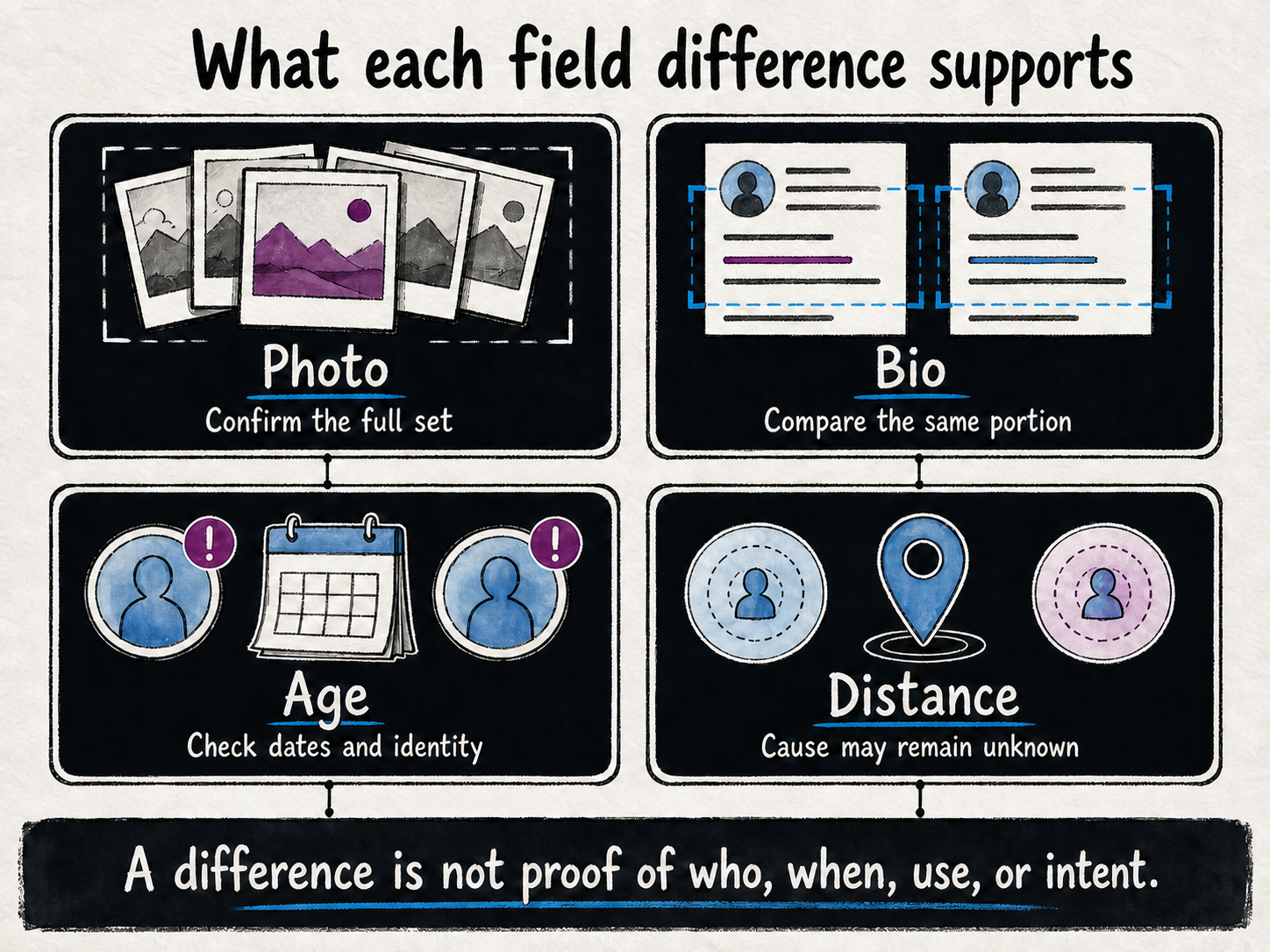
Photo: First establish that the image is genuinely different. A newly observed image may have been uploaded between observations, but it may instead have been reordered, cropped differently, missed earlier, or absent from an incomplete baseline. Tinder’s documentation confirms that photos are editable, not when a particular photo was added.
Consider a new photo beside an unchanged older bio. If the baseline showed the full photo set, the photo difference has some timing value. The unchanged bio neither cancels nor corroborates it. The supportable statement is that one displayed image differed between the two dates.
Bio: Compare the same visible portion in both captures. Different wording can support a field-change finding because Tinder documents the bio as editable. Before reaching that finding, rule out truncation, translation, a display variation, an incomplete capture, or an inaccurate transcription. A sentence outside the first screenshot’s frame was not necessarily added later.
Age: Check the dates first. A birthday between observations can explain a one-year increase, and an incorrect baseline or mistaken identity can explain other differences. Tinder currently says age cannot be edited after account creation. An unexpected age difference therefore should lower confidence in profile identity or comparability rather than be treated automatically as an ordinary profile edit. The documented rule may change, so the linked Tinder page should be checked again before relying on it.
Location or distance: A displayed distance difference establishes only that the visible value differed. Tinder documents Passport Mode, which lets eligible users choose a city or map location, so physical travel is not the only possible location-related explanation. Tinder: Passport Mode
Suppose distance changes while the photos, bio, and age remain stable. The lack of an independent change leaves the timing value limited, particularly if the views came from different places, devices, or observation conditions. Passport is one documented possibility, not a diagnosis of the specific difference. If official material does not explain what you saw, leave the cause unknown.
No field difference by itself proves who made a change, when within the interval it happened, whether someone was using Tinder at the time of observation, or what they intended.
Classify timing value with five confidence checks
Apply these checks to one field difference, not to the person’s character or relationship conduct.
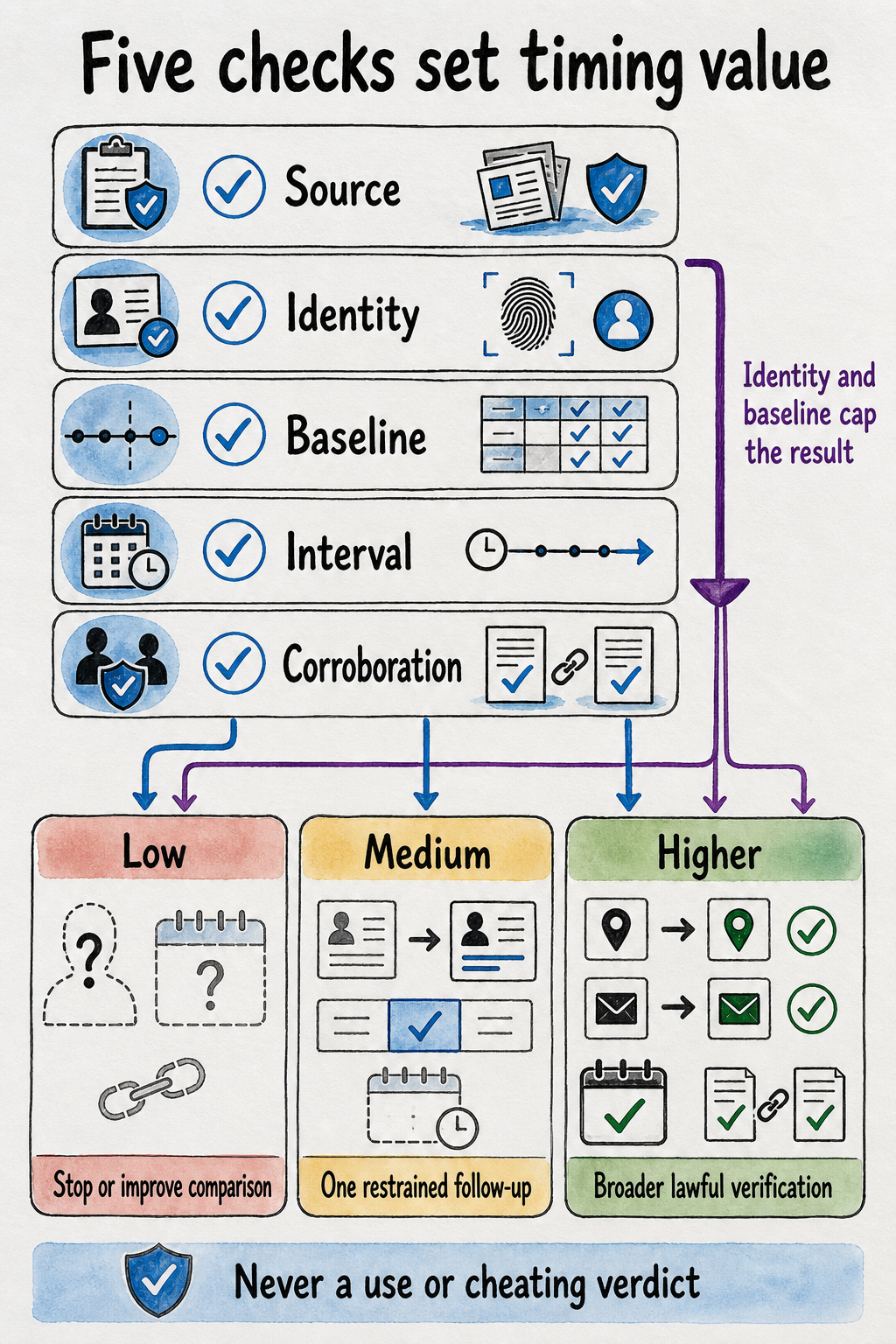
- Source reliability: Were both observations complete and obtained from a dependable, comparable source? A direct view is stronger than a crop forwarded through several people.
- Identity confidence: Do stable photos and profile details reasonably support that both observations concern the same profile? A common name or approximate age is weak identification.
- Baseline quality: Did the earlier observation show the complete field? If the first photo set or bio was partial, the later content may only be newly visible to you.
- Elapsed time: A short interval narrows when the displayed difference could have arisen. A long interval shows only that two distant states differ.
- Independent corroboration: Did another separate field also change? A clearly changed photo and complete bio can offer stronger timing support than either alone, without proving a behavioral conclusion.
Use qualitative categories:
- Low timing value: A date is missing, identity is uncertain, the source is weak, or the baseline is incomplete. Stop or obtain one better lawful comparison before treating the difference as meaningful.
- Medium timing value: Identity and the field difference are reasonably supported, but only one field changed or a plausible observation problem remains. The comparison may justify one restrained follow-up.
- Higher timing value: Reliable, dated observations show clear differences in multiple independent fields on the same reasonably identified profile. This supports a stronger inference that displayed data changed within the interval, not a finding of current use or infidelity.
Identity confidence and baseline quality act as caps. Several apparent differences cannot produce higher timing value when the earlier capture omitted content or the two observations may concern different profiles. There is no defensible percentage or universal field ranking that overrides those limits.
Apply the score, then choose the least intrusive next step
Consider a fictional example. On May 2, Jordan saves a complete profile view from a known source. On May 18, the same source shows one photo absent from the baseline. The name, older bio wording, displayed age, and distance are unchanged.
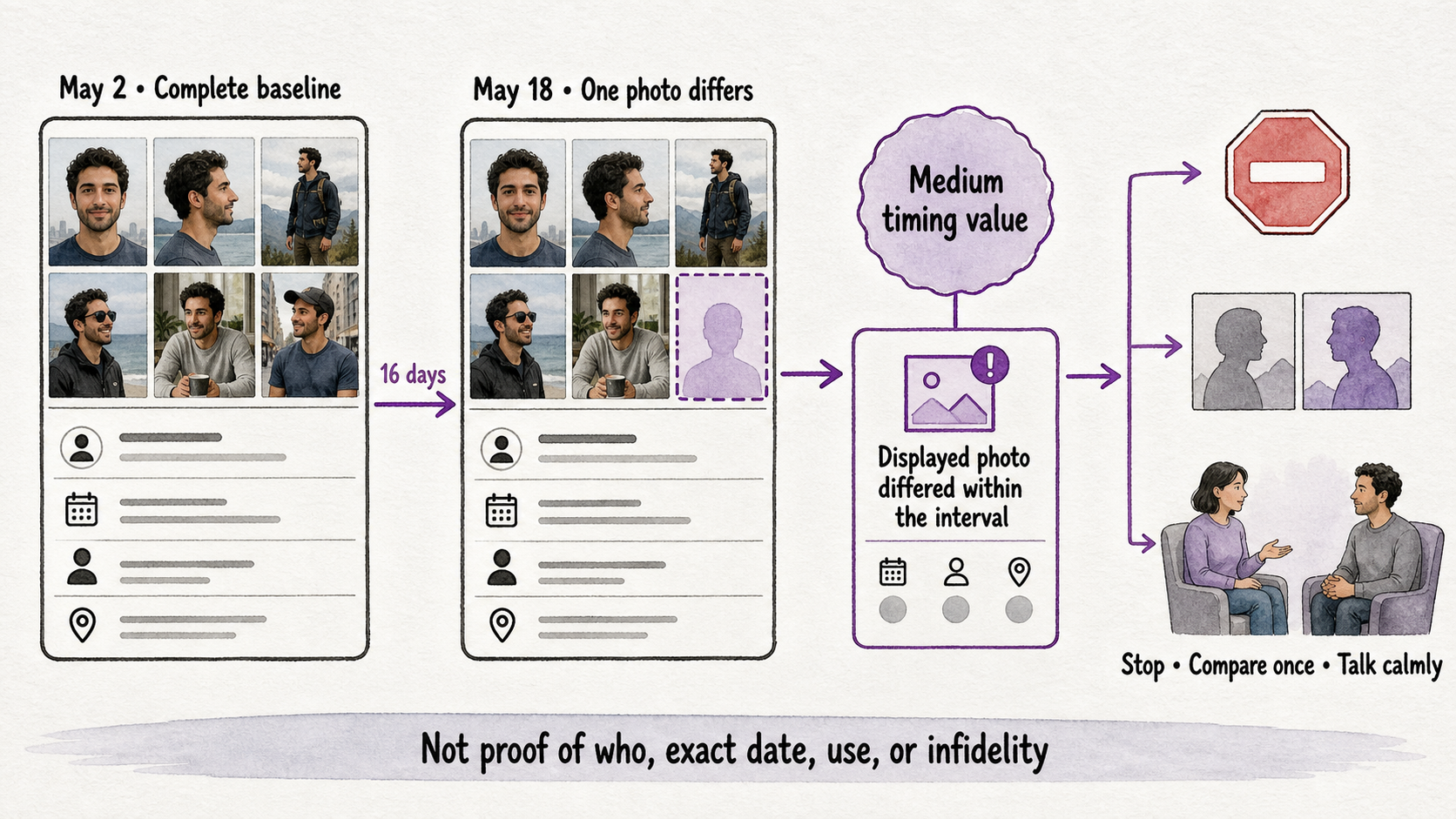
The sources are comparable, several stable details support identity, and the first capture contains the complete visible photo set. The 16-day interval bounds when the displayed difference could have arisen, but it does not reveal an exact date. No second field corroborates the photo difference.
That result has medium timing value. It supports the finding that one displayed photo differed between May 2 and May 18. It does not show who introduced it, whether the profile was used afterward, or whether any messaging, swiping, or infidelity occurred.
Jordan can stop, seek one better lawful comparison, or raise the concern calmly without describing the photo as proof. A private broader search may be proportionate when identity remains uncertain or there is a specific reason to check public or otherwise available profiles across apps.
CheaterBusting says it compares user-supplied details with public or otherwise available dating-app information and presents possible matches with confidence guidance rather than a verdict. It also says a result cannot prove cheating on its own. How CheaterBusting describes possible matches CheaterBusting FAQ Its terms say completeness, correctness, currency, and availability are not guaranteed, so any match or update signal remains context rather than proof. CheaterBusting terms
Keep screenshots to the minimum necessary, store them securely, and use them only for a lawful private purpose. CheaterBusting’s policies say the service does not request passwords or login codes or access private accounts, phones, or messages. Its acceptable-use rules prohibit stalking, harassment, threats, password theft, unlawful surveillance, device access, message interception, and harmful disclosure. CheaterBusting privacy policy CheaterBusting acceptable-use policy
Choose the response by evidence quality. Low timing value means stop or improve the comparison. Medium timing value may justify one better lawful observation or a calm conversation. Higher timing value may justify broader lawful verification. None of the three classifications is an active, inactive, loyal, or cheating verdict.
FAQ
Can one changed Tinder photo prove recent activity?
No. Two dated, comparable observations may show that the displayed photo set differed. They do not establish when the difference arose, who caused it, or whether the account is currently in use. If you saw the profile only once, use the separate profile visibility explainer. If your question concerns Tinder’s Recently Active label, use the dedicated label explainer instead.
What if the distance changed but every other field stayed the same?
Record it as a distance-only difference and keep the timing value low unless a stronger comparison supports more. The displayed value may have differed, but that observation alone does not show travel, a login, or recent use. Uncertain identity, inconsistent observation conditions, or a weak baseline make the inference weaker still.
Can several changed fields identify who made the edits?
No. Separate changes to independent fields can strengthen the conclusion that the displayed profile differed between two observations. They cannot identify who made those changes or establish account control, intent, swiping, messaging, or infidelity. An unchanged field, including a complete but unchanged bio, improves the comparison record but does not count as corroboration.
How much evidence should I keep?
Keep the smallest record that preserves the baseline date, follow-up date, source, relevant field, and your confidence that both observations concern the same profile. Crop out unrelated personal information, store any necessary screenshots securely, and delete them when you no longer have a lawful reason to retain them.
When is further lawful verification reasonable?
Consider one additional check when identity is reasonably supported, both observations are comparable, and the specific change has medium or higher timing value. A calm conversation, one better lawful comparison, or a private broader search may be proportionate. Any possible match or update signal remains guidance, not a verdict, and may be incomplete or out of date.
Stop if the next step would involve credentials, private messages, device access, stalking, harassment, threats, or harmful disclosure. When timing value is low, the sound next action is usually to stop or obtain one better lawful comparison.
Next decision
Need broader evidence across covered apps?
Review scope, confidence limits, and pricing before starting any private search.
Continue reading
Related evidence guides
How to Tell if a Tinder Profile Is Current
Use five evidence layers to assess Tinder profile currency, separate identity from timing, and choose a proportionate next step.
Build a Tinder Activity Timeline Without Overstating Evidence
Organize Tinder screenshots and report updates by source, time, duplicates, and gaps to find the newest defensible observation.
Can Paused Tinder Accounts Appear? Check Source and Time
Separate old records from new Tinder sightings by checking the observation source, capture time, and limits of what pausing Discovery shows.